


A New Hypothesis for Alzheimer's Disease: The Lipid Invasion Model
- PMID: 35530118
- PMCID: PMC9028744
- DOI: 10.3233/ADR-210299
A New Hypothesis for Alzheimer's Disease: The Lipid Invasion Model
Abstract
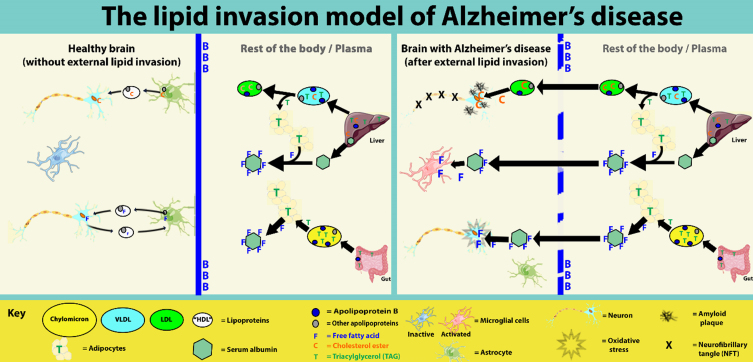
This paper proposes a new hypothesis for Alzheimer's disease (AD)-the lipid invasion model. It argues that AD results from external influx of free fatty acids (FFAs) and lipid-rich lipoproteins into the brain, following disruption of the blood-brain barrier (BBB). The lipid invasion model explains how the influx of albumin-bound FFAs via a disrupted BBB induces bioenergetic changes and oxidative stress, stimulates microglia-driven neuroinflammation, and causes anterograde amnesia. It also explains how the influx of external lipoproteins, which are much larger and more lipid-rich, especially more cholesterol-rich, than those normally present in the brain, causes endosomal-lysosomal abnormalities and overproduction of the peptide amyloid-β (Aβ). This leads to the formation of amyloid plaques and neurofibrillary tangles, the most well-known hallmarks of AD. The lipid invasion model argues that a key role of the BBB is protecting the brain from external lipid access. It shows how the BBB can be damaged by excess Aβ, as well as by most other known risk factors for AD, including aging, apolipoprotein E4 (APOE4), and lifestyle factors such as hypertension, smoking, obesity, diabetes, chronic sleep deprivation, stress, and head injury. The lipid invasion model gives a new rationale for what we already know about AD, explaining its many associated risk factors and neuropathologies, including some that are less well-accounted for in other explanations of AD. It offers new insights and suggests new ways to prevent, detect, and treat this destructive disease and potentially other neurodegenerative diseases.
Keywords: Alzheimer’s disease; anesthesia; anterograde amnesia; apolipoproteins; blood-brain barrier; cholesterol; ethanol; lipids; lipoproteins; nonesterified fatty acids.
© 2022 – The authors. Published by IOS Press.
Conflict of interest statement
The author has no conflict of interest to report.
Figures
References
-
- Alzheimer A, Stelzmann RA, Schnitzlein HN, Murtagh FR (1995) An English translation of Alzheimer’s 1907 paper, “Über eine eigenartige Erkankung der Hirnrinde.”, Clin Anat 8, 429–431. - PubMed
-
- Suzuki K, Parker CC, Pentchev PG, Katz D, Ghetti B, D’Agostino AN, Carstea ED (1995) Neurofibrillary tangles in Niemann-Pick disease type C, Acta Neuropathol 89, 227–238. - PubMed
-
- Götz J, Ittner LM (2008) Animal models of Alzheimer’s disease and frontotemporal dementia, Nat Rev Neurosci 9, 532–544. - PubMed
LinkOut - more resources
Full Text Sources
