


Influence of Weekday and Seasonal Trends on Urgency and In-hospital Mortality of Emergency Department Patients
- PMID: 35530732
- PMCID: PMC9068998
- DOI: 10.3389/fpubh.2022.711235
Influence of Weekday and Seasonal Trends on Urgency and In-hospital Mortality of Emergency Department Patients
Abstract
Background: Given the scarcity of resources, the increasing use of emergency departments (ED) represents a major challenge for the care of emergency patients. Current health policy interventions focus on restructuring emergency care with the help of patient re-direction into outpatient treatment structures. A precise analysis of ED utilization, taking into account treatment urgency, is essential for demand-oriented adjustments of emergency care structures.
Methods: Temporal and seasonal trends in the use of EDs were investigated, considering treatment urgency and hospital mortality. Secondary data of 287,119 ED visits between 2015 and 2017 of the two EDs of Charité Universitätsmedizin Berlin, Campus Charité Mitte and Campus Virchow Klinikum were analyzed.
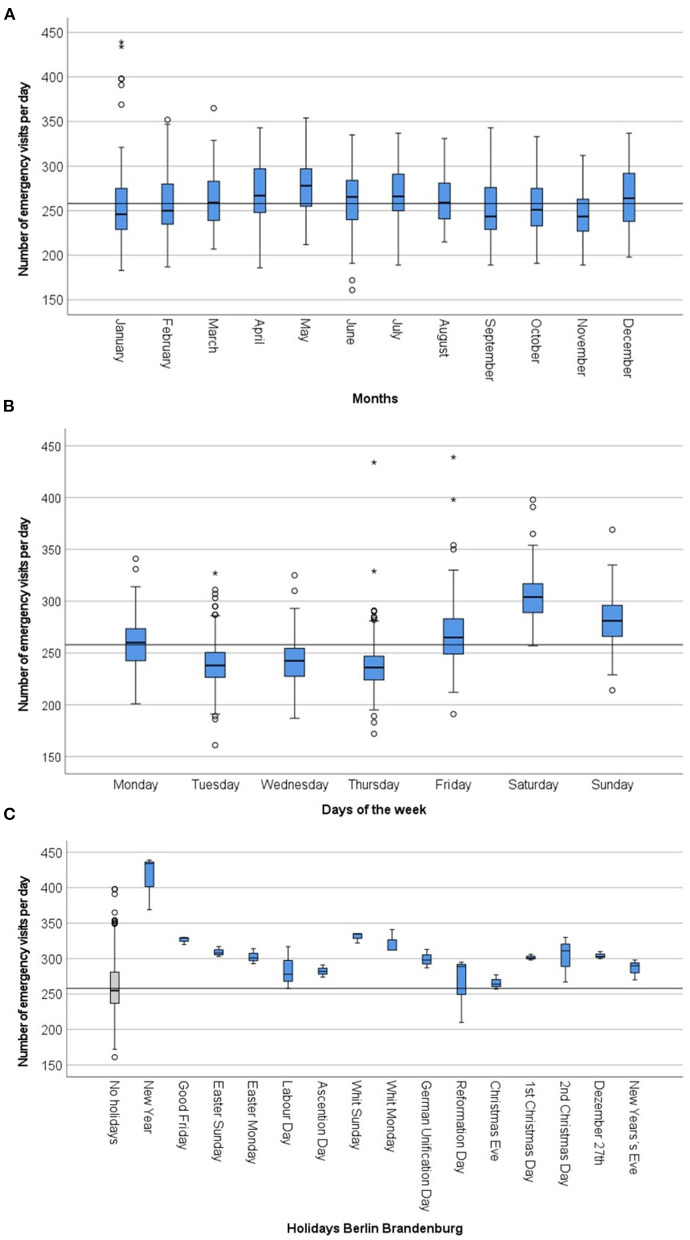
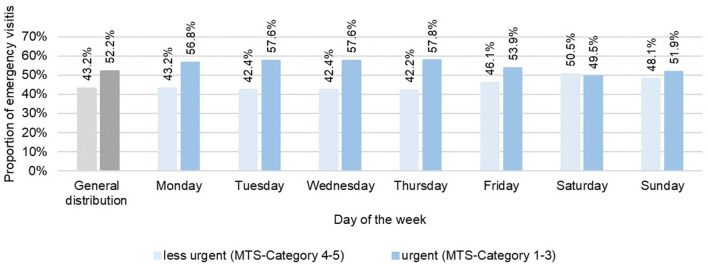
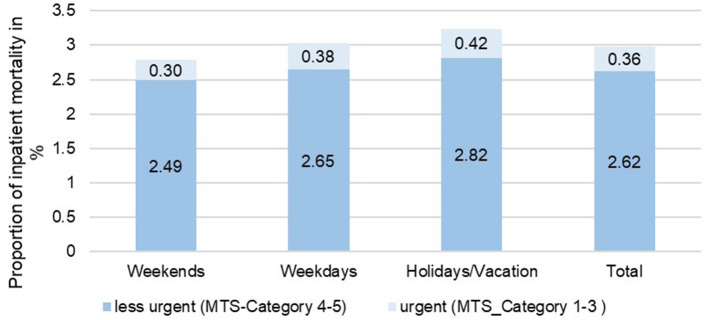
Result: EDs were used significantly more frequently on weekends than on weekdays (Mdn = 290 vs. 245 visits/day; p < 0.001). The proportion of less urgent, outpatient emergency visits on weekends was above average. Holiday periods were characterized by at least 6, and at most 176 additional ED visits. In a comparison of different holidays, most ED visits were observed at New Year (+68% above average). In addition, a significant increase in in-hospital mortality on holidays was evident among inpatients admitted to hospital via the ED (3.0 vs. 3.2%; p < 0.001), with New Year's Day being particularly striking (5.4%).
Conclusion: These results suggest that, in particular, the resource planning of outpatient emergency treatment capacities on weekends and holidays should be adapted to the increased volume of non-urgent visits in EDs. Nevertheless, treatment capacities for the care of urgent, inpatient emergencies should not be disregarded and further research projects are necessary to investigate the causes of increased mortality during holiday periods.
Keywords: emergency department (ED); hospital mortality; seasonal trends; secondary data analysis; temporal trends; urgency; utilization (U).
Copyright © 2022 Hitzek, Fischer-Rosinský, Möckel, Kuhlmann and Slagman.
Conflict of interest statement
The authors declare that the research was conducted in the absence of any commercial or financial relationships that could be construed as a potential conflict of interest.
Figures
References
-
- Berchet C. Emergency Care Services: Trends, Drivers and Interventions to Manage the Demand. Paris: OECD Health Working Papers; (2015) No. 83.
-
- Zi Zentralinstitut Fue de Kassenarztliche Versorgung in deutschland . Zahlen zur ambulanten Notfallversorgung in Deustchland. Berlin: (2019).
-
- Haas C, L M, Schöpke T, Lübke-Naberhaus KD, Schmidt C, Brachmann M, et al. Gutachten zur ambulanten Notfallversorgung im Krankenhaus -Fallkostenkalkulation und Strukturanalyse der Management Consult Kestermann GmbH (MCK) erstellt in Kooperation mit der Deutsche Gesellschaft interdisziplinäre Notfall- und Akutmedizin e. V. (DGINA).
-
- Dräther H, M C. Ambulante Notfallversorgung an Krankenhäusern und durch ambulante Leistungserbringer. Krankenhaus-Report 2016 (2016). p. 43–62.
MeSH terms
LinkOut - more resources
Full Text Sources
