


The Effect of Infection Precautions on Extended-Spectrum Beta-Lactamase Enterobacteriaceae Colonization Among Nurses in Three Beirut Hospitals
- PMID: 35530839
- PMCID: PMC9071177
- DOI: 10.7759/cureus.23849
The Effect of Infection Precautions on Extended-Spectrum Beta-Lactamase Enterobacteriaceae Colonization Among Nurses in Three Beirut Hospitals
Abstract
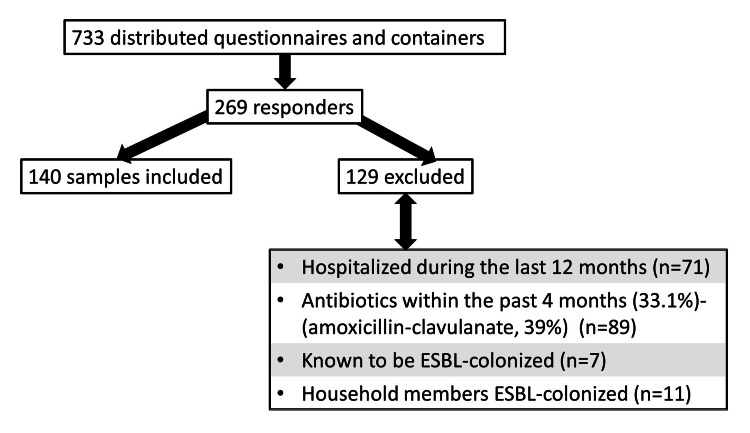
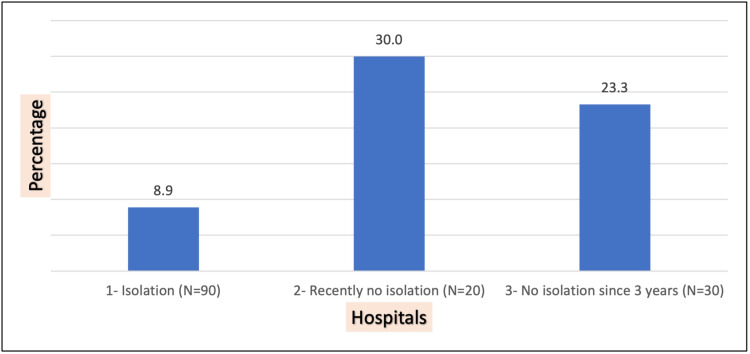
Background and objective Extended-spectrum beta-lactamase-producing Enterobacteriaceae (ESBL-PE) are rapidly emerging worldwide. This study aimed to assess the effect of contact precaution (CP) on ESBL-PE-colonization rates among nurses in three hospitals in Beirut, Lebanon, where ESBL is endemic, in order to define the risk factors for colonization. Accordingly, the ongoing use of CP to prevent ESBL-PE transmission to healthy nurses was evaluated. Methods This cross-sectional study was conducted in three hospitals. Hospital 1 required CP, Hospital 2 had recently stopped CP, and Hospital 3 had stopped it three years previously. Questionnaires and stool-collection containers were distributed to all patient care nurses in those three hospitals. The Returned samples were tested using the agar dilution technique. Results A total of 269 out of 733 nurses volunteered to participate; 140 met the inclusion criteria (no recent hospitalization, antibiotic use, or known ESBL-PE colonization) and provided samples. Among them, 15% were ESBL-positive. Compared to nurses from Hospital 3, nurses from Hospital 1 were 59% less likely to be colonized, while nurses from Hospital 2 were 62% more likely to be colonized. Conclusion In hospitals where CP is in place for ESBL-positive patients, ESBL-PE prevalence in nursing staff was significantly lower. Additionally, a work experience of two to four years increased the odds of ESBL-PE colonization in comparison with longer nursing experience. CP may be a justifiable means of protection against ESBL-PE transmission to healthy nurses. The risk factors for colonization were discontinuation of CP and a shorter clinical work experience.
Keywords: contact precaution; extended-spectrum β-lactamase; hand hygiene; infection control; nursing staff.
Copyright © 2022, AbiGhosn et al.
Conflict of interest statement
The authors have declared that no competing interests exist.
Figures
References
-
- Epidemiology, risk factors and comorbidity for urinary tract infections caused by extended-spectrum beta-lactamase (ESBL)-producing enterobacteria. Briongos-Figuero LS, Gómez-Traveso T, Bachiller-Luque P, et al. Int J Clin Pract. 2012;66:891–896. - PubMed
-
- Bacteremic pneumonia caused by extended-spectrum beta-lactamase-producing Escherichia coli and Klebsiella pneumoniae: appropriateness of empirical treatment matters. Cheng WL, Hsueh PR, Lee CC, et al. J Microbiol Immunol Infect. 2016;49:208–215. - PubMed
-
- Effects of confounders and intermediates on the association of bacteraemia caused by extended-spectrum β-lactamase-producing Enterobacteriaceae and patient outcome: a meta-analysis. Rottier WC, Ammerlaan HS, Bonten MJ. J Antimicrob Chemother. 2012;67:1311–1320. - PubMed
-
- Infections caused by extended-spectrum beta-lactamases producing Enterobacteriaceae: clinical and economic impact in patients hospitalized in 2 teaching hospitals in Dakar, Senegal. Ndir A, Diop A, Ka R, Faye PM, Dia-Badiane NM, Ndoye B, Astagneau P. Antimicrob Resist Infect Control. 2016;5:13. - PMC - PubMed
-
- Impact of infection with extended-spectrum β-lactamase-producing Escherichia coli or Klebsiella species on outcome and hospitalization costs. Maslikowska JA, Walker SA, Elligsen M, Mittmann N, Palmay L, Daneman N, Simor A. J Hosp Infect. 2016;92:33–41. - PubMed
LinkOut - more resources
Full Text Sources
Miscellaneous