


Outcomes of SARS-CoV-2 omicron infection in residents of long-term care facilities in England (VIVALDI): a prospective, cohort study
- PMID: 35531432
- PMCID: PMC9067940
- DOI: 10.1016/S2666-7568(22)00093-9
Outcomes of SARS-CoV-2 omicron infection in residents of long-term care facilities in England (VIVALDI): a prospective, cohort study
Erratum in
-
Correction to Lancet Healthy Longev 2022; 3: e347-55.Lancet Healthy Longev. 2022 Sep;3(9):e587. doi: 10.1016/S2666-7568(22)00203-3. Lancet Healthy Longev. 2022. PMID: 36102772 Free PMC article. No abstract available.
Abstract
Background: The SARS-CoV-2 omicron variant (B.1.1.529) is highly transmissible, but disease severity appears to be reduced compared with previous variants such as alpha and delta. We investigated the risk of severe outcomes following infection in residents of long-term care facilities.
Methods: We did a prospective cohort study in residents of long-term care facilities in England who were tested regularly for SARS-CoV-2 between Sept 1, 2021, and Feb 1, 2022, and who were participants of the VIVALDI study. Residents were eligible for inclusion if they had a positive PCR or lateral flow device test during the study period, which could be linked to a National Health Service (NHS) number, enabling linkage to hospital admissions and mortality datasets. PCR or lateral flow device test results were linked to national hospital admission and mortality records using the NHS-number-based pseudo-identifier. We compared the risk of hospital admission (within 14 days following a positive SARS-CoV-2 test) or death (within 28 days) in residents who had tested positive for SARS-CoV-2 in the period shortly before omicron emerged (delta-dominant) and in the omicron-dominant period, adjusting for age, sex, primary vaccine course, past infection, and booster vaccination. Variants were confirmed by sequencing or spike-gene status in a subset of samples.
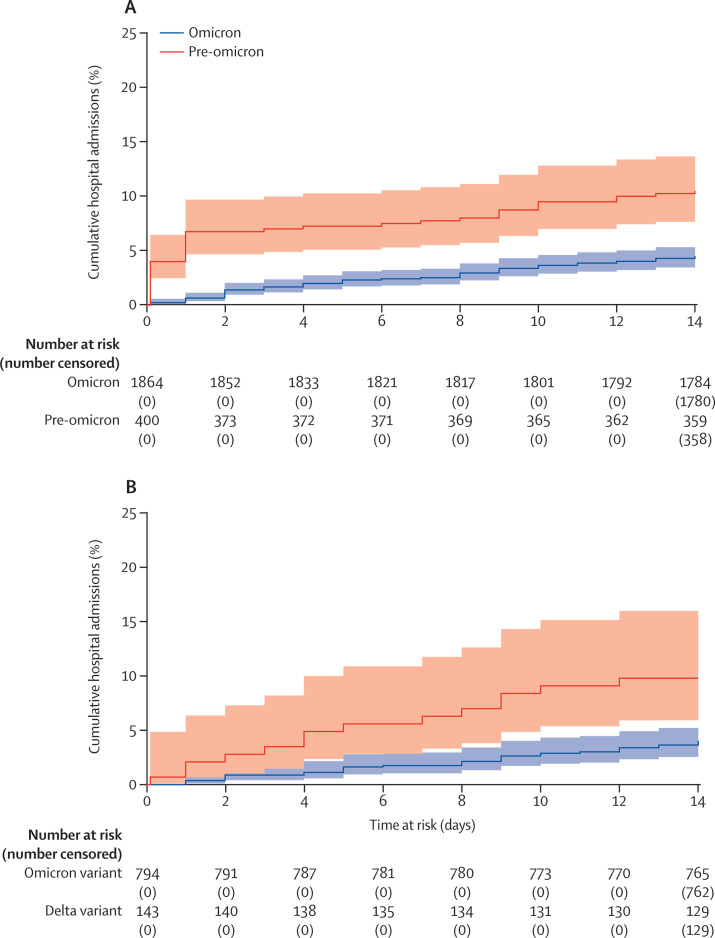
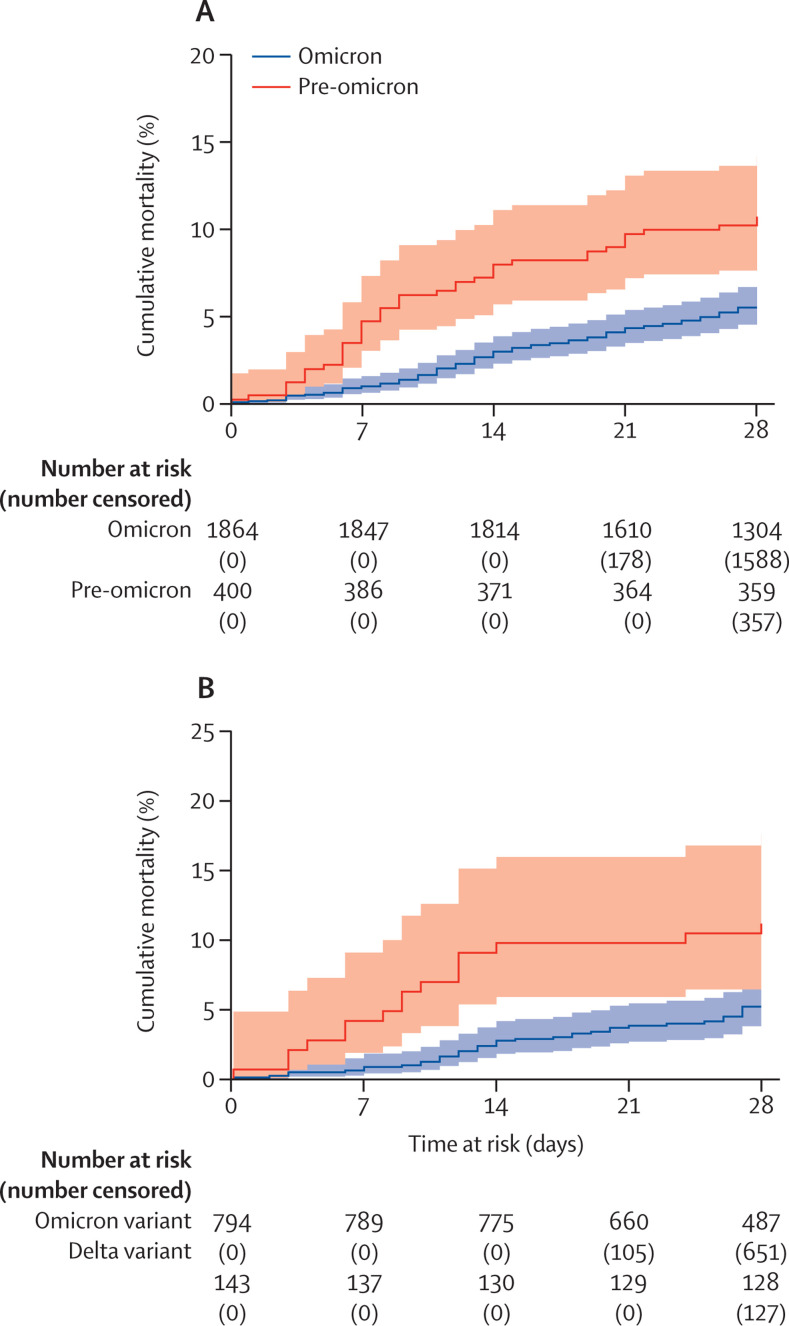
Results: 795 233 tests were done in 333 long-term care facilities, of which 159 084 (20·0%) could not be linked to a pseudo-identifier and 138 012 (17·4%) were done in residents. Eight residents had two episodes of infection (>28 days apart) and in these cases the second episode was excluded from the analysis. 2264 residents in 259 long-term care facilities (median age 84·5 years, IQR 77·9-90·0) were diagnosed with SARS-CoV-2, of whom 253 (11·2%) had a previous infection and 1468 (64·8%) had received a booster vaccination. About a third of participants were male. Risk of hospital admissions was markedly lower in the 1864 residents infected in the omicron-period (4·51%, 95% CI 3·65-5·55) than in the 400 residents infected in the pre-omicron period (10·50%, 7·87-13·94), as was risk of death (5·48% [4·52-6·64] vs 10·75% [8·09-14·22]). Adjusted hazard ratios (aHR) also indicated a reduction in hospital admissions (0·64, 95% CI 0·41-1·00; p=0·051) and mortality (aHR 0·68, 0·44-1·04; p=0·076) in the omicron versus the pre-omicron period. Findings were similar in residents with a confirmed variant.
Interpretation: Observed reduced severity of the omicron variant compared with previous variants suggests that the wave of omicron infections is unlikely to lead to a major surge in severe disease in long-term care facility populations with high levels of vaccine coverage or natural immunity. Continued surveillance in this vulnerable population is important to protect residents from infection and monitor the public health effect of emerging variants.
Funding: UK Department of Health and Social Care.
© 2022 The Author(s). Published by Elsevier Ltd. This is an Open Access article under the CC BY-NC-ND 4.0 license.
Conflict of interest statement
LS, TP, AC, AH, and OS report grants from the Department of Health and Social Care during the conduct of the study and LS is a member of the Social Care Working Group, which reports to the Scientific Advisory Group for Emergencies. AI-S and VB are employed by the Department of Health and Social Care, which funded the study. AH reports funding from the COVID Core Studies Programme and is a member of the New and Emerging Respiratory Virus Threats Advisory Group at the Department of Health and Environmental Modelling Group of the Scientific Advisory Group for Emergencies. All other authors declare no competing interests.
Figures
Comment in
-
Omicron infection milder in nursing home residents.Lancet Healthy Longev. 2022 May;3(5):e314-e315. doi: 10.1016/S2666-7568(22)00101-5. Epub 2022 May 4. Lancet Healthy Longev. 2022. PMID: 35531431 Free PMC article. No abstract available.
References
-
- WHO Update on Omicron. 2021. https://www.who.int/news/item/28-11-2021-update-on-omicron
-
- CoVariants Variant: 21K (Omicron) 2022. https://covariants.org/variants/21K.Omicron
-
- Centers for Disease Control and Prevention COVID Data Tracker. Variant proportions. 2022. https://covid.cdc.gov/covid-data-tracker/#variant-proportions
-
- GISAID NextStrain. 2022. https://www.gisaid.org/phylodynamics/global/nextstrain/
-
- Ferguson N, Ghani A, Cori A, Hogan A, Hinsley W, Volz E. Report 49: growth, population distribution and immune escape of Omicron in England. 2021. https://www.imperial.ac.uk/media/imperial-college/medicine/mrc-gida/2021...
Publication types
MeSH terms
Supplementary concepts
Grants and funding
LinkOut - more resources
Full Text Sources
Medical
Miscellaneous
