


MicroRNA-146 attenuates lipopolysaccharide induced ovarian dysfunction by inhibiting the TLR4/NF- κB signaling pathway
- PMID: 35531876
- PMCID: PMC9275987
- DOI: 10.1080/21655979.2022.2070584
MicroRNA-146 attenuates lipopolysaccharide induced ovarian dysfunction by inhibiting the TLR4/NF- κB signaling pathway
Abstract
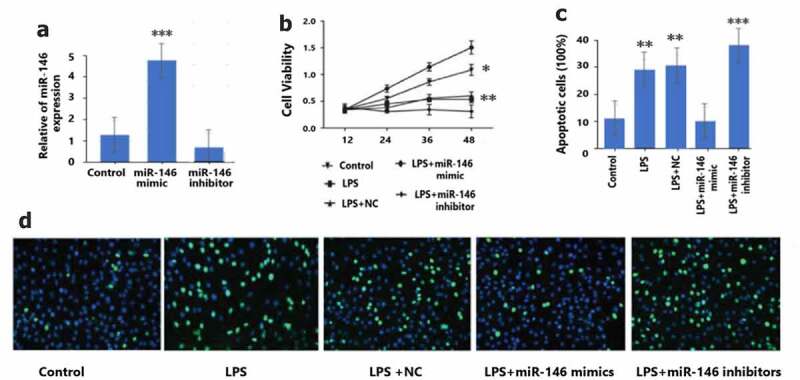
Premature ovarian insufficiency (POI) is a disease that seriously affects women's reproductive function and even leads to lifelong infertility. Little is known about the mechanism of lipopolysaccharide (LPS)-induced ovarian dysfunction. Thus, we aimed to identify the role of the up-regulation of microRNA (miRNA)-146 expression offered protection against ovarian dysfunction by inhibiting the toll-like receptor (TLR) 4, TLR4/phosphorylated (p)-nuclear factor (NF)-κB signaling pathway and inflammatory cytokine tumor necrosis factor (TNF)-a and Interleukin (IL)-6. In an in vivo study, we established an LPS-induced ovarian dysfunction mouse model. The mouse ovarian granulosa cells were transfected with miR-146 mimic or negative controls or inhibitor and then treated with LPS. Therefore, cell viability, cells apoptosis, IL-6 and TNF-a, TLR4, NF- κB were assessed, respectively. These results demonstrated that the up-regulation of miRNA-146 expression may protect against LPS-induced ovarian dysfunction and markedly increased the cell viability, and significantly reduced the ovarian granulosa cells apoptotic rate, and down-regulated IL-6 and TNF-a expression. In addition, miRNA-146 exerted protective ovarian functions might be via inhibiting TLR4/NF-κB signaling pathway. In summary, we reveal the up-regulation of miRNA-146 expression mitigated ovarian dysfunction by negatively regulating expression of the IL-6 and TNF-a, which may shed light on the potential molecular mechanisms of overexpression of miRNA-146 may reversed the ovarian dysfunction by inhibiting the TLR4/ NF-κB signaling pathway.
Keywords: apoptosis; lipopolysaccharide (LPS); miRNA-146; ovarian dysfunction; ovarian insufficiency (POI).
Conflict of interest statement
The authors declared that they do not have any commercial or associative interest that represents a conflict of interest in connection with the work submitted.
Figures




References
-
- Prosper I, Abdeljabar EA, Ujalla S, et al. Intraovarian injection of autologous human mesenchymal stem cells increases estrogen production and reduces menopausal symptoms in women with premature ovarian failure: two case reports and a review of the literature. J Med Case Rep. 2020;14(1):108. - PMC - PubMed
-
- Giri R, Vincent AJ.. Prevalence and Risk Factors of Premature Ovarian Insufficiency/ Early Menopause. Semin Reprod Med. 2020;38(4–05):237–246. - PubMed
-
- Deng T, Jing H, Yao Q, et al. Human Umbilical Cord Mesenchymal Stem Cells Improve Ovarian Function in Chemotherapy-Induced Premature Ovarian Failure Mice Through Inhibiting Apoptosis and Inflammation via a Paracrine Mechanism. Reprod Sci. 2021;28(6):1718–1732. - PubMed
-
- Nahand JS, Karimzadeh MR, Nezamnia M, et al. The role of miR-146a in viral infection. IUBMB Life. 2020;72(3):343–360. - PubMed
MeSH terms
Substances
LinkOut - more resources
Full Text Sources
Medical
