


Three legs of the missing heritability problem
- PMID: 35533541
- PMCID: PMC9172633
- DOI: 10.1016/j.shpsa.2022.04.004
Three legs of the missing heritability problem
Abstract
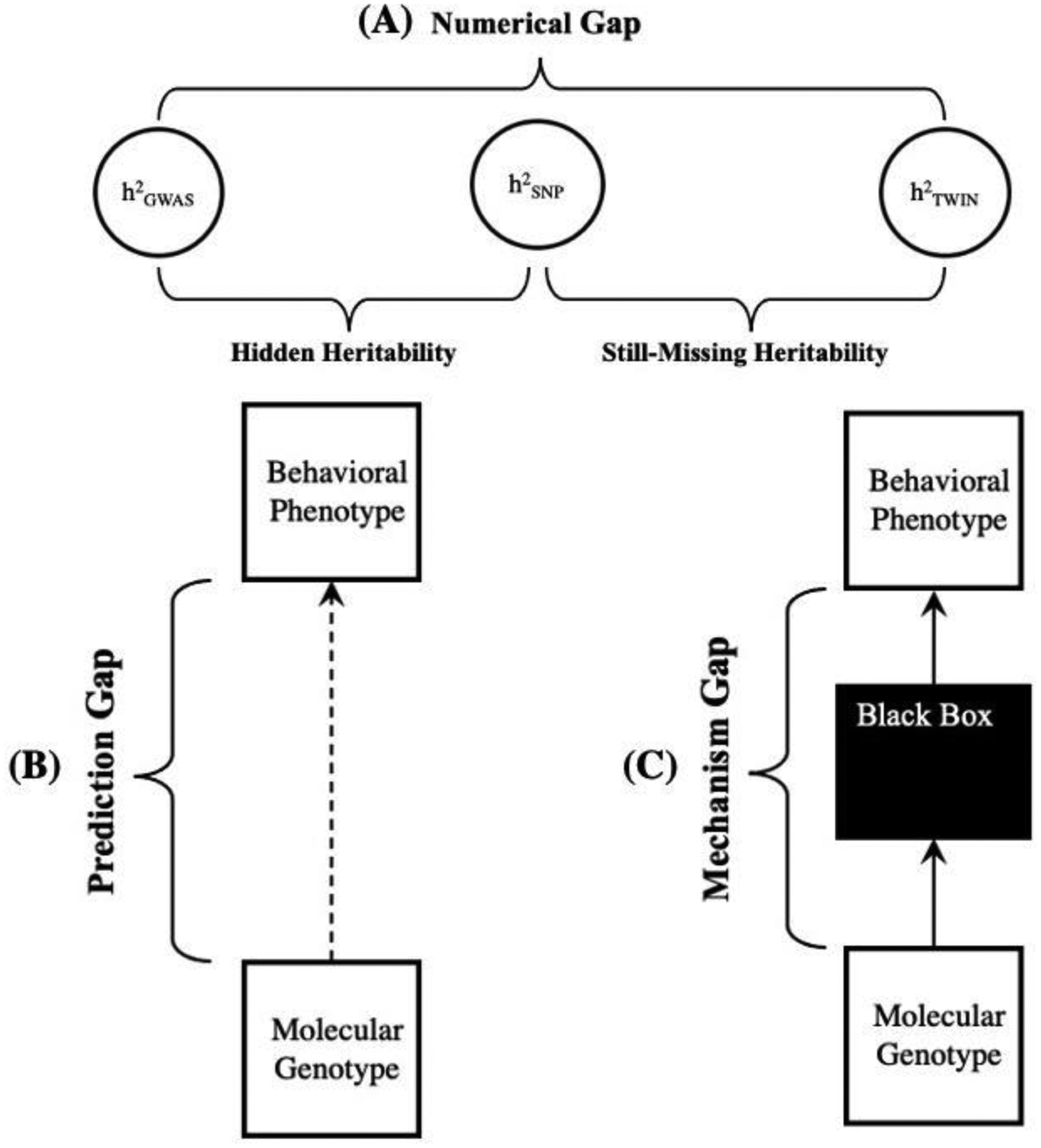
The so-called 'missing heritability problem' is often characterized by behavior geneticists as a numerical discrepancy between alternative kinds of heritability. For example, while 'traditional heritability' derived from twin and family studies indicates that approximately ∼50% of variation in intelligence is attributable to genetics, 'SNP heritability' derived from genome-wide association studies indicates that only ∼10% of variation in intelligence is attributable to genetics. This 40% gap in variance accounted for by alternative kinds of heritability is frequently referred to as what's "missing." Philosophers have picked up on this reading, suggesting that "dissolving" the missing heritability problem is merely a matter of closing the numerical gap between traditional and molecular kinds of heritability. We argue that this framing of the problem undervalues the severity of the many challenges to scientific understanding of the "heritability" of human behavior. On our view, resolving the numerical discrepancies between alternative kinds of heritability will do little to advance scientific explanation and understanding of behavior genetics. Thus, we propose a new conceptual framework of the missing heritability problem that comprises three independent methodological and explanatory challenges: the numerical gap, the prediction gap, and the mechanism gap.
Keywords: Behavior genetics; Explanation; Genomics; Heritability; Mechanism; Prediction.
Copyright © 2022 Elsevier Ltd. All rights reserved.
Figures
References
-
- Borkenau P, Riemann R, Angleitner A, & Spinath FM (2002). Similarity of childhood experiences and personality resemblance in monozygotic and dizygotic twins: A test of the equal environments assumption. Personality and Individual Differences, 33(2), 261–269. 10.1016/S0191-8869(01)00150-7 - DOI
-
- Bourrat P, & Lu Q (2017). Dissolving the Missing Heritability Problem. Philosophy of Science, 84(5), 1055–1067. 10.1086/694007 - DOI
MeSH terms
Grants and funding
LinkOut - more resources
Full Text Sources
Miscellaneous
