


Cisplatin exposure acutely disrupts mitochondrial bioenergetics in the zebrafish lateral-line organ
- PMID: 35534350
- PMCID: PMC9745743
- DOI: 10.1016/j.heares.2022.108513
Cisplatin exposure acutely disrupts mitochondrial bioenergetics in the zebrafish lateral-line organ
Abstract
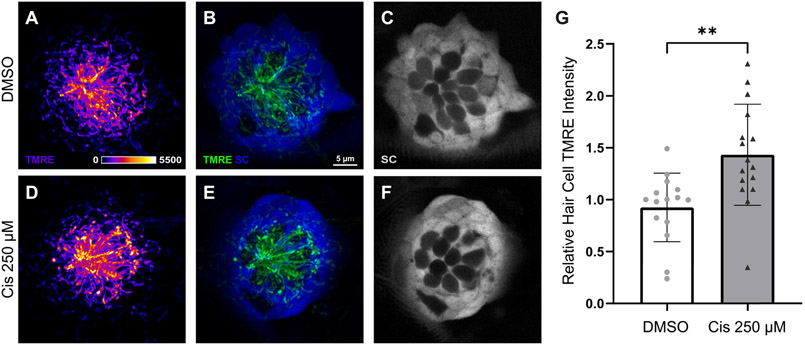
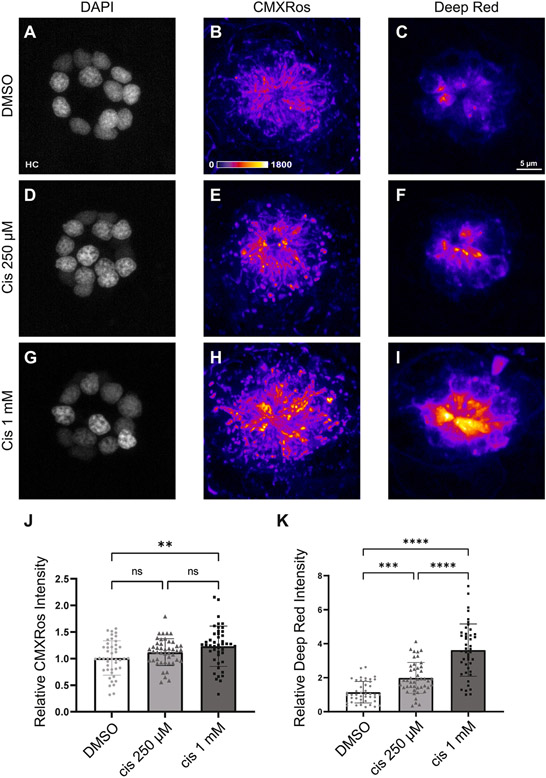
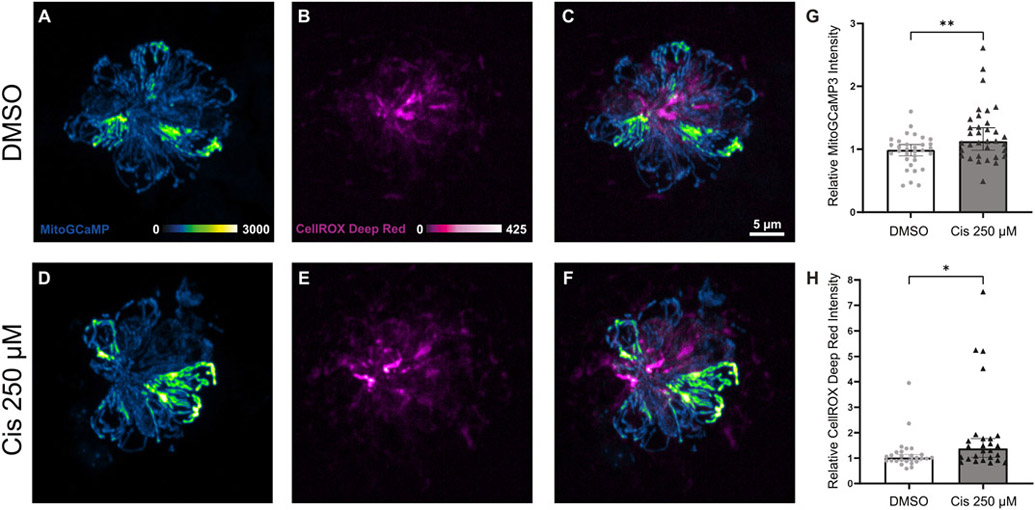
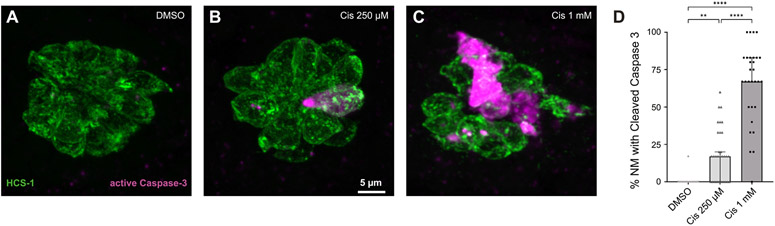
Cisplatin is a commonly used chemotherapeutic agent that causes debilitating high-frequency hearing loss. No targeted therapies currently exist to treat cisplatin ototoxicity, partly because the underlying mechanisms of cisplatin-induced hair cell damage are not completely defined. Zebrafish may offer key insights to cisplatin ototoxicity because their lateral-line organ contains hair cells that are remarkably similar to those within the cochlea but are optically accessible, permitting observation of cisplatin injury in live intact hair cells. In this study, we used a combination of genetically encoded biosensors in zebrafish larvae and fluorescent indicators to characterize changes in mitochondrial bioenergetics in response to cisplatin. Following exposure to cisplatin, confocal imaging of live intact neuromasts demonstrated increased mitochondrial activity. Staining with fixable fluorescent dyes that accumulate in active mitochondria similarly showed hyperpolarized mitochondrial membrane potential. Zebrafish expressing a calcium indicator within their hair cells revealed elevated levels of mitochondrial calcium immediately following completion of cisplatin treatment. A fluorescent ROS indicator demonstrated that these changes in mitochondrial function were associated with increased oxidative stress. After a period of recovery, cisplatin-exposed zebrafish demonstrated caspase-3-mediated apoptosis. Altogether, these findings suggest that cisplatin acutely disrupts mitochondrial bioenergetics and may play a key role in initiating cisplatin ototoxicity.
Keywords: Cisplatin ototoxicity; Mitochondrial bioenergetics; Mitochondrial dysfunction; Zebrafish.
Copyright © 2022 The Author(s). Published by Elsevier B.V. All rights reserved.
Conflict of interest statement
Declaration of Competing Interest None.
Figures
References
-
- Behra M, Gallardo VE, Bradsher J, Torrado A, Elkahloun A, Idol J, Sheehy J, Zonies S, Xu L, Shaw KM, Satou C, Higashijima S-I, Weinstein BM, Burgess SM, 2012. Transcriptional signature of accessory cells in the lateral line, using the Tnk1bp1:EGFP transgenic zebrafish line. BMC Dev. Biol 12 (1), 6. doi: 10.1186/1471-213x-12-6. - DOI - PMC - PubMed
-
- Bilan DS, Pase L, Joosen L, Gorokhovatsky AY, Ermakova YG, Gadella TW, Grabher C, Schultz C, Lukyanov S, Belousov VV, 2013. HyPer-3: a genetically encoded H(2)O(2) probe with improved performance for ratiometric and fluorescence lifetime imaging. ACS Chem. Biol 8 (3), 535–542. doi: 10.1021/cb300625g. - DOI - PubMed
-
- Borse V, Al Aameri RFH, Sheehan K, Sheth S, Kaur T, Mukherjea D, Tupal S, Lowy M, Ghosh S, Dhukhwa A, Bhatta P, Rybak LP, Ramkumar V, 2017. Epigallocatechin-3-gallate, a prototypic chemopreventative agent for protection against cisplatin-based ototoxicity. Cell Death Dis. 8 (7), e2921. doi: 10.1038/cddis.2017.314, - DOI - PMC - PubMed
Publication types
MeSH terms
Substances
Grants and funding
LinkOut - more resources
Full Text Sources
Research Materials
