


Follicular fluid-derived exosomal miR-143-3p/miR-155-5p regulate follicular dysplasia by modulating glycolysis in granulosa cells in polycystic ovary syndrome
- PMID: 35534864
- PMCID: PMC9082924
- DOI: 10.1186/s12964-022-00876-6
Follicular fluid-derived exosomal miR-143-3p/miR-155-5p regulate follicular dysplasia by modulating glycolysis in granulosa cells in polycystic ovary syndrome
Erratum in
-
Correction: Follicular fluid-derived exosomal miR-143-3p/miR-155-5p regulate follicular dysplasia by modulating glycolysis in granulosa cells in polycystic ovary syndrome.Cell Commun Signal. 2022 Aug 1;20(1):116. doi: 10.1186/s12964-022-00938-9. Cell Commun Signal. 2022. PMID: 35915462 Free PMC article. No abstract available.
Abstract
Objective: Polycystic ovary syndrome (PCOS) is characterized by follicular dysplasia. An insufficient glycolysis-derived energy supply of granulosa cells (GCs) is an important cause of follicular dysplasia in PCOS. Follicular fluid (FF) exosomal microRNAs (miRNAs) have been proven to regulate the function of GCs. In this study, exosomes extracted from clinical FF samples were used for transcriptome sequencing (RNA-seq) analysis, and a human ovarian granulocyte tumour cell line (KGN cells) was used for in vitro mechanistic studies.
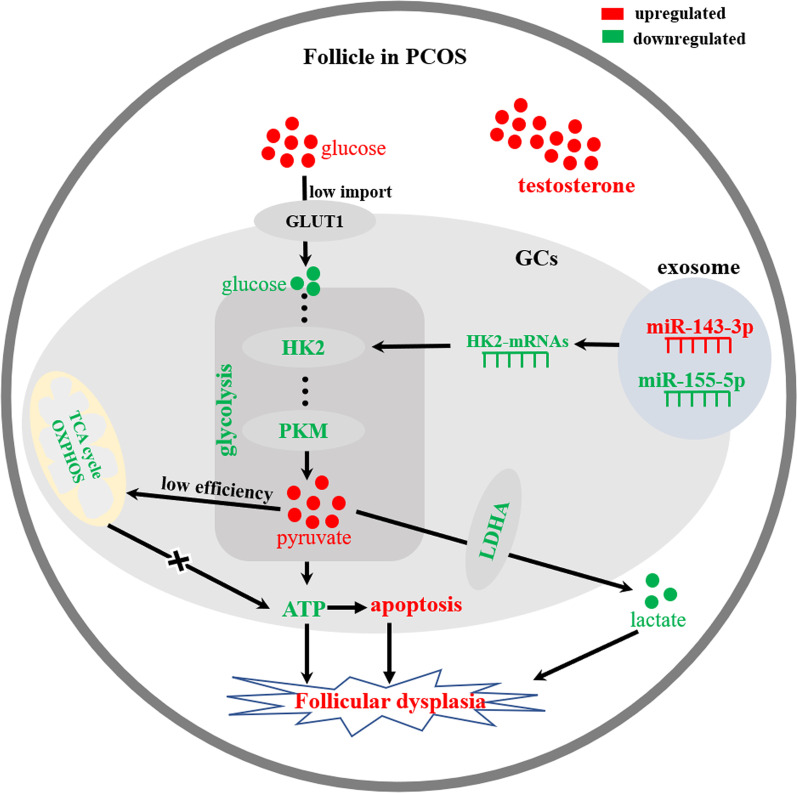
Methods and results: In FF exosomal RNA-seq analysis, a decrease in glycolysis-related pathways was identified as an important feature of the PCOS group, and the differentially expressed miR-143-3p and miR-155-5p may be regulatory factors of glycolysis. By determining the effects of miR-143-3p and miR-155-5p on hexokinase (HK) 2, pyruvate kinase muscle isozyme M2 (PKM2), lactate dehydrogenase A (LDHA), pyruvate, lactate and apoptosis in KGN cells, we found that upregulated miR-143-3p expression in exosomes from the PCOS group inhibited glycolysis in KGN cells; knockdown of miR-143-3p significantly alleviated the decrease in glycolysis in KGN cells in PCOS. MiR-155-5p silencing attenuated glycolytic activation in KGN cells; overexpression of miR-155-5p significantly promoted glycolysis in KGN cells in PCOS. In this study, HK2 was found to be the mediator of miR-143-3p and miR-155-5p in FF-derived exosome-mediated regulation of glycolysis in KGN cells. Reduced glycolysis accelerated apoptosis of KGN cells, which mediated follicular dysplasia through ATP, lactate and apoptotic pathways.
Conclusions: In conclusion, these results indicate that miR-143-3p and miR-155-5p in FF-derived exosomes antagonistically regulate glycolytic-mediated follicular dysplasia of GCs in PCOS. Video Abstract.
Keywords: Exosomes; Glycolysis; HK2; Polycystic ovary syndrome; miR-143-3p; miR-155-5p.
© 2022. The Author(s).
Conflict of interest statement
None.
Figures


References
-
- Alvarez-Blasco F, Martínez-García MA, Luque-Ramírez M, Parraza N, San Millán JL, Escobar-Morreale HF. Role of haptoglobin in polycystic ovary syndrome (PCOS), obesity and disorders of glucose tolerance in premenopausal women. PLoS ONE. 2009;4:5606. doi: 10.1371/journal.pone.0005606. - DOI - PMC - PubMed
Publication types
MeSH terms
Substances
LinkOut - more resources
Full Text Sources
Medical
Miscellaneous
