


Increased multimorbidity is associated with impaired cerebral and peripheral hemodynamic stabilization during active standing
- PMID: 35535653
- PMCID: PMC9545463
- DOI: 10.1111/jgs.17810
Increased multimorbidity is associated with impaired cerebral and peripheral hemodynamic stabilization during active standing
Abstract
Background: Age-related morbidities and frailty are associated with impaired blood pressure (BP) and heart rate (HR) recovery after standing. Here we investigate how multimorbidity affects cerebral and peripheral hemodynamics during standing in a large sample of older patients.
Methods: Patients were recruited from a national Falls and Syncope Unit. They underwent an active stand test (5-10 min lying +3 min standing) with monitoring of continuous BP, HR, total peripheral resistance (TPR), stroke volume (SV), and a near-infrared spectroscopy (NIRS) derived cerebral tissue saturation index (TSI). A multimorbidity count was derived from a 26-item list of conditions. Features derived from the signals included: nadir, overshoot, value at 30 s, steady-state and recovery rate. Robust linear regression was used to assess the association between multimorbidity, TSI and peripheral hemodynamics while correcting for covariates. A p-value <0.05 was considered statistically significant.
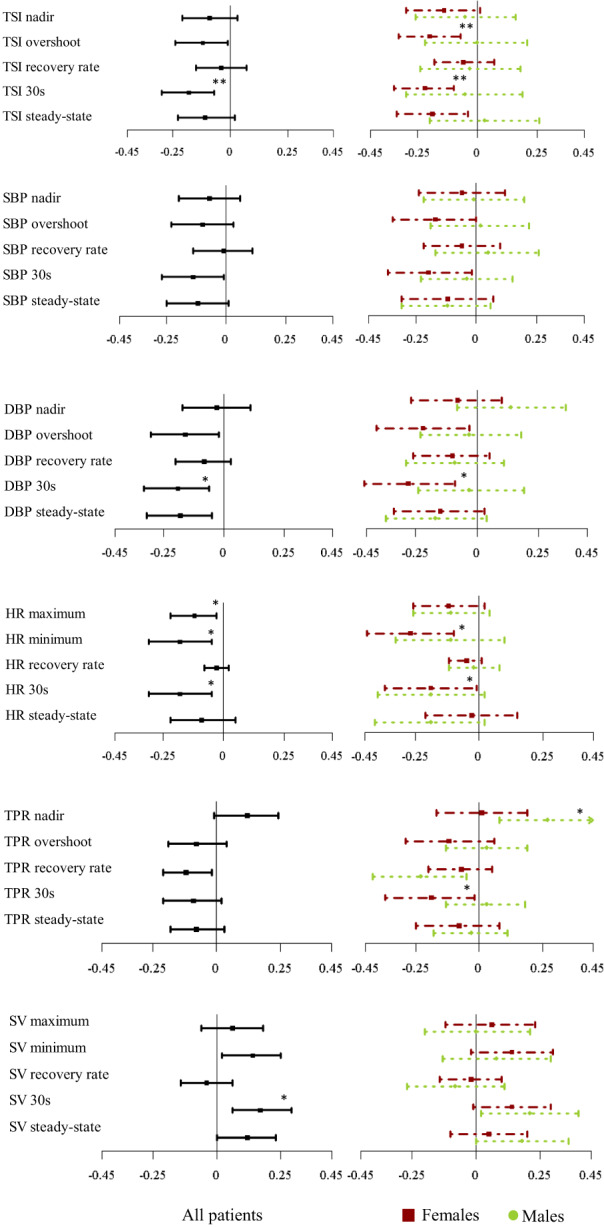
Results: Multimorbidity was associated with poorer recovery of TSI at 30 s after standing (β: -0.15, CI:[-0.25-0.06], p = 0.009) independent of all peripheral hemodynamics. Impaired diastolic BP (DBP) recovery at 30s (β:-1.34, CI:[-2.29-0.40], p = 0.032), DBP steady-state (β:-1.18, CI:[-2.04-0.32], p = 0.032), TPR overshoot-to-nadir difference (β:-0.041, CI:[-0.070-0.013], p = 0.045), and SV at 30s (β:1.30, CI:[0.45 2.15], p = 0.027) were also associated with increasing multimorbidity. After sex stratification, only females demonstrated impaired TSI with multimorbidity at overshoot (β: -0.19, CI: [-0.32 -0.07], p = 0.009), 30 s (β: -0.22 [-0.35-0.10], p = 0.005) and steady-state (β: -0.20, CI:[-0.35-0.04], p = 0.023), independent of peripheral hemodynamics.
Conclusions: Transient cerebral oxygenation and peripheral hemodynamic responses are impaired with multimorbidity (frailty) in older patients, particularly in females. This study demonstrates the feasibility of using NIRS in this clinical context and may inform the development of clinical management strategies targeting both cerebral oxygenation and blood pressure impairments in patients with faints and falls.
Keywords: active standing; cerebral oxygenation; multimorbidity; near-infrared spectroscopy; orthostatic hypotension.
© 2022 The Authors. Journal of the American Geriatrics Society published by Wiley Periodicals LLC on behalf of The American Geriatrics Society.
Conflict of interest statement
The authors have no conflicts of interest to disclose.
Figures


References
-
- McNicholas T, Tobin K, Carey D, O'Callaghan S, Kenny RA. Is baseline orthostatic hypotension associated with a decline in global cognitive performance at 4‐year follow‐up? Data from TILDA (the Irish longitudinal study on ageing). J Am Heart Assoc. 2018;7(19):e008976. doi:10.1161/JAHA.118.008976 - DOI - PMC - PubMed
Publication types
MeSH terms
Grants and funding
LinkOut - more resources
Full Text Sources
