


Persistent Methicilin-Resistant Staphylococcus aureus Bacteremia: Resetting the Clock for Optimal Management
- PMID: 35535790
- PMCID: PMC9617577
- DOI: 10.1093/cid/ciac364
Persistent Methicilin-Resistant Staphylococcus aureus Bacteremia: Resetting the Clock for Optimal Management
Erratum in
-
Correction to: Persistent Methicillin-Resistant Staphylococcus aureus Bacteremia: Resetting the Clock for Optimal Management.Clin Infect Dis. 2023 Apr 3;76(7):1346-1347. doi: 10.1093/cid/ciad008. Clin Infect Dis. 2023. PMID: 36680537 Free PMC article. No abstract available.
Abstract
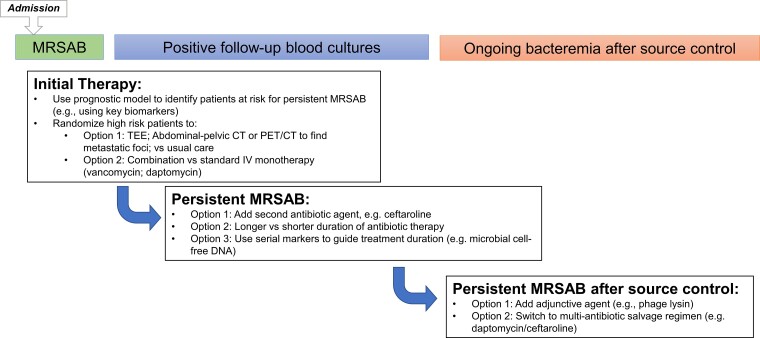
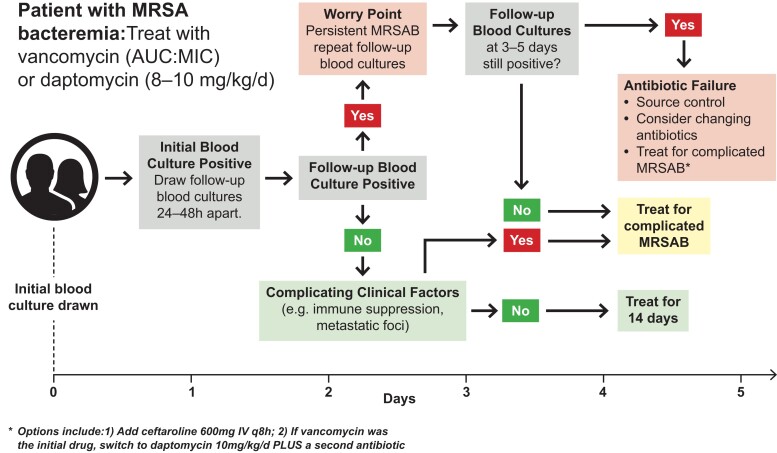
A positive follow-up blood culture for methicillin-resistant Staphylococcus aureus (MRSA) while on seemingly appropriate therapy is a common and ominous development. However, the definition and management of persistent MRSA bacteremia is unstandardized. In this Opinion Paper, we identify the presence of bacteremia for > 1 calendar day as a "worry point" that should trigger an intensive diagnostic evaluation to identify metastatic infection sites. Next, we define the duration of MRSA bacteremia that likely constitutes antibiotic failure and outline a potential management algorithm for such patients. Finally, we propose pragmatic clinical trial designs to test treatment strategies for persistent MRSA bacteremia.
Keywords: Staphylococcus aureus bacteremia; methicillin-resistance.
© The Author(s) 2022. Published by Oxford University Press on behalf of the Infectious Diseases Society of America. All rights reserved. For permissions, please e-mail: journals.permissions@oup.com.
Conflict of interest statement
Potential conflicts of interest. T. L. H. reports NIH grant UM1-AI104681 (Antibacterial Resistance Leadership Group), consulting fees from Basilea Pharmaceutica, Genentech, Motif Bio, and Aridis, and personal fees from Lysovant; participation on SNAP Trial Platform DSMB; and royalties from UpToDate. A. S. B. reports research grants from Roivant Pharmaceuticals, ContraFect Corp., and Akagera Medicines, Lysovant Pharmaceuticals, National Institutes of Health (NIAID), Cystic Fibrosis Foundation, and Department of Defense. V. G. F. reports personal fees from Novartis, Novadigm, Durata, Debiopharm, Genentech, Achaogen, Affinium, Medicines Co., Cerexa, Tetraphase, Trius, MedImmune, Bayer, Theravance, Basilea, Affinergy, Janssen, xBiotech, Contrafect, Regeneron, Basilea, Destiny, Amphliphi Biosciences. Integrated Biotherapeutics, C3J, Armata, Valanbio, Akagera, Aridis, and Roche; grants from NIH, MedImmune, Cerexa/Forest/Actavis/Allergan, Pfizer, Advanced Liquid Logics, Theravance, Novartis, Cubist/Merck; Medical Biosurfaces; Locus; Affinergy; Contrafect; Karius; Genentech, Regeneron, Basilea, Janssen, from Green Cross, Cubist, Cerexa, Durata, Theravance; Debiopharm, Royalties from UpToDate; supported by Contrafect to present Phase 2 data at 2019 ECCMID; is an Associate Editor for Clinical Infectious Diseases; stock or stock options from ArcBio and Valanbio; and a patent pending in sepsis diagnostics. All authors have submitted the ICMJE Form for Disclosure of Potential Conflicts of Interest. Conflicts that the editors consider relevant to the content of the manuscript have been disclosed.
Figures
References
-
- Levine DP, Fromm BS, Reddy BR. Slow response to vancomycin or vancomycin plus rifampin in methicillin-resistant Staphylococcus aureus endocarditis. Ann Intern Med 1991; 115:674–80. - PubMed
-
- Markowitz N, Quinn EL, Saravolatz LD. Trimethoprim-sulfamethoxazole compared with vancomycin for the treatment of Staphylococcus aureus infection. Ann Intern Med 1992; 117:390–8. - PubMed
Publication types
MeSH terms
Substances
Grants and funding
LinkOut - more resources
Full Text Sources
Medical
