. 2022 Jun 29;10(3):e0091622.
doi: 10.1128/spectrum.00916-22. Epub 2022 May 10.

Pneumococcal Phasevarions Control Multiple Virulence Traits, Including Vaccine Candidate Expression

Affiliations

Pneumococcal Phasevarions Control Multiple Virulence Traits, Including Vaccine Candidate Expression

Zachary N Phillips et al. Microbiol Spectr. .

Abstract

Streptococcus pneumoniae is the most common cause of bacterial illness worldwide. Current vaccines based on the polysaccharide capsule are only effective against a limited number of the >100 capsular serotypes. A universal vaccine based on conserved protein antigens requires a thorough understanding of gene expression in S. pneumoniae. All S. pneumoniae strains encode the SpnIII Restriction-Modification system. This system contains a phase-variable methyltransferase that switches specificity, and controls expression of multiple genes-a phasevarion. We examined the role of this phasevarion during pneumococcal pathobiology, and determined if phase variation resulted in differences in expression of currently investigated conserved protein antigens. Using locked strains that express a single methyltransferase specificity, we found differences in clinically relevant traits, including survival in blood, and adherence to and invasion of human cells. We also observed differences in expression of numerous proteinaceous vaccine candidates, which complicates selection of antigens for inclusion in a universal protein-based pneumococcal vaccine. This study will inform vaccine design against S. pneumoniae by ensuring only stably expressed candidates are included in a rationally designed vaccine. IMPORTANCE S. pneumoniae is the world's foremost bacterial pathogen. S. pneumoniae encodes a phasevarion (phase-variable regulon), that results in differential expression of multiple genes. Previous work demonstrated that the pneumococcal SpnIII phasevarion switches between six different expression states, generating six unique phenotypic variants in a pneumococcal population. Here, we show that this phasevarion generates multiple phenotypic differences relevant to pathobiology. Importantly, expression of conserved protein antigens varies with phasevarion switching. As capsule expression, a major pneumococcal virulence factor, is also controlled by the phasevarion, our work will inform the selection of the best candidates to include in a rationally designed, universal pneumococcal vaccine.

Keywords: Streptococcus pneumoniae; epigenetic regulation; phase variation; phasevarion; pneumococcus; vaccine.


Conflict of interest statement

The authors declare no conflict of interest.

Figures
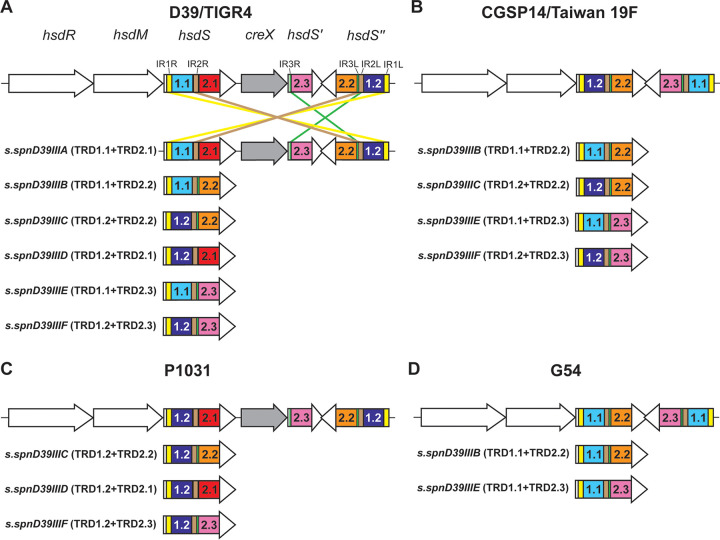
FIG 1
FIG 1
Different major forms of the SpnIII system in surveyed genomes. The SpnIII system was examined in NCBI fully annotated S. pneumoniae genomes. (A) The “full” six-way switch as first described in strains D39 and TIGR4. (B) A simpler four-way switch as seen in strain CGSP14 and Taiwan 19F. (C) A three-way switch seen in strain P1031. (D) A two-way switch seen in strain G54. Further details can be found in Table S1. All TRD fragments of the same name (e.g., 1.1) are identical.
FIG 2
FIG 2
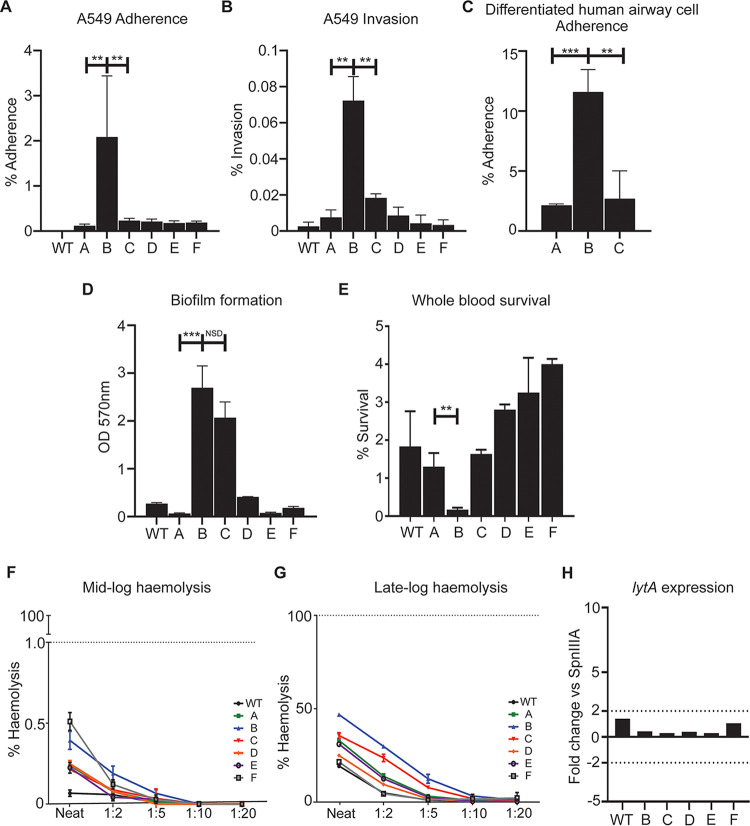
Clinically relevant traits of the SpnIII system using strain D39. (A) Adherence of strains expressing SpnIII alleles to A549 cells after 1 h. Values represent percent (%) of inoculum that was adherent. (B) Invasion assay measuring invasive ability of strains expressing SpnIII alleles after 1 h of incubation, then 45 min of antibiotic treatment. Values represent percent of inoculum that invaded A549 cells. SpnIII B had significantly better invasive ability compared with all other alleles. (C) Adherence to differentiated human airway epithelial cells after 1 h. Values represent percent of inoculum that adhered to cells. SpnIII B is significantly more adherent versus A and C. (D) Static biofilm formation was assessed after 24 h via crystal violet absorbance assay. SpnIII B and C form a significantly denser static biofilm compared to strains expressing other alleles. (E) Ability of SpnIII alleles A to F assessed for their survival in whole human blood (group O+) for 1.5 h. SpnIII B showed attenuated (~0%) survival, whereas SpnIII E and F showed greatest mean survival (~3% to 4%). Ability of SpnIII A to F alleles (strain D39) to lyse Human erythrocytes (group O+) measured at (F) mid log (OD O.5) and (G) late log (OD 1.0) growth phases after 1 h. Cells expressing SpnIII allele B had the highest consistent hemolytic ability compared with other locked alleles and WT S. pneumoniae D39. Evaluating lytA expression in late log samples (H) showed that no significant difference between locked SpnIII alleles A to F or WT D39. This indicates differences in hemolytic ability seen in (F) and (G) are independent of lytA expression. MOI 100:1. See Fig. S1 for challenge ratios. *, P < 0.05; **, P < 0.01; ***, P < 0.001.
FIG 3
FIG 3
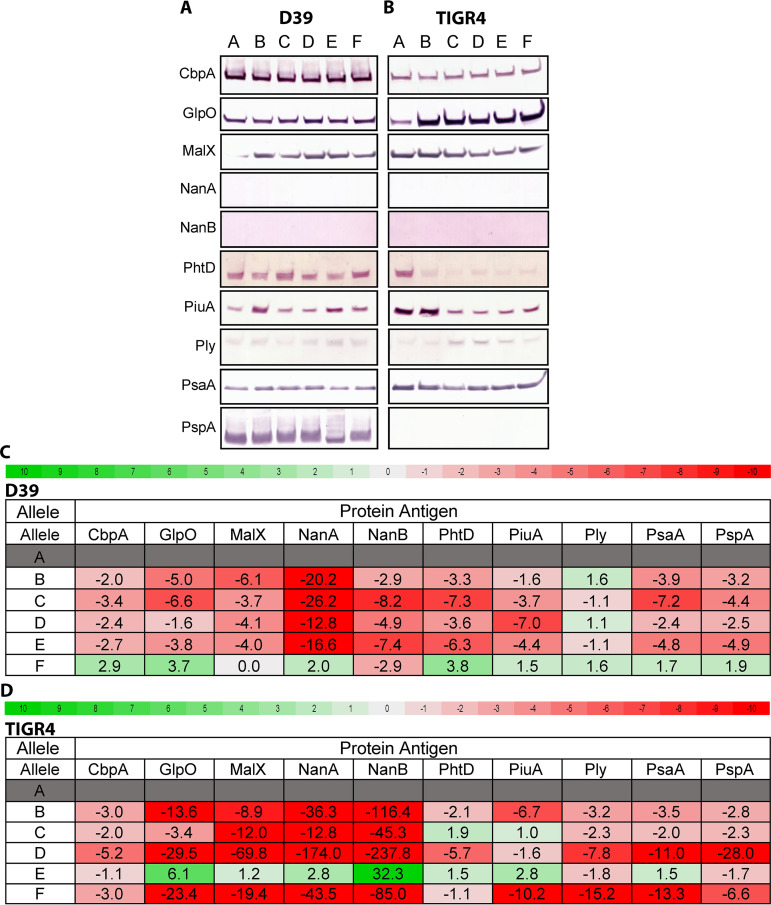
Expression differences in conserved proteinaceous vaccine candidates. Western blots examining differences in expression of protein levels between strains expressing alleles of the SpnIII system in strains (A) D39 and (B) TIGR4. Heatmaps of RT-qPCR expression data of concomitant expressed RNA levels of genes encoding these vaccine candidates from strains (C) D39 and (D) TIGR4. Red (negative fold difference) to green (positive fold difference) using SpnIII locked allele A as the baseline. Differences over >2 fold are in bold. All data with all locked variants as the baseline is presented in the same format in Table S2.
FIG 4
FIG 4
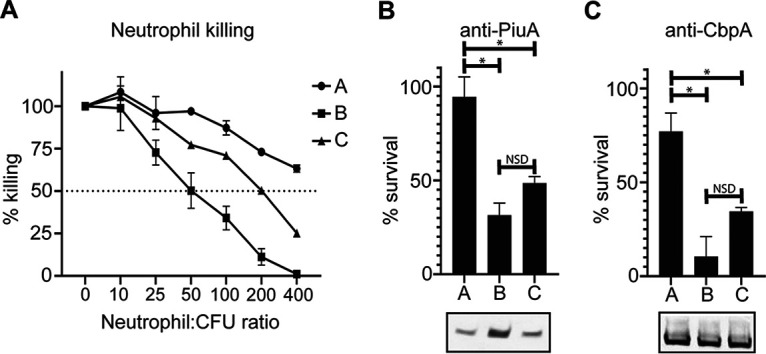
(A) Killing by differentiated neutrophil-like HL-60 cells with 10% (vol/vol) complement after 1 h. SpnIII A failed to reach 50% killing at maximum neutrophil:CFU ratio (400:1) after 1 h. SpnIII B and SpnIII C reached 50% killing at 50 and 200 neutrophil:CFU ratios, respectively. Opsonophagocytic killing assays using antisera against (B) PiuA and (C) CbpA at 1 in 20 dilution. Effects of antibody-mediated killing were masked by large differences in antibody-independent killing (A), independent of differences in antisera target. Western Blot showing expression of antisera targets in locked SpnIII alleles included for comparison. MOI for assays presented in Fig. S1. *, P < 0.05; NSD, no significant difference.

References

    1. Ferreira M, Santos M, Rodrigues J, Diogo C, Resende C, Baptista C, Faria C. 2021. Epidemiology of bacteremia in a pediatric population - a 10-year study. Enferm Infecc Microbiol Clin. doi: 10.1016/j.eimc.2021.06.011. - DOI - PubMed
    1. Simell B, Auranen K, Käyhty H, Goldblatt D, Dagan R, O’Brien KL, Pneumococcal Carriage Group . 2012. The fundamental link between pneumococcal carriage and disease. Expert Rev Vaccines 11:841–855. doi: 10.1586/erv.12.53. - DOI - PubMed
    1. Monasta L, Ronfani L, Marchetti F, Montico M, Vecchi Brumatti L, Bavcar A, Grasso D, Barbiero C, Tamburlini G. 2012. Burden of disease caused by otitis media: systematic review and global estimates. PLoS One 7:e36226. doi: 10.1371/journal.pone.0036226. - DOI - PMC - PubMed
    1. Marom T, Tan A, Wilkinson GS, Pierson KS, Freeman JL, Chonmaitree T. 2014. Trends in otitis media–related health care use in the USA, 2001–2011. JAMA Pediatr 168:68–75. doi: 10.1001/jamapediatrics.2013.3924. - DOI - PMC - PubMed
    1. Ignatova GL, Avdeev SN, Antonov VN. 2021. Comparative effectiveness of pneumococcal vaccination with PPV23 and PCV13 in COPD patients over a 5-year follow-up cohort study. Sci Rep 11:15948. doi: 10.1038/s41598-021-95129-w. - DOI - PMC - PubMed

Publication types

LinkOut - more resources