


Addressing Hypertension Outcomes Using Telehealth and Population Health Managers: Adaptations and Implementation Considerations
- PMID: 35536464
- PMCID: PMC9087161
- DOI: 10.1007/s11906-022-01193-6
Addressing Hypertension Outcomes Using Telehealth and Population Health Managers: Adaptations and Implementation Considerations
Abstract
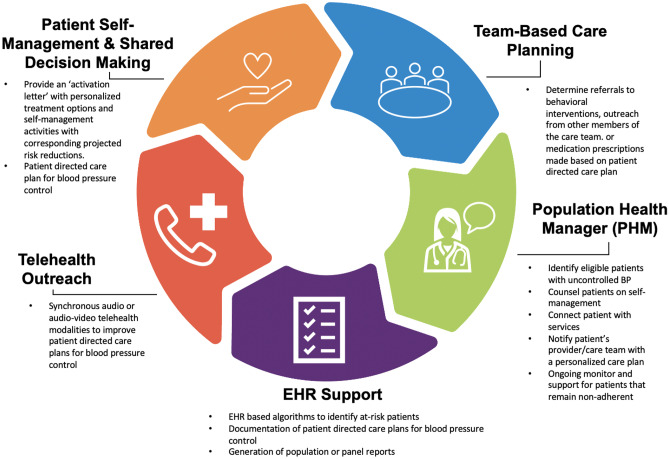
Purpose of review: There is a growing evidence base describing population health approaches to improve blood pressure control. We reviewed emerging trends in hypertension population health management and present implementation considerations from an intervention called Team-supported, Electronic health record-leveraged, Active Management (TEAM). By doing so, we highlight the role of population health managers, practitioners who use population level data and to proactively engage at-risk patients, in improving blood pressure control.
Recent findings: Within a population health paradigm, we discuss telehealth-delivered approaches to equitably improve hypertension care delivery. Additionally, we explore implementation considerations and complementary features of team-based, telehealth-delivered, population health management. By leveraging the unique role and expertise of a population health manager as core member of team-based telehealth, health systems can implement a cost-effective and scalable intervention that addresses multi-level barriers to hypertension care delivery. We describe the literature of telehealth-based population health management for patients with hypertension. Using the TEAM intervention as a case study, we then present implementation considerations and intervention adaptations to integrate a population health manager within the health care team and effectively manage hypertension for a defined patient population. We emphasize practical considerations to inform implementation, scaling, and sustainability. We highlight future research directions to advance the field and support translational efforts in diverse clinical and community contexts.
Keywords: Electronic health record; Hypertension; Implementation science; Multidisciplinary care team; Population health management; Telemedicine.
© 2022. The Author(s).
Conflict of interest statement
Dr. Drake reports receiving funds from ZealCare. Dr. Lewinski reports receiving funding from the PhRMA Foundation and Otsuka. Dr. Bosworth reports receiving research funds from Sanofi, Otsuka, Johnson and Johnson, Improved Patient Outcomes, Novo Nordisk, PhRMA Foundation as well as consulting funds from Walmart, Webmed, Sanofi, Otsuka, Abbott, and Novartis. Dr. Zullig reports receiving funding from the PhRMA Foundation and Proteus Digital Health as well as consulting funds from Novartis and Pfizer. The remaining authors have no competing interests to declare. The findings and conclusions in this document are those of the author(s) who are responsible for its contents and do not represent the views of the Department of Veterans Affairs, the US Government, or Duke University. Therefore, no statement in this article should be construed as an official position of the Department of Veterans Affairs or Duke University.
Figures
References
-
- Centers for Disease Control and Prevention (CDC). Facts about hypertension. US Department of Health and Human Services. 2020. https://www.cdc.gov/bloodpressure/facts.htm. Accessed 7 April 2021.
-
- Buttorff C, Ruder T, Bauman M. Multiple chronic conditions in the United States. Santa Monica, CA: Rand. 2017;10.
-
- Bozkurt B, Aguilar D, Deswal A, Dunbar SB, Francis GS, Horwich T, Jessup M, Kosiborod M, Pritchett A, Ramasubbu K, Rosendorff C, Yancy C. Contributory risk and management of comorbidities of hypertension, obesity, diabetes mellitus, hyperlipidemia, and metabolic syndrome in chronic heart failure: a scientific statement from the American Heart Association. Circulation. 2016;134(23):535–578. doi: 10.1161/CIR.0000000000000450. - DOI - PubMed
Publication types
MeSH terms
Grants and funding
LinkOut - more resources
Full Text Sources
Medical
Research Materials
