. 2022 May 25;144(20):8951-8960.
doi: 10.1021/jacs.1c10584. Epub 2022 May 10.

Effective Storage of Electrons in Water by the Formation of Highly Reduced Polyoxometalate Clusters

Affiliations

Effective Storage of Electrons in Water by the Formation of Highly Reduced Polyoxometalate Clusters

Jia-Jia Chen et al. J Am Chem Soc. .

Abstract

Aqueous solutions of polyoxometalates (POMs) have been shown to have potential as high-capacity energy storage materials due to their potential for multi-electron redox processes, yet the mechanism of reduction and practical limits are currently unknown. Herein, we explore the mechanism of multi-electron redox processes that allow the highly reduced POM clusters of the form {MO3}y to absorb y electrons in aqueous solution, focusing mechanistically on the Wells-Dawson structure X6[P2W18O62], which comprises 18 metal centers and can uptake up to 18 electrons reversibly (y = 18) per cluster in aqueous solution when the countercations are lithium. This unconventional redox activity is rationalized by density functional theory, molecular dynamics simulations, UV-vis, electron paramagnetic resonance spectroscopy, and small-angle X-ray scattering spectra. These data point to a new phenomenon showing that cluster protonation and aggregation allow the formation of highly electron-rich meta-stable systems in aqueous solution, which produce H2 when the solution is diluted. Finally, we show that this understanding is transferrable to other salts of [P5W30O110]15- and [P8W48O184]40- anions, which can be charged to 23 and 27 electrons per cluster, respectively.


Conflict of interest statement

The authors declare no competing financial interest.

Figures

Figure 1
Figure 1
Super-reduced polyoxometalates blueprint data. (a) Structure and frontier molecular orbital (MO) energies for different reduction and protonation states of [P2W18O62]6– (abbreviated as {P2W18}) cluster. Level energies in red and green represent oxo and d(W) orbitals, respectively, see text. All energy values (eV) represented in the diagram were computed with the BP86 functional and a Slater TZP basis set (further details in the Computational section, Supporting Information). (b) Galvanostatic discharge curves for the reduction and reoxidation of a 50 mM Li6[P2W18O62] solution with a constant current density of ±50 mA cm–2 (±648 mA), showing 16 equiv of electrons per cluster. (c) Same experiment with 50 mM Na6[P2W18O62] solution with a constant current density of ±50 mA cm–2 (±648 mA) showing 13 equiv of electrons per cluster. (d) Same experiment with 50 mM K6[P2W18O62] solution with a constant current density of ±50 mA cm–2 (±648 mA). Showing 11 equivalents of electrons per cluster.
Figure 2
Figure 2
SAXS spectra of {P2W18} solutions exhibiting differences in the supramolecular assembly. (a) K-{P2W18} fully oxidized and fully reduced; (b) Na-{P2W18} fully oxidized and fully reduced; and (c) Li-{P2W18} fully oxidized and fully reduced. Solutions shown in (a–c) are similar in concentrations for direct comparison; (d) Li-{P2W18} fully oxidized and fully reduced at 100 mMolar, demonstrating formation of large aggregates upon reduction.
Figure 3
Figure 3
Electronic properties and collective behavior of Wells–Dawson anions at initial reduction states. (a) Snapshot of a representative 3D-periodic simulation box used for classical MD simulations (see the Computational Details section for further details). (b) POM···POM radial distribution functions (RDFs) computed from classical MD simulations taking as reference the center of mass of each POM. Red, light blue, and dark blue lines denote simulations with [{P2W18}]6–, [H{P2W18}-4e]9–, and [H3{P2W18}-6e]9– anions, respectively. RDFs were averaged over the last 10 ns of 40 ns simulations and sampling data every 2 ps. (c) Schematic MO diagram showing the stabilizing effect of agglomeration on the MOs of H{P2W18}-4e. Energies (in eV) were computed for the POM highlighted in cyan in the snapshots using the hybrid-GGA B3LYP functional and a DZP-quality basis set. Solvent effects (water) were included through the IEF-PCM model.
Figure 4
Figure 4
Electronic properties and collective behavior for the super-reduced [P2W18O62] anion. (a) Polyhedral and balls-and-sticks representation of anion H17{P2W18}-18e (7b:10t), bearing seven and ten protons at bridging and terminal oxygen atoms. This proton distribution was found to be the most likely distribution for a system with 17 protons, although other distributions can coexist under the experimental conditions (Table S8-2). (b) Comparison of the POM···POM RDF for several H17{P2W18}-18e anions with different bridging/terminal ratios (Table S8-2), obtained from MD simulations of 100 mM POM solutions. (c) Snapshot of a H17{P2W18}-18e (7b:10t) agglomerate at the last step of the simulation. POMs are represented as polyhedra, Li cations as purple spheres, and hydronium cations as sticks with O atoms highlighted in green. Water molecules are omitted for clarity. (d) Evolution of the number of hydrogen bonds between POMs computed over 40 ns of simulation for H17{P2W18}-18e (7b:10t) (blue line) and H2{P2W18}-4e (purple line), highlighting that direct H-bonding arises as a non-negligible cohesion agent in super-reduced anions. (e) Comparison of the POM···POM RDF at different concentrations using the H17{P2W18}-18e (10b:7t) anion as a representative example. The simulation at a high concentration revealed an average number of 1.34 POMs in close contact with another POM, whereas at low concentrations, the average number of neighbors drops to 0.06 POMs, in agreement with the experimental concentration dependence. (f) Schematic MO diagram comparing the energy levels of the SOMO of {P2W18}-1e with the highest SOMO of H17{P2W18}-18e (7b:10t) in solution (non-associated monomer) and within an agglomerate structure (Figure S8-9).
Figure 5
Figure 5
Comparative data sets for Ultraviolet–visible (UV–vis) experimental and computational that describes the Li-{P2W18} cluster. Redox flow electrolysis cell results from 0–12 electrons in cluster for a 10 mM of Li-{P2W18}, namely Li6[P2W18O62], in water, (a,b) UV–vis data, each line represents an increase in voltage applied to the bias equivalent to the reduction of Li-{P2W18}, see Supporting Information. (c) Computed UV–vis spectra for the fully oxidized {P2W18} anion (red line) and the 2 and 6 electron-reduced forms (light and dark blue, respectively) and (d) Effect of protonation in the UV–vis spectrum of {P2W18}-6e.
Figure 6
Figure 6
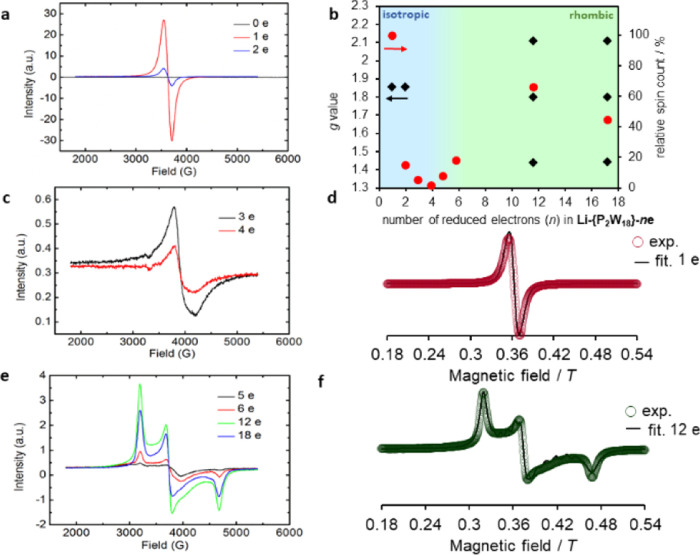
EPR results of 100 mM Li-{P2W18} salt at different reduction states at T = 100 K. (a) EPR for the Li-{P2W18} sample, corresponding to the applied current for 1 and 2 electron-reduced samples. (b) Different g values for multiple reduced Li-{P2W18} samples. Different g values corresponding to two types of W atom environments in the cluster. From species reduced between 1-5e, electron density is located around 12 W in the belt region; beyond that (6–18e), the electron density is also distributed around the 6 W cap, and clusters are protonated and aggregated. (c) Signal corresponding to 3 and 4 e– reduced samples. (d) Theoretical EPR fitting for 1 e– reduced Li-{P2W18} spectra. Finally, (e) signals for 5–18 electron-reduced Li-{P2W18} samples. (f) Theoretical EPR fitting for 12 electron-reduced Li-{P2W18} EPR spectra.
Figure 7
Figure 7
Galvanostatic discharge curves for the reduction and reoxidation of K salts of {P5W30} and -{P8W48} anions. (a) 23 e–reduction/reoxidation curves of a 10 mM solution of K-{P5W30} and (b) 27 e–reduction/reoxidation curves of a 25 mM solution of K-{P8W48} and battery testing devices were heated to 70 °C to maintain the solubility.

References

    1. Sanchez C.; Livage J.; Launay J. P.; Fournier M. Electron Delocalization in Mixed-Valence Tungsten Polyanions. J. Am. Chem. Soc. 1983, 105, 6817–6823. 10.1021/ja00361a012. - DOI
    1. Liu J.; Cheng L.; Liu B.; Dong S. Covalent Modification of a Glassy Carbon Surface by 4-Aminobenzoic Acid and Its Application in Fabrication of a Polyoxometalates-Consisting Monolayer and Multilayer Films. Langmuir 2000, 16, 7471–7476. 10.1021/la9913506. - DOI
    1. Rinfray C.; Renaudineau S.; Izzet G.; Proust A. A Covalent Polyoxomolybdate-Based Hybrid with Remarkable Electron Reservoir Properties. Chem. Commun. 2014, 50, 8575–8577. 10.1039/c4cc03779k. - DOI - PubMed
    1. Liu J.; Chen Z.; Chen S.; Zhang B.; Wang J.; Wang H.; Tian B.; Chen M.; Fan X.; Huang Y.; Sum T. C.; Lin J.; Shen Z. X. electron/Ion Sponge”-Like V-Based Polyoxometalate: Toward High-Performance Cathode for Rechargeable Sodium Ion Batteries. ACS Nano 2017, 11, 6911–6920. 10.1021/acsnano.7b02062. - DOI - PubMed

    1. Nishimoto Y.; Yokogawa D.; Yoshikawa H.; Awaga K.; Irle S. Super-Reduced Polyoxometalates: Excellent Molecular Cluster Battery Components and Semipermeable Molecular Capacitors. J. Am. Chem. Soc. 2014, 136, 9042–9052. 10.1021/ja5032369. - DOI - PubMed