


Foundational ingredients of robotic gait training for people with incomplete spinal cord injury during inpatient rehabilitation (FIRST): A randomized controlled trial protocol
- PMID: 35536844
- PMCID: PMC9089894
- DOI: 10.1371/journal.pone.0267013
Foundational ingredients of robotic gait training for people with incomplete spinal cord injury during inpatient rehabilitation (FIRST): A randomized controlled trial protocol
Abstract
Introduction: As technological advances allow the use of robotic exoskeleton devices with gait training, there is a critical need to establish a robotic gait training (RGT) program to meet the needs of people with spinal cord injury (SCI) during inpatient rehabilitation. The purposes of this study are to prospectively examine the efficacy of a stakeholder informed RGT program compared to usual care gait training (UC) during inpatient rehabilitation in people with incomplete SCI and compare the intensity of RGT and UC gait training during inpatient rehabilitation.
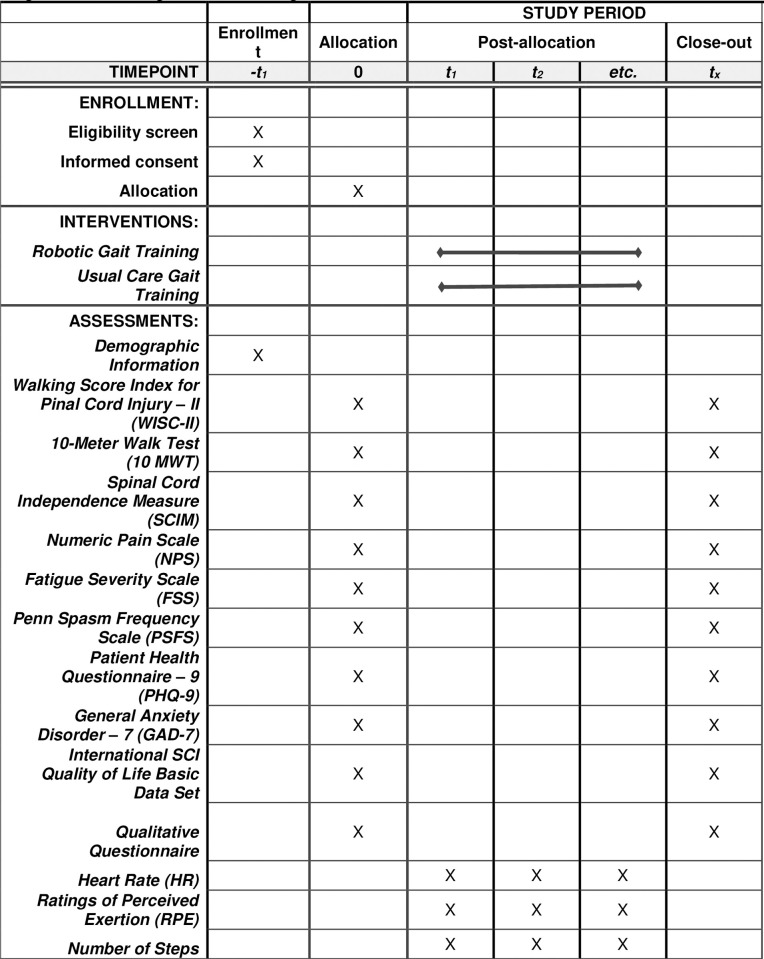
Study design: 128 patients with incomplete SCI admitted to our inpatient rehabilitation facility will be screened for eligibility and randomized to either the RGT or UC group. RGT sessions will use the Ekso robotic exoskeleton [class II medical device (United States FDA)]. UC sessions will use traditional gait training approaches such as manually assisted overground gait training with walkers and orthotics and body weight-supported treadmill training (BWSTT). Our primary outcome is gait function as characterized by the Walking Index for Spinal Cord Injury-II (WISCI-II). Secondary outcomes are gait speed, Spinal Cord Independence Measure (SCIM), Numeric Pain Rating Scale (NPRS), Fatigue Severity Scale (FSS), Penn Spasm Frequency Scale (PSFS), Patient Health Questionnaire-9 (PHQ-9), General Anxiety Disorder- 7 (GAD-7), International Spinal Cord Injury Quality of Life Basic Data Set, and a Qualitative Questionnaire. Assessments of primary and secondary outcomes will occur at admission and discharge from inpatient rehabilitation. General or generalized linear models will be used to analyze differences between groups for all measures.
Clinical impact: Successful completion of this study will provide a usable, replicable, stakeholder informed RGT intervention for use with individuals with incomplete SCI during inpatient rehabilitation.
Conflict of interest statement
The authors have declared that no competing interests exist.
Figures
References
-
- National Spinal Cord Injury Statistical Center. Facts and Figures at a Glance 2018 [Available from: https://www.nscisc.uab.edu
-
- Fleerkotte BM, Koopman B, Buurke JH, van Asseldonk EH, van der Kooij H, Rietman JS. The effect of impedance-controlled robotic gait training on walking ability and quality in individuals with chronic incomplete spinal cord injury: an explorative study. Journal of neuroengineering and rehabilitation. 2014;11(1):1. - PMC - PubMed
Publication types
MeSH terms
LinkOut - more resources
Full Text Sources
Medical
Research Materials
