Landscape of immunoglobulin heavy chain gene repertoire and its clinical relevance to LPL/WM
- PMID: 35537114
- PMCID: PMC9278287
- DOI: 10.1182/bloodadvances.2022007279
Landscape of immunoglobulin heavy chain gene repertoire and its clinical relevance to LPL/WM
Abstract
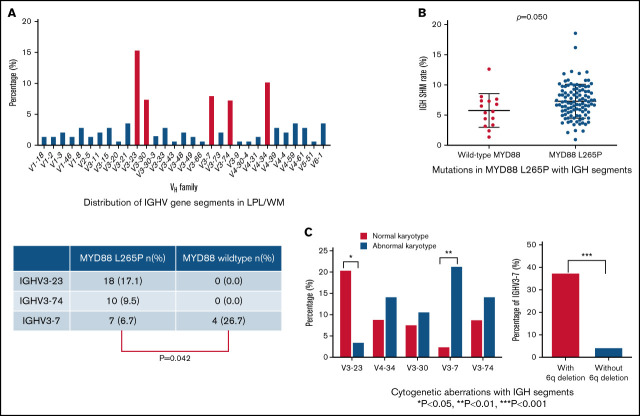
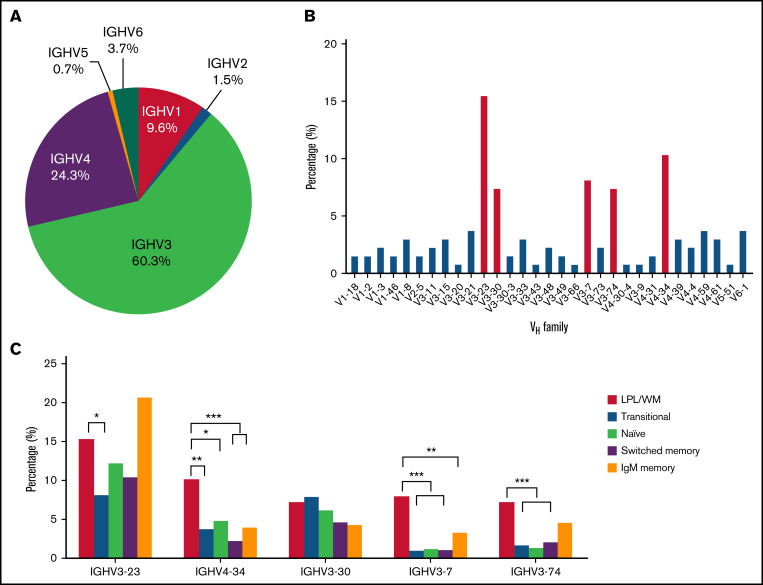
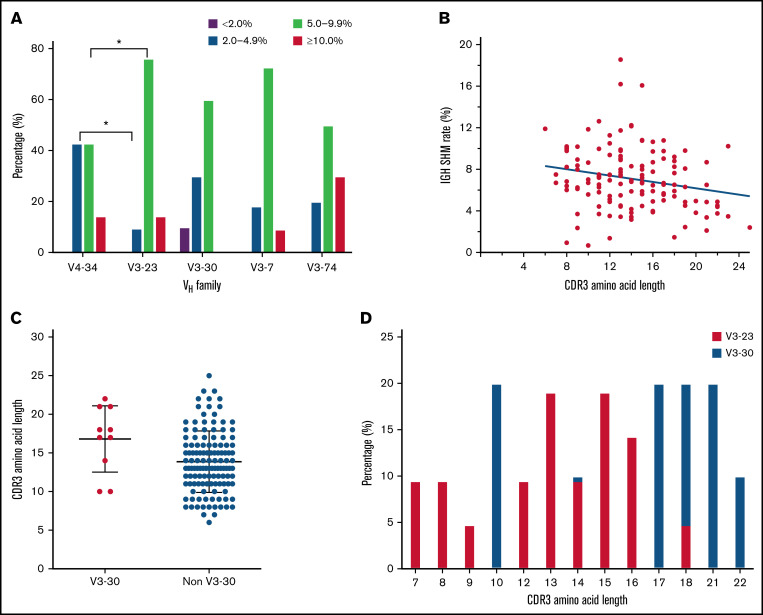
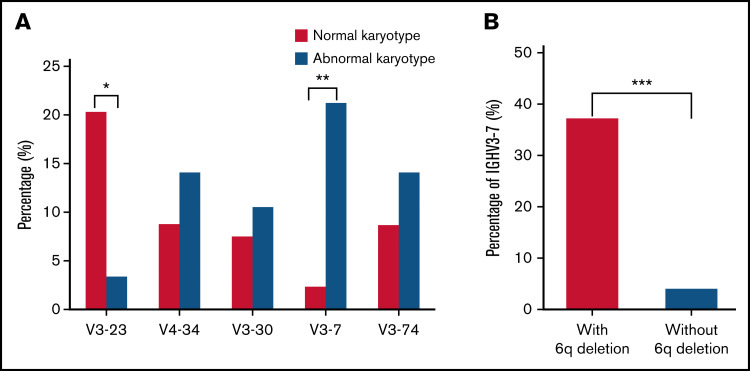
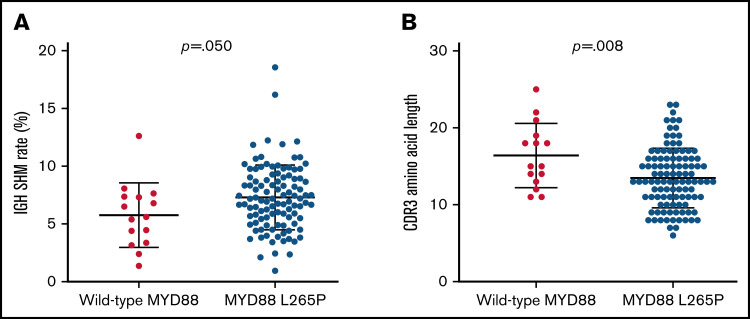
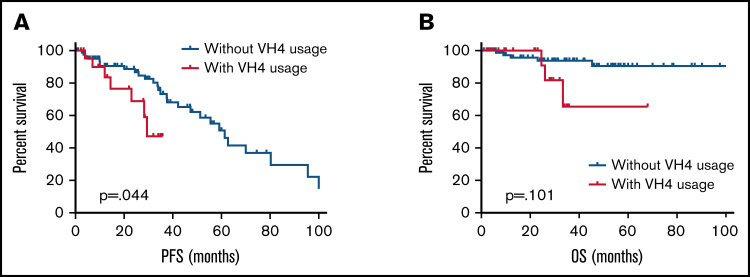
Lymphoplasmacytic lymphoma/Waldenström macroglobulinemia (LPL/WM) is a heterogeneous disease in which the role of immunoglobulin heavy-chain genes (IGHs) remains unknown. To determine the clinical relevance of the IGH repertoire in patients with LPL/WM, we performed immunoglobulin gene rearrangement and complementarity determining region 3 (CDR3) analysis. The IGH variable gene (IGHV) repertoire was remarkably biased in LPL/WM. IGHV3-23, IGHV4-34, IGHV3-30, IGHV3-7, and IGHV3-74 accounted for one-half of the cohort's repertoire. Most cases (97.1%) were found to carry mutated IGHV genes, based on a 98% IGHV germline homology cutoff. IGHV3-30 was associated with long heavy chain CDR3, indicating there was specific antigen selection in LPL/WM. Patients with IGHV3-7 were significantly more likely to harbor the 6q deletion (P < .001) and an abnormal karyotype (P = .004). The IGHV hypermutation rate in patients with the MYD88 L265P mutation was significantly higher than that of wild-type patients (P = .050). IGHV3-23 and IGHV3-74 segments were more frequently detected in patients with MYD88-mutated LPL/WM (P = .050), whereas IGHV3-7 presented more frequently in MYD88 wild-type patients (P = .042). Patients with IGHV4, especially IGHV4-34, had higher levels of lactate dehydrogenase, and IGHV4 was a predictive marker of shorter progression-free survival. These results showed for the first time that the IGHV repertoire has clinical relevance in LPL/WM.
© 2022 by The American Society of Hematology. Licensed under Creative Commons Attribution-NonCommercial-NoDerivatives 4.0 International (CC BY-NC-ND 4.0), permitting only noncommercial, nonderivative use with attribution. All other rights reserved.
Figures
References
-
- Lynch RC, Gratzinger D, Advani RH. Clinical impact of the 2016 update to the WHO Lymphoma Classification. Curr Treat Options Oncol. 2017;18(7):45. - PubMed
-
- Bartl R, Frisch B, Mahl G, et al. Bone marrow histology in Waldenström’s macroglobulinaemia. Clinical relevance of subtype recognition. Scand J Haematol. 1983;31(4):359-375. - PubMed
-
- Gertz MA. Waldenström macroglobulinemia: 2019 update on diagnosis, risk stratification, and management. Am J Hematol. 2019;94(2):266-276. - PubMed
-
- Advani P, Paulus A, Ailawadhi S. Updates in prognostication and treatment of Waldenström’s macroglobulinemia. Hematol Oncol Stem Cell Ther. 2019;12(4):179-188. - PubMed