


Gastruloids: Pluripotent stem cell models of mammalian gastrulation and embryo engineering
- PMID: 35537519
- PMCID: PMC9477185
- DOI: 10.1016/j.ydbio.2022.05.002
Gastruloids: Pluripotent stem cell models of mammalian gastrulation and embryo engineering
Abstract
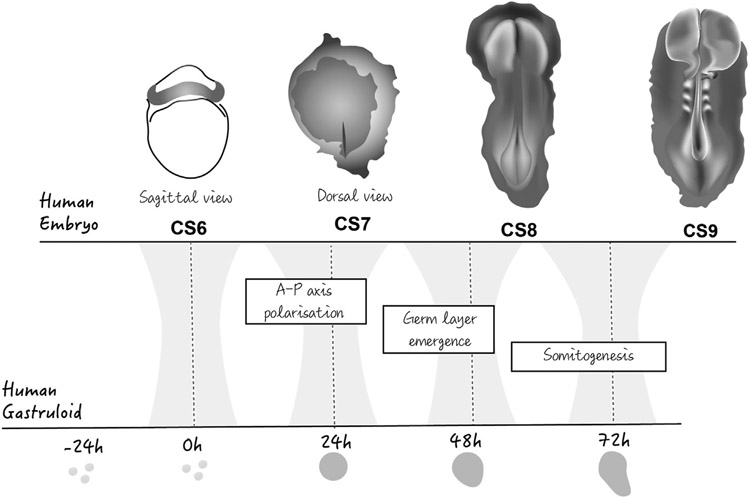
Gastrulation is a fundamental and critical process of animal development whereby the mass of cells that results from the proliferation of the zygote transforms itself into a recognizable outline of an organism. The last few years have seen the emergence of a number of experimental models of early mammalian embryogenesis based on Embryonic Stem (ES) cells. One of this is the Gastruloid model. Gastruloids are aggregates of defined numbers of ES cells that, under defined culture conditions, undergo controlled proliferation, symmetry breaking, and the specification of all three germ layers characteristic of vertebrate embryos, and their derivatives. However, they lack brain structures and, surprisingly, reveal a disconnect between cell type specific gene expression and tissue morphogenesis, for example during somitogenesis. Gastruloids have been derived from mouse and human ES cells and several variations of the original model have emerged that reveal a hereto unknown modularity of mammalian embryos. We discuss the organization and development of gastruloids in the context of the embryonic stages that they represent, pointing out similarities and differences between the two. We also point out their potential as a reproducible, scalable and searchable experimental system and highlight some questions posed by the current menagerie of gastruloids.
Keywords: Embryos; Experimental embryology; Gastruloids; Systems biology.
Copyright © 2022. Published by Elsevier Inc.
Figures


References
-
- Anderson KV, Ingham PW, 2003. The transformation of the model organism: a decade of developmental genetics. Nat. Genet 33 (Suppl. l), 285–293. - PubMed
-
- Arnold SJ, Robertson EJ, 2009. Making a commitment: cell lineage allocation and axis patterning in the early mouse embryo. Nat. Rev. Mol. Cell Biol 10, 91–103. - PubMed
-
- Bai CB, Stephen D, Joyner AL, 2004. All mouse ventral spinal cord patterning by hedgehog is Gli dependent and involves an activator function of Gli3. Dev. Cell 6, 103–115. - PubMed
Publication types
MeSH terms
Grants and funding
LinkOut - more resources
Full Text Sources
Other Literature Sources
