. 2022 Jun;298(6):102020.
doi: 10.1016/j.jbc.2022.102020. Epub 2022 May 7.

Factor inhibiting HIF can catalyze two asparaginyl hydroxylations in VNVN motifs of ankyrin fold proteins

Affiliations

Factor inhibiting HIF can catalyze two asparaginyl hydroxylations in VNVN motifs of ankyrin fold proteins

Thomas M Leissing et al. J Biol Chem. 2022 Jun.

Abstract

The aspariginyl hydroxylase human factor inhibiting hypoxia-inducible factor (FIH) is an important regulator of the transcriptional activity of hypoxia-inducible factor. FIH also catalyzes the hydroxylation of asparaginyl and other residues in ankyrin repeat domain-containing proteins, including apoptosis stimulating of p53 protein (ASPP) family members. ASPP2 is reported to undergo a single FIH-catalyzed hydroxylation at Asn-986. We report biochemical and crystallographic evidence showing that FIH catalyzes the unprecedented post-translational hydroxylation of both asparaginyl residues in "VNVN" and related motifs of ankyrin repeat domains in ASPPs (i.e., ASPP1, ASPP2, and iASPP) and the related ASB11 and p18-INK4C proteins. Our biochemical results extend the substrate scope of FIH catalysis and may have implications for its biological roles, including in the hypoxic response and ASPP family function.

Keywords: JmjC demethylase; ankyrin; epigenetics; factor inhibiting HIF; hypoxia-inducible factor; iron and 2-oxoglutarate/alpha-ketoglutarate oxygenase; post-translational modification/hydroxylation.


Conflict of interest statement

Conflict of interest The authors declare that they have no conflicts of interest with the contents of this article.

Figures
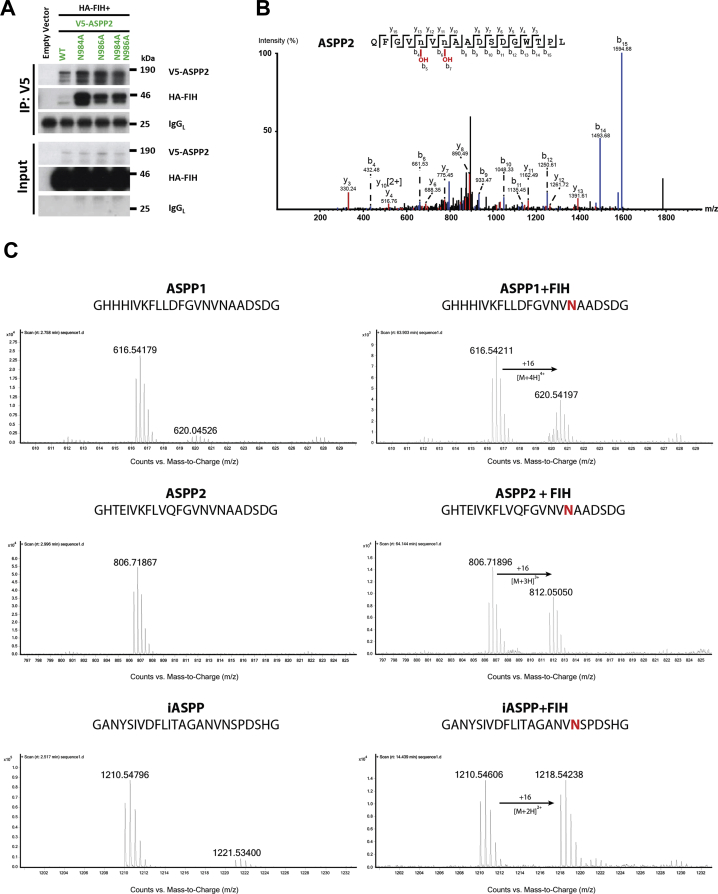
Figure 1
Figure 1
Evidence for FIH-catalyzed double hydroxylation of ASPP2-V5 within the same ankyrin repeat in protein from U2OS cells but not in studies with peptide fragments.A, Western Blot analysis of V5-ASPP2 variants and HA-FIH using total cell lysates from ASPP2/FIH-double KO U2OS cells, transfected with an empty vector, or cotransfected with pcDNA3 vectors encoding for HA-tagged FIH and V5-tagged WT ASPP2 or “NVN” variants, immunoprecipitated (IP) with an anti-V5 antibody (Thermo Fisher Scientific). HA-tagged FIH, V5-ASPP2, and IgG light-chain (IgGL) levels are indicated. B, LC–MS/MS analysis of V5-ASPP2 from U2OS FIH CRISPR KO cells cotransfected with vectors encoding for V5-ASPP2 and HA-FIH. The spectrum shows fragments from the elastase-catalyzed digestion of ASPP2 showing evidence for hydroxylation at Asp-984 and Asp-986 (indicated by lowercase n). Conditions: V5-ASPP2 in pcDNA3. The vectors encoding for ASPP2 and FIH variants were transfected and overexpressed for 24 h in U2OS FIH CRISPR KO cells. Immunoprecipitation was employed with an anti-V5 antibody. Proteins were separated by SDS-PAGE; the band corresponding to ASPP2 was excised and digested using elastase for 16 h at 37 °C. C, LC–MS-based hydroxylation assays of an ASPP1-derived peptide (residues 932–954), an ASPP2-derived peptide (residues 969–991), and an iASPP-derived peptide (residues 670–693). Conditions: 0.1 μM FIH, 100 μM sodium ascorbate, 10 μM 2OG disodium salt, 10 μM Fe(II), 50 mM Tris–HCl (pH 7.5), and 50 mM NaCl, at ambient temperature. 2OG, 2-oxoglutarate; ASPP, apoptosis stimulating of p53 protein; FIH, factor inhibiting hypoxia-inducible factor; HA, hemagglutinin; IgG, immunoglobulin G.
Figure 2
Figure 2
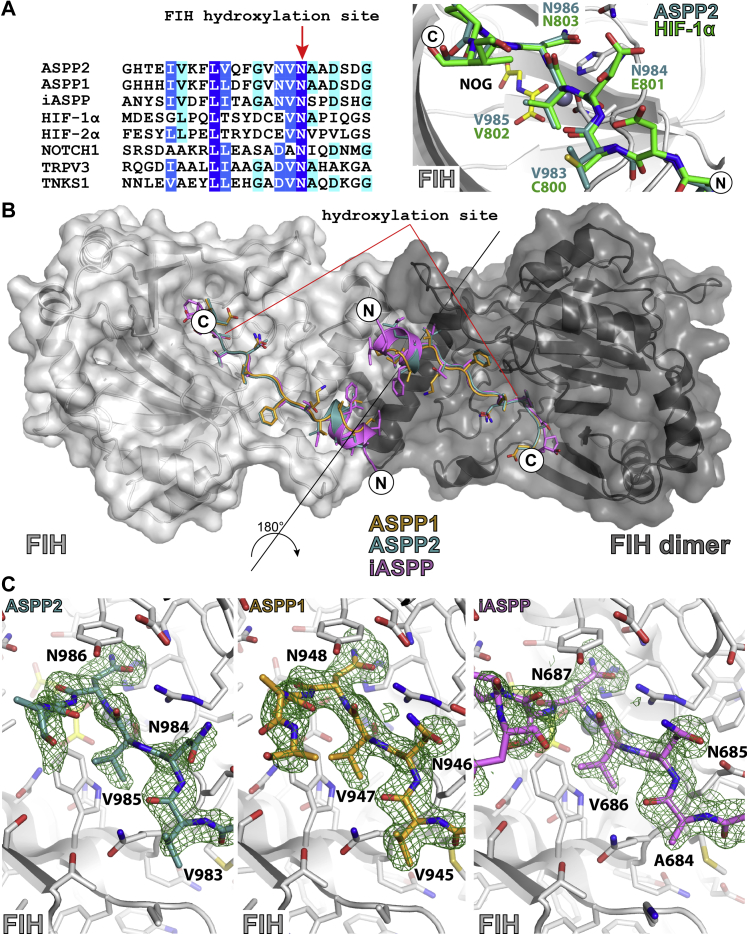
Views from crystal structures of FIH in complex with ASPP-derived peptides.A, left, sequence alignment of ASPPs with reported FIH substrates. Right, overlay of crystal structure–derived views of FIH in complex with ASPP2 and HIF-1α (Protein Data Bank code: 1H2K; 2.15 Å) showing the conserved nature of substrate binding. B, views from the dimeric structure of FIH in complex with an iASPP-derived peptide (residues 670–693), an ASPP1-derived peptide (residues 932–954), and an ASPP2-derived peptide (residues 969–991). C, close-up views from crystal structures of FIH in complex with ASPP-derived peptides, the Fo–Fc OMIT maps, shown in green mesh, are contoured to 3σ. ASPP, apoptosis stimulating of p53 protein; FIH, factor inhibiting hypoxia-inducible factor; HIF, hypoxia-inducible factor.
Figure 3
Figure 3
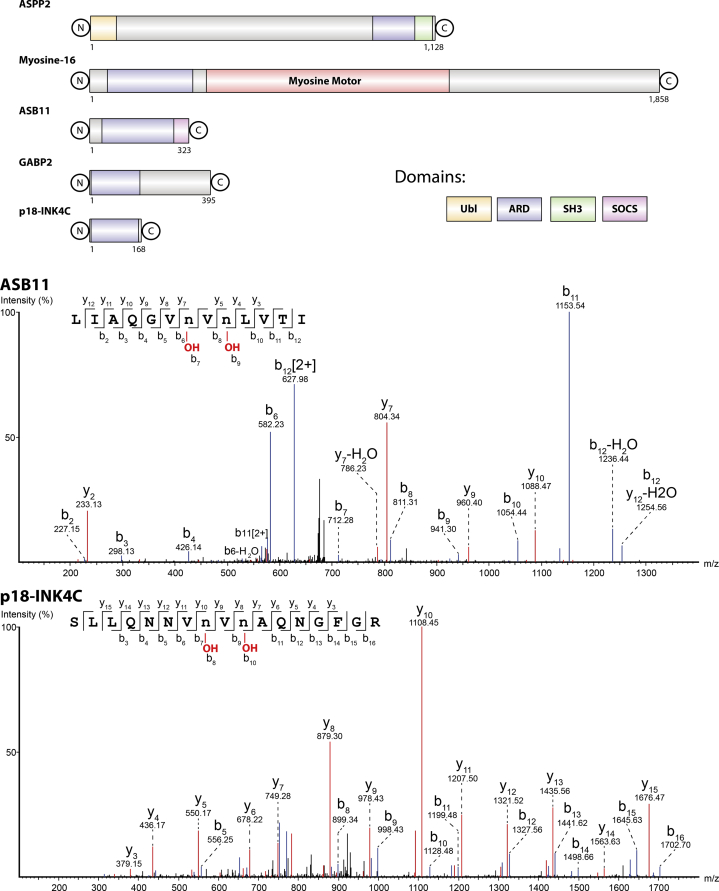
Evidence that FIH catalyzes two hydroxylations of ASB11 and p18.Top, domain structure of human “VNVN” motif–containing proteins. Middle, LC–MS/MS spectra implying a doubly hydroxylated ASB11 peptide at Asn-92 and Asn-90 (indicated by a lowercase n). Bottom, LC–MS/MS spectra for doubly hydroxylated peptides at Asn-32 and Asn-30 (indicated by a lowercase n). Reaction conditions: 1 μM ASB11, 0.25 μM FIH, 1 mM sodium ascorbate, 1 mM 2OG disodium salt, 200 μM Fe(II), and Tris–HCl (pH 7.5) incubated for 3 h at 37 °C. 2OG, 2-oxoglutarate; FIH, factor inhibiting hypoxia-inducible factor.

References

    1. Ivan M., Kondo K., Yang H., Kim W., Valiando J., Ohh M., et al. HIFalpha targeted for VHL-mediated destruction by proline hydroxylation: implications for O2 sensing. Science. 2001;292:464–468. - PubMed
    1. Jaakkola P., Mole D.R., Tian Y.M., Wilson M.I., Gielbert J., Gaskell S.J., et al. Targeting of HIF-alpha to the von Hippel-Lindau ubiquitylation complex by O2-regulated prolyl hydroxylation. Science. 2001;292:468–472. - PubMed
    1. Epstein A.C., Gleadle J.M., McNeill L.A., Hewitson K.S., O'Rourke J., Mole D.R., et al. C. elegans EGL-9 and mammalian homologs define a family of dioxygenases that regulate HIF by prolyl hydroxylation. Cell. 2001;107:43–54. - PubMed
    1. Kaelin W.G., Ratcliffe P.J. Oxygen sensing by metazoans: the central role of the HIF hydroxylase pathway. Mol. Cell. 2008;30:393–402. - PubMed
    1. Brocato J., Chervona Y., Costa M. Molecular responses to hypoxia-inducible factor 1α and beyond. Mol. Pharmacol. 2014;85:651–657. - PMC - PubMed

Publication types