. 2022 May 10;13(1):2314.
doi: 10.1038/s41467-022-29614-9.

Archival influenza virus genomes from Europe reveal genomic variability during the 1918 pandemic

Affiliations

Archival influenza virus genomes from Europe reveal genomic variability during the 1918 pandemic

Livia V Patrono et al. Nat Commun. .

Abstract

The 1918 influenza pandemic was the deadliest respiratory pandemic of the 20th century and determined the genomic make-up of subsequent human influenza A viruses (IAV). Here, we analyze both the first 1918 IAV genomes from Europe and the first from samples prior to the autumn peak. 1918 IAV genomic diversity is consistent with a combination of local transmission and long-distance dispersal events. Comparison of genomes before and during the pandemic peak shows variation at two sites in the nucleoprotein gene associated with resistance to host antiviral response, pointing at a possible adaptation of 1918 IAV to humans. Finally, local molecular clock modeling suggests a pure pandemic descent of seasonal H1N1 IAV as an alternative to the hypothesis of origination through an intrasubtype reassortment.


Conflict of interest statement

M.A.S. reports contracts from the US Department of Veteran Affairs, the US Food & Drug Administration and Janssen Research & Development, all outside the scope of this work. The remaining authors declare no competing interests.

Figures
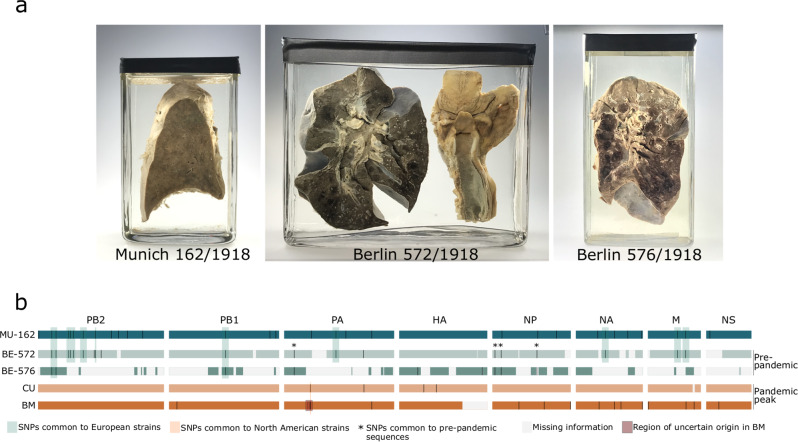
Fig. 1
Fig. 1. Positive specimens and influenza A virus genomic coverage.
Specimens positive for influenza A virus (a) and comparison of all available 1918 influenza A virus genomes (b). We identified single nucleotide polymorphisms (SNPs) in the new genomes using BM as a reference; for BM and CU, we plotted SNPs unique to these genomes. Missing information represents areas where we did not get any coverage or this was lower than our consensus calling criteria.
Fig. 2
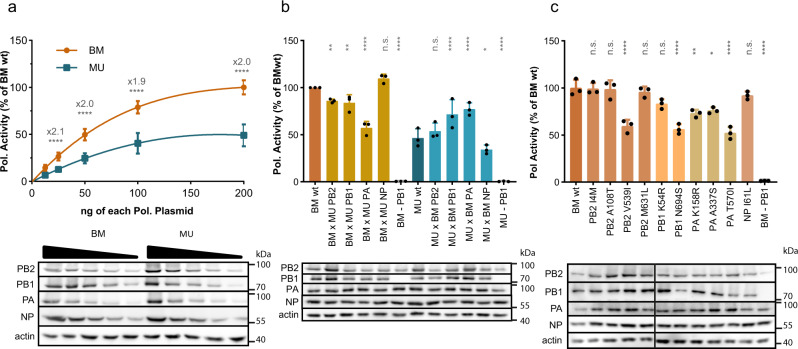
Fig. 2. In vitro activity of reconstituted BM and MU-162 polymerases by mini-genome reporter assay.
a Dose response of transfected MU-162 (here referred to as MU) polymerase in comparison to BM activity, arbitrarily set to 100%. b Effect of whole segment swapping. Comparative analysis of BM and MU-162 polymerase complexes expressed as wild type (wt) or as reassorted 3 + 1 combinations. c Effect of single BM-to-MU-162 aa changes in the context of the BM polymerase. Each assay was conducted in n = 3 independent replicates with experimental triplicates. Values are means ± SD. Significance was determined by nested ANOVA. *P < 0.05; **P < 0.01; ****P < 0.0001. All three lower panels depict the expression levels of polymerase subunits by immunoblot analyses. A representative result of n = 3 independent assays is shown. Source data are provided as a Source Data file.
Fig. 3
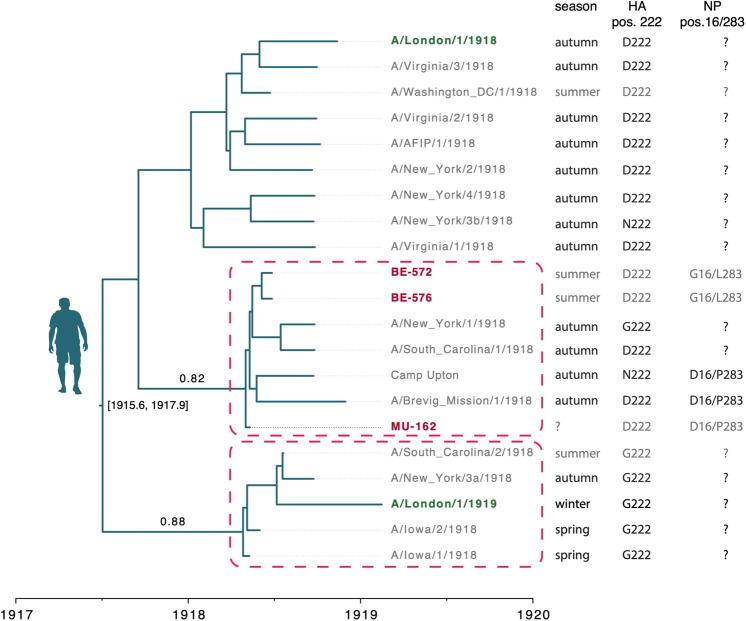
Fig. 3. Time-scaled phylogeny reconstructed based on HA sequences from 1918 flu strains.
US sequences are in gray, European sequences are in dark red (Germany) and dark green (UK). Dashed rectangles highlight clades comprising strains from different continents and with posterior support ≥0.75; for these clades posterior probabilities are reported above stem branches. The season column indicates from which season the samples originate, with light gray for the pre-pandemic peak period (spring and summer) and dark gray for the pandemic peak period (autumn and winter). The amino acid residues at HA position 222 and NP positions 16 and 283 are also indicated. ‘?’ indicate the absence of information. Numbers between brackets next to the root node indicate the 95% Highest Posterior Density (HPD) of its estimated age. The BE-576 consensus genome with ambiguities was used in this analysis; an equivalent reconstruction using majority rule consensus base calling can be found in Supplementary Fig. 5.
Fig. 4
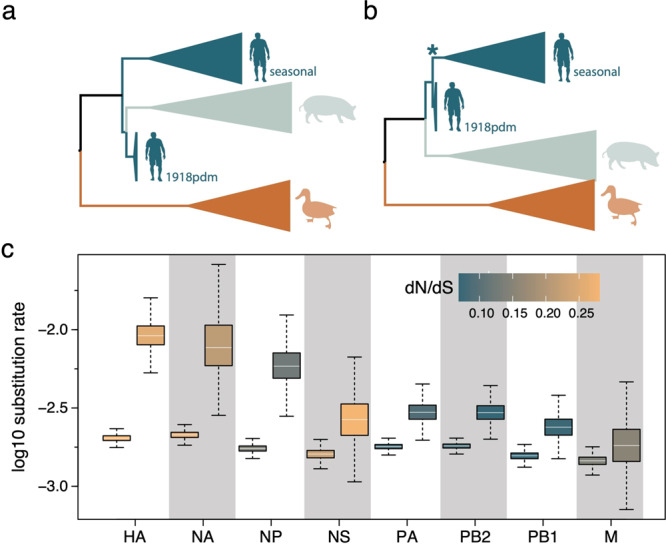
Fig. 4. Time-measured phylogenetic patterns and evolutionary rates estimated using Bayesian molecular clock modeling.
a The phylogenetic pattern for HA and NA inferred using a standard host-specific local clock (HSLC) model. b A monophyletic cluster for human pandemic and seasonal viruses estimated for HA and NA using an extended HSLC model (and using either model for all other segments). The star denotes the branch that is allowed to have a separate evolutionary rate in the HSLCext model. c Evolutionary rate estimates for the human lineage (first box) and the seasonal ancestral branch (second box) under the extended HSLC model for each segment ordered according to difference in these two rates. The boxes are colored according to the dN/dS estimate for the human lineage and the seasonal ancestral branch in each segment. The horizontal line in the whisker plots represents the mean. The lower and upper bounds of the boxes indicate the first and third quartile, respectively. Vertical lines are the upper and lower whisker representing the minimum of the largest value and 1.5 times the inter quartile distance, respectively the maximum of the smallest value and 1.5 times the inter quartile distance. Sample size from the MCMC chain is 2702 for NA and 4502 for all other segments. Source data are provided as a Source Data file.

Comment in

References

    1. Johnson NPAS, Mueller J. Updating the accounts: global mortality of the 1918-1920 ‘Spanish’ influenza pandemic. Bull. Hist. Med. 2002;76:105–115. doi: 10.1353/bhm.2002.0022. - DOI - PubMed
    1. Taubenberger JK, Morens DM. 1918 Influenza: the mother of all pandemics. Emerg. Infect. Dis. 2006;12:15–22. doi: 10.3201/eid1209.05-0979. - DOI - PMC - PubMed
    1. Graeme Gibson, H., Bowman, F. B. & Connor, J. I. A filtrable virus as the cause of the early stage of the present epidemic of influenza (A preliminary note.) Br. Med. J. 2, 645–646 (1918). - PMC - PubMed
    1. Taubenberger JK, Reid AH, Krafft AE, Bijwaard KE, Fanning TG. Initial genetic characterization of the 1918 ‘Spanish’ influenza virus. Science. 1997;275:1793–1796. doi: 10.1126/science.275.5307.1793. - DOI - PubMed
    1. Reid AH, Fanning TG, Hultin JV, Taubenberger JK. Origin and evolution of the 1918 ‘Spanish’ influenza virus hemagglutinin gene. Proc. Natl. Acad. Sci. USA. 1999;96:1651–1656. doi: 10.1073/pnas.96.4.1651. - DOI - PMC - PubMed

Publication types