


Health impact of seven herpesviruses on (pre)diabetes incidence and HbA1c: results from the KORA cohort
- PMID: 35538159
- PMCID: PMC9090457
- DOI: 10.1007/s00125-022-05704-7
Health impact of seven herpesviruses on (pre)diabetes incidence and HbA1c: results from the KORA cohort
Abstract
Aims/hypothesis: The prevalence of type 2 diabetes is increasing worldwide, and previous studies have suggested that it is higher in individuals who are seropositive for herpesviruses. This study examines the prospective association of herpesviruses with (pre)diabetes to evaluate their potential role in diabetes aetiology.
Methods: Two follow-up examinations of the German population-based KORA cohort (F4 and FF4) were used to identify participants with normal glucose tolerance at baseline, thus being at risk for (pre)diabetes (n = 1257). All participants had repeated OGTTs and antibody measurements for herpes simplex virus (HSV) 1 and 2, varicella-zoster virus, Epstein-Barr virus, cytomegalovirus (CMV) and human herpesvirus 6 and 7. Regression models were used to evaluate the association between serostatus with (pre)diabetes incidence after a 7 year follow-up and HbA1c.
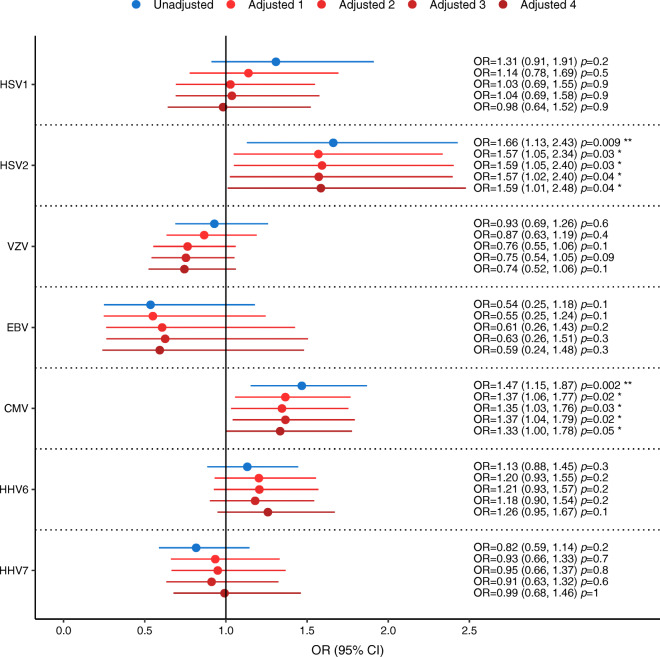
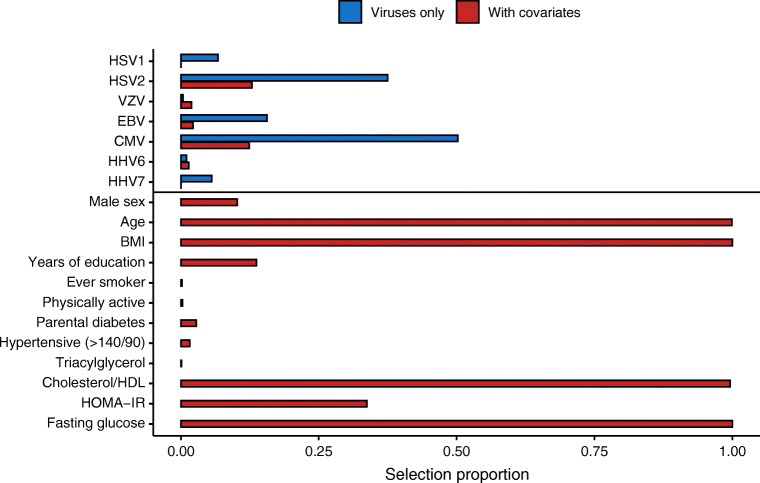
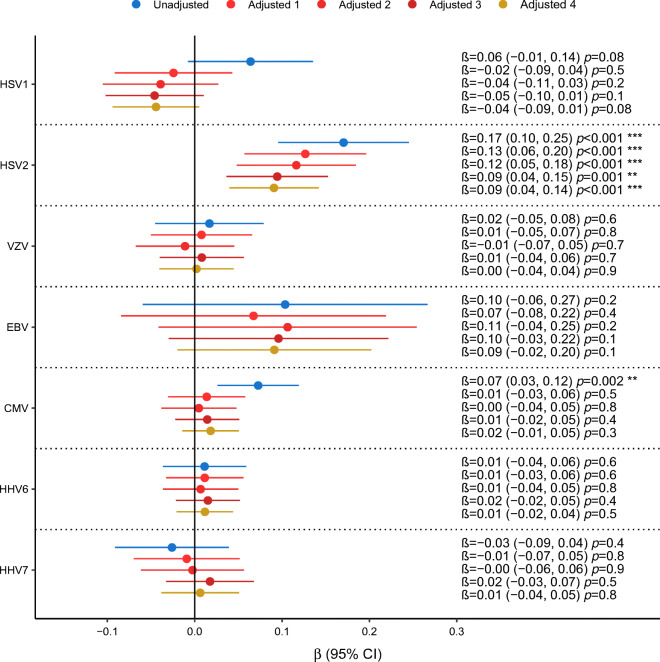
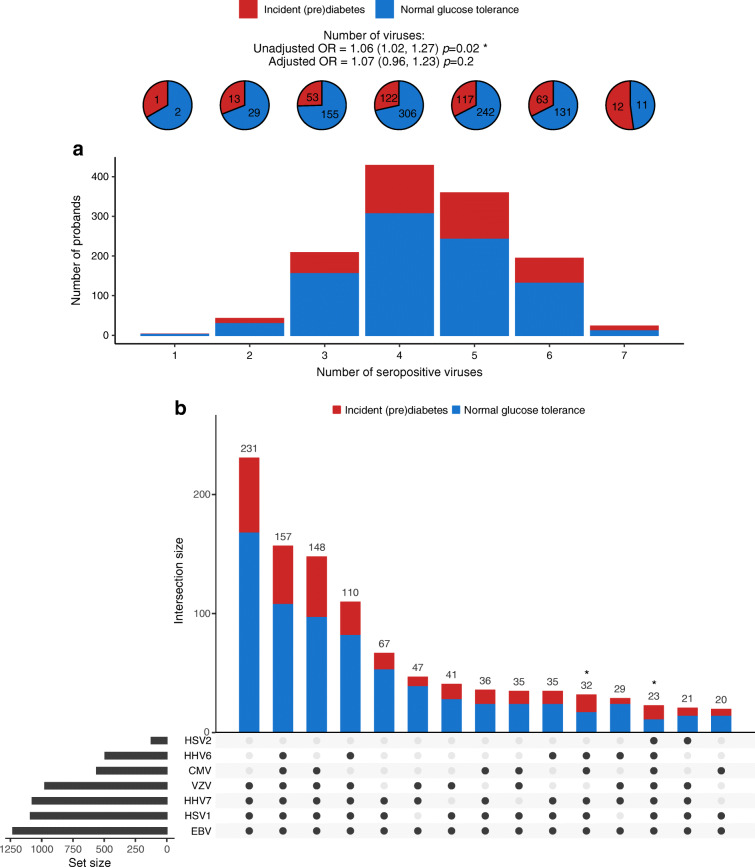
Results: HSV2 and CMV were associated with (pre)diabetes incidence after adjustment for sex, age, BMI, education, smoking, physical activity, parental diabetes, hypertension, lipid levels, insulin resistance and fasting glucose. Seropositivity of both viruses was also cross-sectionally associated with higher HbA1c at baseline, with the association of HSV2 being independent of confounders, including the prevalence of (pre)diabetes itself. While seropositivity for multiple herpesviruses was associated with a higher incidence of (pre)diabetes, this association was not independent of confounders.
Conclusions/interpretation: The associations of HSV2 and CMV serostatus with (pre)diabetes incidence indicate that these herpesviruses may contribute to the development of impaired glucose metabolism. Our results highlight the link between viral infection and (pre)diabetes, and the need for more research evaluating viral prevention strategies.
Keywords: Cytomegalovirus (CMV); Epstein–Barr virus (EBV); HbA1c; Herpes simplex virus 1 (HSV1); Herpes simplex virus 2 (HSV2); Human herpes virus 6 (HHV6); Human herpes virus 7 (HHV7); Incidence; Prediabetes; Varicella-zoster virus (VZV).
© 2022. The Author(s).
Figures
References
-
- Davison AJ, et al. Overview of classification. In: Arvin A, Campadelli-Fiume G, Mocarski E, et al., editors. Human herpesviruses: biology, therapy, and Immunoprophylaxis. Cambridge: Cambridge University Press; 2007. - PubMed
-
- Saeedi P, Petersohn I, Salpea P, et al. Global and regional diabetes prevalence estimates for 2019 and projections for 2030 and 2045: results from the international diabetes federation diabetes atlas, 9th edition. Diabetes Res Clin Pract. 2019;157:107843. doi: 10.1016/j.diabres.2019.107843. - DOI - PubMed
-
- The Global Burden of Metabolic Risk Factors for Chronic Diseases Collaboration Cardiovascular disease, chronic kidney disease, and diabetes mortality burden of cardiometabolic risk factors from 1980 to 2010: a comparative risk assessment. Lancet Diabetes Endocrinol. 2014;2(8):634–647. doi: 10.1016/S2213-8587(14)70102-0. - DOI - PMC - PubMed
-
- Kowall B, Rathmann W, Bongaerts B, et al. Incidence rates of type 2 diabetes in people with impaired fasting glucose (ADA vs. WHO criteria) and impaired glucose tolerance: results from an older population (KORA S4/F4/FF4 study) Diabetes Care. 2019;42(2):e18–e20. doi: 10.2337/dc18-1473. - DOI - PubMed
Publication types
MeSH terms
Substances
Grants and funding
LinkOut - more resources
Full Text Sources
Medical
Miscellaneous
