


Habitual adaptive emotion regulation moderates the association between maladaptive emotion regulation and eating disorder symptoms, but not clinical impairment
- PMID: 35538308
- PMCID: PMC10042081
- DOI: 10.1007/s40519-022-01399-2
Habitual adaptive emotion regulation moderates the association between maladaptive emotion regulation and eating disorder symptoms, but not clinical impairment
Abstract
Purpose: Emotion regulation (ER) refers to the processes by which individuals influence the onset, intensity, and duration of emotions. Previous studies have examined the effects of adaptive ER and maladaptive ER in isolation, but growing evidence suggests that they should be studied in conjunction. This study examined the interactions between habitual adaptive and maladaptive ER strategies with eating disorder (ED) symptoms and ED-related clinical impairment.
Methods: Students (N = 1377) from a Midwestern American university reported ED symptoms, ED-related impairment, habitual adaptive ER (i.e., cognitive reappraisal), and habitual maladaptive ER (i.e., distraction and suppression). Multiple linear regressions were conducted using the PROCESS v3 macro.
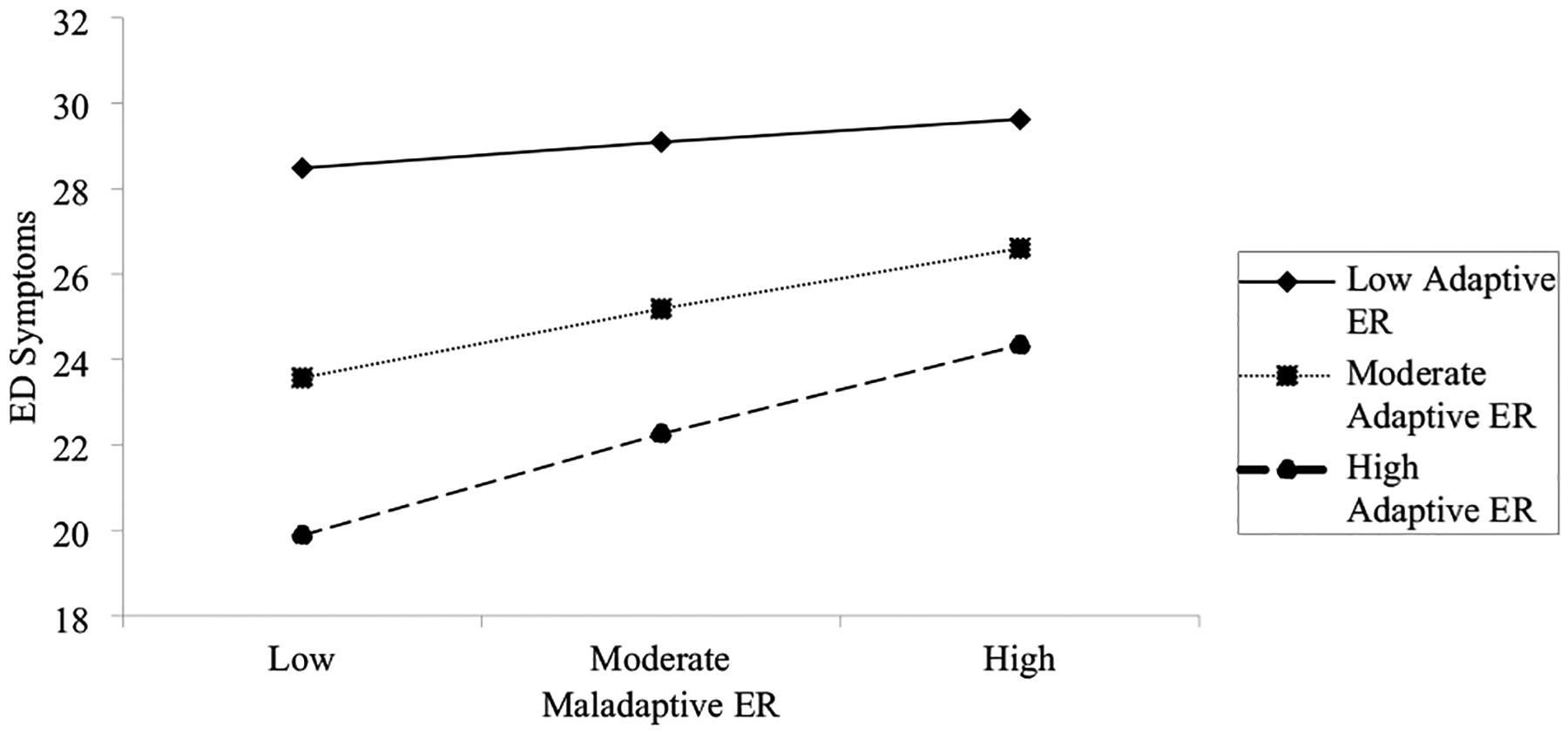
Results: The study found that adaptive ER was negatively associated with ED symptoms and ED-related impairment, whereas maladaptive ER was positively associated with both outcome variables. Adaptive ER moderated the association between maladaptive ER and ED symptoms, but not clinical impairment. When habitual adaptive ER was low (< 33.4th percentile), there was no association between maladaptive ER and ED symptoms; however, when habitual adaptive ER was moderate to high (> 33.4th percentile), there was a positive association between frequency of maladaptive ER use and ED symptoms. There was no significant three-way interaction among adaptive ER, maladaptive ER, and probable ED diagnosis, for ED-related impairment or symptoms.
Conclusion: Results suggest that irrespective of frequency of maladaptive ER, people with low adaptive ER reported elevated psychopathology. Findings point to the utility of interventions to reduce maladaptive ER and increase adaptive ER in ED populations.
Level of evidence: Level V, cross-sectional descriptive study.
Keywords: Cognitive reappraisal; Distraction; Eating disorders; Emotion regulation; Suppression.
© 2022. The Author(s), under exclusive licence to Springer Nature Switzerland AG.
Conflict of interest statement
Figures

References
-
- Gross JJ (1998) The emerging field of emotion regulation: an integrative review. Rev Gen Psychol 2(3):271–299. 10.1037/1089-2680.2.3.271 - DOI
-
- McMahon TP, Naragon-Gainey K (2018) The moderating effect of maladaptive emotion regulation strategies on reappraisal: a daily diary study. Cognit Ther Res 42(5):552–564. 10.1007/s10608-018-9913-x - DOI
MeSH terms
Grants and funding
LinkOut - more resources
Full Text Sources
Medical
Research Materials
