Review
. 2022 May 10;21(1):113.
doi: 10.1186/s12943-022-01577-x.

Liquid biopsies to occult brain metastasis

Affiliations
Review

Liquid biopsies to occult brain metastasis

Asad Ur Rehman et al. Mol Cancer. .

Abstract

Brain metastasis (BrM) is a major problem associated with cancer-related mortality, and currently, no specific biomarkers are available in clinical settings for early detection. Liquid biopsy is widely accepted as a non-invasive method for diagnosing cancer and other diseases. We have reviewed the evidence that shows how the molecular alterations are involved in BrM, majorly from breast cancer (BC), lung cancer (LC), and melanoma, with an inception in how they can be employed for biomarker development. We discussed genetic and epigenetic changes that influence cancer cells to breach the blood-brain barrier (BBB) and help to establish metastatic lesions in the uniquely distinct brain microenvironment. Keeping abreast with the recent breakthroughs in the context of various biomolecules detections and identifications, the circulating tumor cells (CTC), cell-free nucleotides, non-coding RNAs, secretory proteins, and metabolites can be pursued in human body fluids such as blood, serum, cerebrospinal fluid (CSF), and urine to obtain potential candidates for biomarker development. The liquid biopsy-based biomarkers can overlay with current imaging techniques to amplify the signal viable for improving the early detection and treatments of occult BrM.

Keywords: Brain microenvironment; CTCs; Cancer diagnostics; Cell-free DNA; Exosomes; microRNA.


Conflict of interest statement

SKB is co-founder of Sanguine Diagnostics and Therapeutics, Inc. Other authors declare no competing interests.

Figures
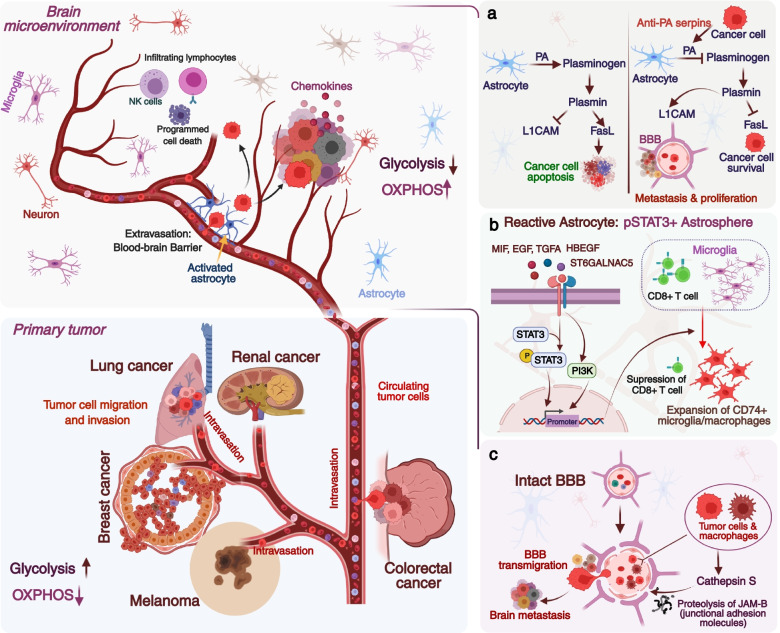
Fig. 1
Fig. 1
Brain metastases occur when cancer cells migrate from their primary site commonly lung, breast, colon, kidney, and melanoma to the brain. Circulating tumor cells (CTCs) or disseminated cancer cells are continuously shed from the tumor that survives in the bloodstream and can seed secondary tumors. The CTCs can house at metastatic sites and go dormant, which can eventually come out of the dormancy triggered by various mechanisms. (A) Brain stroma has plasmin that converts the astrocytic FasL into paracrine death signal for the metastatic cancer cells and inhibits L1CAM, needed for vascular co-option and metastatic outgrowth. In brain metastasis, anti-plasminogen activator (PA) serpins inhibit the plasmin (via inhibiting plasminogen activator) that guards the cells against FasL attack and activates the L1CAM that helps in vascular co-option of the brain metastatic cells. (B) STAT3 was found to label a subpopulation of astrocytes that were reactive and required for BrM. Brain metastatic cells had upregulated cytokines like MIF, TGF-α, and EGF that induced the STAT3 activation via phosphorylation leading to astrospheres formation that was capable of suppressing CD8+ T-cells. Reactive astrocytes also induce MIF to activate the MIF-CD74 axis to promote the outgrowth in BrM. (C) Cathepsin S proteolytically cleaves the junctional adhesion molecules, JAM-B in blood-brain barrier and helps in the transmigration of brain metastatic cells. Cathepsin S is elevated in primary tumors as well as in the macrophages of the stroma in TME
Fig. 2
Fig. 2
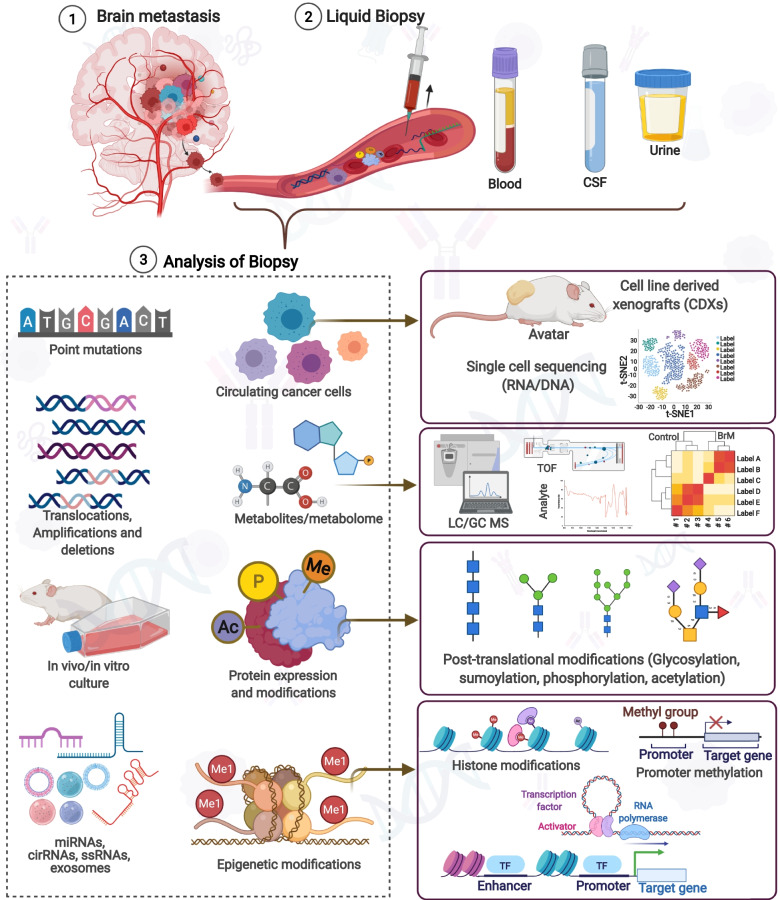
Cells and various factors are shed by the tumor into the circulation that can be harnessed for liquid biopsy. Blood, CSF, and urine are the analytes that can be targeted. Usually, CTCs can give a glimpse of various abnormalities associated with DNA, RNA, proteins. ctDNA can be targeted to infer mutations, translocation, deletion, or amplification. Exosomes are enriched with metabolites and proteins besides various non-coding RNAs which can be present in cell-free form too. High throughput technologies like NGS, single-cell sequencing, proteomics, epigenetics, and metabolomics can unfurl these target biomolecules, which can be implicative in BrM

References

    1. Dimenstein IB. Grossing biopsies: an introduction to general principles and techniques. Ann Diagn Pathol. 2009;13:106–113. doi: 10.1016/j.anndiagpath.2008.12.010. - DOI - PubMed
    1. Wang CC, Huang KT, Chang HC, Tseng CC, Lai CH, Lan J, et al. Comprehensive analysis of PD-L1 in non-small cell lung cancer with emphasis on survival benefit, impact of driver mutation and histological types, and archival tissue. Thorac Cancer. 2021. - PMC - PubMed
    1. Zarogoulidis P, Gaga M, Huang H, Darwiche K, Rapti A, Hohenforst-Schmidt W. Tissue is the issue and tissue competition. Re-biopsy for mutation T790: where and why? Clin Transl Med. 2017;6(6). - PMC - PubMed
    1. Hofman P. The challenges of evaluating predictive biomarkers using small biopsy tissue samples and liquid biopsies from non-small cell lung cancer patients. J Thorac Dis. 2019;11:S57–S64. doi: 10.21037/jtd.2018.11.85. - DOI - PMC - PubMed
    1. Rodriguez J, Avila J, Rolfo C, Ruiz-Patino A, Russo A, Ricaurte L, Ordonez-Reyes C, Arrieta O, Zatarain-Barron ZL, Recondo G, Cardona AF. When tissue is an issue the liquid biopsy is nonissue: a review. Oncol Ther. 2021;9:89–110. doi: 10.1007/s40487-021-00144-6. - DOI - PMC - PubMed

Publication types

Substances