


Timing of primary three-dose hepatitis B vaccination and postvaccination serologic testing among a large cohort of healthy adults
- PMID: 35538595
- PMCID: PMC9543124
- DOI: 10.1002/jmv.27848
Timing of primary three-dose hepatitis B vaccination and postvaccination serologic testing among a large cohort of healthy adults
Abstract
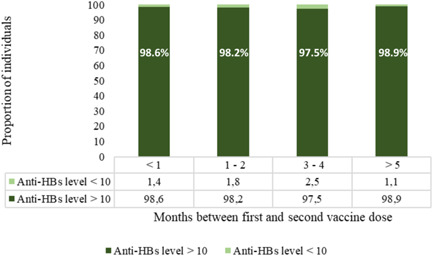
This study evaluated the optimal timing of a primary three-dose hepatitis B vaccination and postvaccination serologic testing (PVST) among a large group of healthy naïve adults in the Netherlands. Data were collected from the Ease Travel Clinic hepatitis B vaccination database. The study population consisted of 22,997 adults who received three hepatitis B vaccinations. Seroprotection was attained in 97.3% individuals. When compared with PVST performed at 1-2 months (98.2%) after the final dose, lower seroprotection rates were observed with <1 (97.3%, p = 0.128), 3-6 (90.6%, p < 0.001), and ≥7 (88.4%, p < 0.001) months after vaccination. Among the subpopulation with a PVST 1-2 months, no statistically significant difference was observed for the various intervals between the first and second vaccination (<1, 1-2, 3-4, or ≥5 months). When compared with 4-5 months between the second and third vaccine dose, lower seroprotection rates were observed with <4 (odds ratio [OR]: 0.29, p = 0.020) and ≥12 (OR: 0.22, p < 0.001) months, although comparable rates were observed with 6-11 months interval (OR: 0.85, p = 0.262). Our data indicate that PVST should be obtained 1-2 months after the last vaccination and a delayed PVST was the major determinant of a lower seroprotection rate after primary three-dose hepatitis B vaccination schedule. Based on our data, the hepatitis B vaccination also leaves room for flexibility for the second dose and the third dose without the necessity of restarting the vaccination series or confirmation of the immune response to the vaccine.
Keywords: antibody response; hepatitis B; immunization; vaccination; vaccine.
© 2022 The Authors. Journal of Medical Virology published by Wiley Periodicals LLC.
Conflict of interest statement
Özgür M. Koc received travel grants from Gilead Sciences and his institution received grants from Gilead Sciences, AbbVie, MSD, and CyTuVax B.V. Eva van Oorschot, Lloyd Brandts, and Astrid Oude Lashof have no conflicts of interest to report.
Figures



References
-
- World Health Organization . Hepatitis B. 2020. Accessed August 20, 2020. https://www.who.int/news-room/fact-sheets/detail/hepatitis-b#:%7E:text=H...
-
- Polaris Observatory Collaboarators . Global prevalence, treatment, and prevention of hepatitis B virus infection in 2016: a modelling study. Lancet Gastroenterol Hepatol. 2018;3(6):383‐403. - PubMed
-
- Koc ÖM, Menart C, Theodore J, et al. Ethnicity and response to primary three‐dose hepatitis B vaccination in employees in the Netherlands, 1983 through 2017. J Med Virol. 2020;92(3):309‐316. - PubMed
MeSH terms
Substances
LinkOut - more resources
Full Text Sources
Medical
