Review
. 2022 Aug 5;66(2):229-242.
doi: 10.1042/EBC20210059.

Plant peroxisome proteostasis-establishing, renovating, and dismantling the peroxisomal proteome

Affiliations
Review

Plant peroxisome proteostasis-establishing, renovating, and dismantling the peroxisomal proteome

DurreShahwar Muhammad et al. Essays Biochem. .

Abstract

Plant peroxisomes host critical metabolic reactions and insulate the rest of the cell from reactive byproducts. The specialization of peroxisomal reactions is rooted in how the organelle modulates its proteome to be suitable for the tissue, environment, and developmental stage of the organism. The story of plant peroxisomal proteostasis begins with transcriptional regulation of peroxisomal protein genes and the synthesis, trafficking, import, and folding of peroxisomal proteins. The saga continues with assembly and disaggregation by chaperones and degradation via proteases or the proteasome. The story concludes with organelle recycling via autophagy. Some of these processes as well as the proteins that facilitate them are peroxisome-specific, while others are shared among organelles. Our understanding of translational regulation of plant peroxisomal protein transcripts and proteins necessary for pexophagy remain based in findings from other models. Recent strides to elucidate transcriptional control, membrane dynamics, protein trafficking, and conditions that induce peroxisome turnover have expanded our knowledge of plant peroxisomal proteostasis. Here we review our current understanding of the processes and proteins necessary for plant peroxisome proteostasis-the emergence, maintenance, and clearance of the peroxisomal proteome.

Keywords: Arabidopsis thaliana; peroxin; peroxisomes; plant biology; proteolysis.


Conflict of interest statement

The authors declare that there are no competing interests associated with the manuscript.

Figures
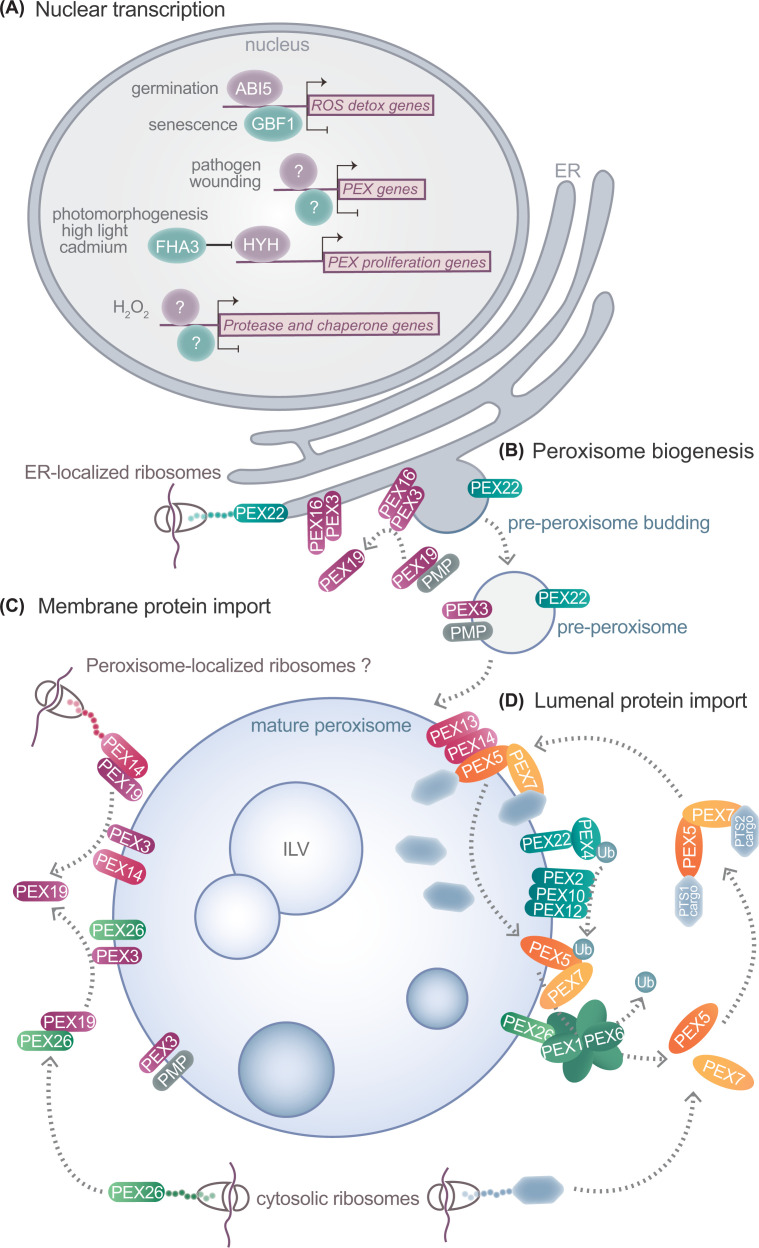
Figure 1
Figure 1. Establishing the peroxisomal proteome
(A) Nuclear encoded peroxisomal protein genes are governed by various transcriptional activators (mauve) and repressors (teal) and are modulated during development and by abiotic and biotic challenges that elicit individual-protein and whole-organelle changes. (B) As part of the endomembrane system, peroxisomes arise from the ER as pre-peroxisomes lacking lumenal proteins. (C) mRNA of some peroxisomal membrane proteins (PMPs) are likely translated by ER-localized ribosomes and the protein is trafficked through the ER to bud with pre-peroxisomes. Other PMPs are translated by cytosolic and potentially peroxisome-localized ribosomes. PEX19 acts as a chaperone, binding to the mPTS (membrane peroxisome targeting signal) of PMPs and transferring mPTS-cargo to PEX3 for membrane insertion. (D) Mature peroxisomes contain PMPs, intralumenal vesicles (ILVs) derived from the outer membrane, and lumenal proteins. PTS1 and PTS2 (peroxisome targeting signal 1 and 2) cargo (enzymes, chaperones, proteases) are imported into the lumen via receptors (PEX5 and PEX7) and the membrane docking complex (PEX13 and PEX14). After delivery of lumenal cargo, PEX5 is monoubiquitinated by peroxisome-associated ubiquitination machinery (the PEX4-PEX22 ubiquitin conjugating enzyme complex and the PEX2-PEX10-PEX12 ubiquitin ligase enzyme complex) and retrotranslocated for reuse by an ATPase complex (PEX1, PEX6, and PEX26).
Figure 2
Figure 2. Renovating the peroxisomal proteome
(A) Intralumenal proteostasis involves proteases and chaperones. Proteases cleave the PTS2 (peroxisome targeting signal 2) peptide and degrade damaged and obsolete proteins; chaperones assist protein folding, complex assembly, and aggregate dissociation. Peroxisomal proteins with cytosolic domains (e.g., PEX5) can be polyubiquitinated by a ubiquitin (Ub)-conjugating enzyme (PEX4) and the Ub-protein ligase complex (PEX2, PEX10, and PEX12) at the peroxisome membrane. (B) Polyubiquitinated proteins are degraded by the cytosolic 26S proteosome.
Figure 3
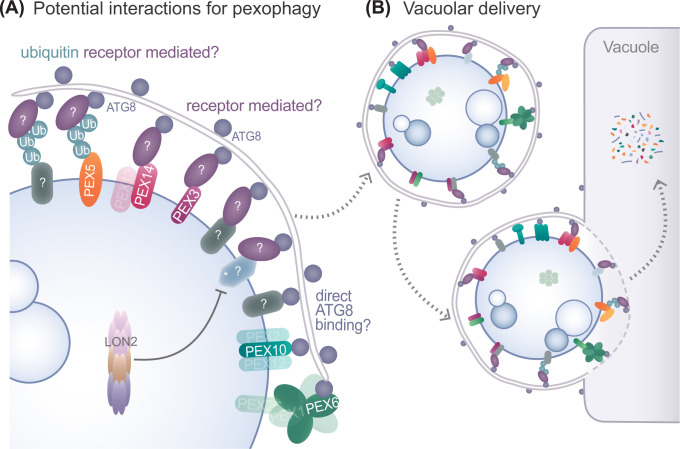
Figure 3. Dismantling the peroxisomal proteome
(A) Peroxisomes are targeted for pexophagy by recruitment of autophagy machinery, including a double-bilayer isolation membrane marked by ATG8 (violet circles). Recruitment could occur through direct interaction of peroxisomal proteins with ATG8 or via an intermediary receptor (purple ovals) that recognizes peroxisomal proteins or their ubiquitinated (Ub) derivates. Illustrated targeting mechanisms are based on receptor-mediated partners observed in non-plant systems or demonstrated ATG8 interactions in plants; none of the interactions depicted have been shown as necessary or sufficient to induce pexophagy in plants. (B) Following recruitment of the isolation membrane, cargo is fully engulfed to form an autophagosome. Contents are delivered through fusion of the outer autophagosomal membrane with the vacuolar membrane. In the vacuole, resident proteases and lipases degrade the peroxisomal proteins and lipids to allow nutrient recycling.

References

    1. Hoepfner D., Schildknegt D., Braakman I., Philippsen P. and Tabak H.F. (2005) Contribution of the endoplasmic reticulum to peroxisome formation. Cell 122, 85–95 10.1016/j.cell.2005.04.025 - DOI - PubMed
    1. Lee M.S., Mullen R.T. and Trelease R.N. (1997) Oilseed isocitrate lyases lacking their essential type 1 peroxisomal targeting signal are piggybacked to glyoxysomes. Plant Cell 9, 185–197 10.1105/tpc.9.2.185 - DOI - PMC - PubMed
    1. McNew J.A. and Goodman J.M. (1994) An oligomeric protein is imported into peroxisomes in vivo. J. Cell Biol. 127, 1245–1257 10.1083/jcb.127.5.1245 - DOI - PMC - PubMed
    1. Schrader M., Bonekamp N.A. and Islinger M. (2012) Fission and proliferation of peroxisomes. Metab. Funct. Biog. Peroxisomes Health Dis. 1822, 1343–1357 10.1016/j.bbadis.2011.12.014 - DOI - PubMed
    1. Wright Z.J. and Bartel B. (2020) Peroxisomes form intralumenal vesicles with roles in fatty acid catabolism and protein compartmentalization in Arabidopsis. Nat. Commun. 11, 6221 10.1038/s41467-020-20099-y - DOI - PMC - PubMed

Publication types