


Fabrication of a magnetite/diazonium functionalized-reduced graphene oxide hybrid as an easily regenerated adsorbent for efficient removal of chlorophenols from aqueous solution
- PMID: 35539153
- PMCID: PMC9078394
- DOI: 10.1039/c8ra00503f
Fabrication of a magnetite/diazonium functionalized-reduced graphene oxide hybrid as an easily regenerated adsorbent for efficient removal of chlorophenols from aqueous solution
Abstract
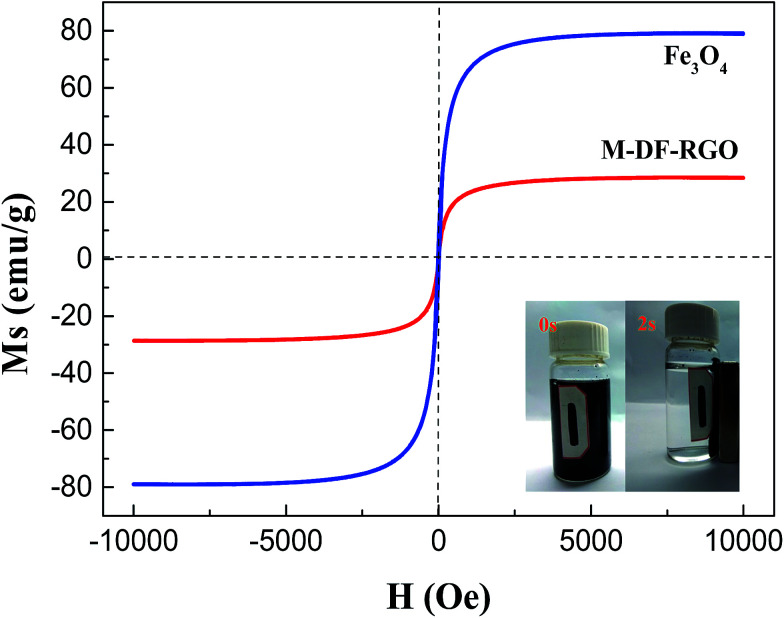
A magnetic hybrid nanomaterial, which contains magnetite (Fe3O4) particles and diazonium functionalized-reduced graphene oxide (DF-RGO), was fabricated via a three-pot reaction. First, the reduced graphene oxide (RGO) was synthesized via a redox reaction. Second, diazonium functionalized-RGO was prepared via a feasible chemical reaction. Third, Fe3O4 particles were loaded onto the surface of DF-RGO by covalent bonding, fabricating the M-DF-RGO hybrid. The fabricated hybrid was characterized by SEM, TEM, AFM, XRD, XPS, FT-IR, TGA, Raman spectroscopy, and magnetometry. The resulting M-DF-RGO hybrid possessed unique magnetic properties and was applied to remove 4-chlorophenol (4-CP) and 2,4-dichlorophenol (2,4-DCP) from aqueous solution. The adsorption of 4-CP and 2,4-DCP on the M-DF-RGO hybrid was performed under various conditions, with respect to initial chlorophenol concentration, pH, and contact time. The results suggest that the adsorption of 4-CP and 2,4-DCP onto the M-DF-RGO hybrid is strongly dependent on pH and weakly dependent on contact time. In addition, the adsorption isotherm of 4-CP and 2,4-DCP on the M-DF-RGO hybrid fits the Freundlich model well and the adsorption capacities of 4-CP and 2,4-DCP on M-DF-RGO reached 55.09 and 127.33 mg g-1, respectively, at pH 6 and 25 °C. In this situation, intermolecular interactions including π-π interactions and hydrogen bonding are operative. The calculated results of density functional theory further demonstrate that 2,4-DCP molecules could be more easily absorbed than 4-CP molecules by the M-DF-RGO hybrid. Moreover, the M-DF-RGO hybrid could be easily separated by a magnetic separation process, and showed good recyclability of more than five cycles.
This journal is © The Royal Society of Chemistry.
Conflict of interest statement
There are no conflicts of interest to declare.
Figures




References
-
- Matias T. Marques J. Quina M. J. Gando-Ferreira L. Valente A. J. M. Portugal A. Durães L. Colloids Surf., A. 2015;480:260–269. doi: 10.1016/j.colsurfa.2015.01.074. - DOI
-
- Yang Q. Gao M. Zang W. Colloids Surf., A. 2017;520:805–816. doi: 10.1016/j.colsurfa.2017.02.057. - DOI
-
- Ahmaruzzaman M. Gayatri S. L. J. Chem. Eng. Data. 2011;56:3004–3016. doi: 10.1021/je100937r. - DOI
-
- Dehghani M. H. Mostofi M. Alimohammadi M. McKay G. Yetilmezsoy K. Albadarin A. B. Heibati B. AlGhouti M. Mubarak N. M. Sahu J. N. J. Ind. Eng. Chem. 2016;35:63–74. doi: 10.1016/j.jiec.2015.12.010. - DOI
-
- Strachowski P. Bystrzejewski M. Colloids Surf., A. 2015;467:113–123. doi: 10.1016/j.colsurfa.2014.11.044. - DOI
LinkOut - more resources
Full Text Sources
Research Materials
Miscellaneous
