


Pilot study of the effect of EPA + DHA supplementation on the fatty acid profile of erythrocytes and breast milk of lactating women from Sonsón, Colombia
- PMID: 35540308
- PMCID: PMC9079638
- DOI: 10.1016/j.crfs.2022.04.008
Pilot study of the effect of EPA + DHA supplementation on the fatty acid profile of erythrocytes and breast milk of lactating women from Sonsón, Colombia
Abstract
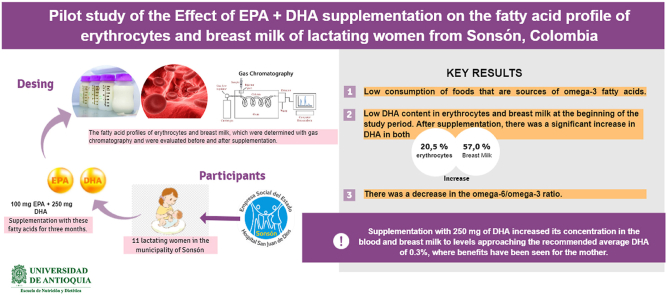
Objective: The objective of this study was to evaluate changes in the concentrations of EPA and DHA in the erythrocytes and breast milk of a group of lactating women in the municipality of Sonsón (Antioquia) before and after receiving supplementation with these fatty acids for three months.
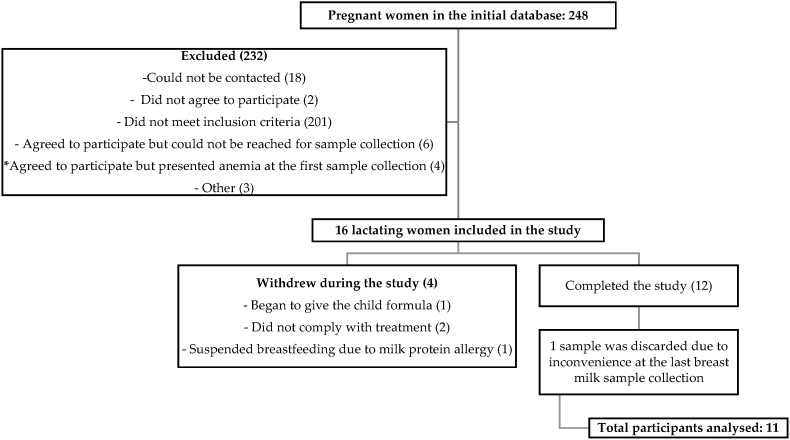
Design: In a quasi-experimental study, 11 lactating women were evaluated before and after EPA (100 mg) and DHA (250 mg) supplementation for three months. The consumption of omega-3 food sources was determined by simple frequency, anthropometry (weight, height) was performed, and the fatty acid profiles of erythrocytes and breast milk were determined with gas chromatography.
Environment: Sonsón, Colombia.
Participants: A group of lactating women in the municipality of Sonsón (Antioquia).
Results: Low consumption of foods that are sources of omega-3 fatty acids was found, as was low EPA and DHA content in erythrocytes and breast milk at the beginning of the study period. After supplementation, there was no significant change for EPA, however, there was a significant increase in DHA in both erythrocytes and breast milk; in addition, there was a decrease in the omega-6/omega-3 ratio.
Conclusions: Supplementation with 250 mg of DHA increased its concentration in the blood and breast milk to levels approaching the recommended average DHA of 0.3%, where benefits have been seen for the mother.
Keywords: Breast milk; Breastfeeding; Docosahexaenoic acid (DHA); Eicosapentaenoic acid (EPA); Erythrocytes; Fatty acids; Lactating woman; Omega-3.
© 2022 The Authors.
Conflict of interest statement
The authors declare the following financial interests/personal relationships which may be considered as potential competing interests: This research was funded by Laboratorios Laproff SA, which donated fresh and in-kind resources (supplement) equivalent to 33% of the total value of the research. The other 67% of fresh and in-kind resources for the research were granted by the University of Antioquia. “The sponsors had no role in the design, execution, interpretation or writing of the study”.
Figures
References
-
- Ailhaud G., Massiera F., Alessandri J.-M., Guesnet P. Fatty acid composition as an early determinant of childhood obesity. Genes Nutr. 2007;2:39–40. http://link.springer.com/10.1007/s12263-007-0017-6 - DOI - PMC - PubMed
-
- Amaral Y., Marano D., Silva L., Guimarães A., Moreira M. Are there changes in the fatty acid profile of breast milk with supplementation of omega-3 sources? A systematic review. Rev. Bras. Ginecol. Obstet./RBGO Gynecol Obstet. 2017;39:128–141. doi://dx.doi.org/ - PMC - PubMed
-
- Antonakou A., Skenderi K.P., Chiou A., Anastasiou C.A., Bakoula C., Matalas A.-L. Breast milk fat concentration and fatty acid pattern during the first six months in exclusively breastfeeding Greek women. Eur. J. Nutr. 2013;52:963–973. http://link.springer.com/10.1007/s00394-012-0403-8 - DOI - PubMed
-
- Büyükuslu N., Ovalı S., Altuntaş Ş.L., Batırel S., Yiğit P., Garipağaoğlu M. Supplementation of docosahexaenoic acid (DHA)/Eicosapentaenoic acid (EPA) in a ratio of 1/1.3 during the last trimester of pregnancy results in EPA accumulation in cord blood. Prostaglandins Leukot. Essent. Fatty Acids. 2017;125:32–36. doi: 10.1016/j.plefa.2017.08.005. - DOI - PubMed
LinkOut - more resources
Full Text Sources
Research Materials
