


Socio-economic disparities in child-to-adolescent growth trajectories in China: Findings from the China Health and Nutrition Survey 1991-2015
- PMID: 35540561
- PMCID: PMC9079352
- DOI: 10.1016/j.lanwpc.2022.100399
Socio-economic disparities in child-to-adolescent growth trajectories in China: Findings from the China Health and Nutrition Survey 1991-2015
Abstract
Backgrounds: Socio-economic disparities in growth trajectories of children from low-/middle-income countries are poorly understood, especially those experiencing rapid economic growth. We investigated socio-economic disparities in child growth in recent decades in China.
Methods: Using longitudinal data on 5095 children/adolescents (7-18 years) from the China Health and Nutrition Survey (1991-2015), we estimated mean height and BMI trajectories by socio-economic position (SEP) and sex for cohorts born in 1981-85, 1986-90, 1991-95, 1996-2000, using random-effects models. We estimated differences between high (urbanization index ≥median, household income per capita ≥median, parental education ≥high school, or occupational classes I-IV) and low SEP groups.
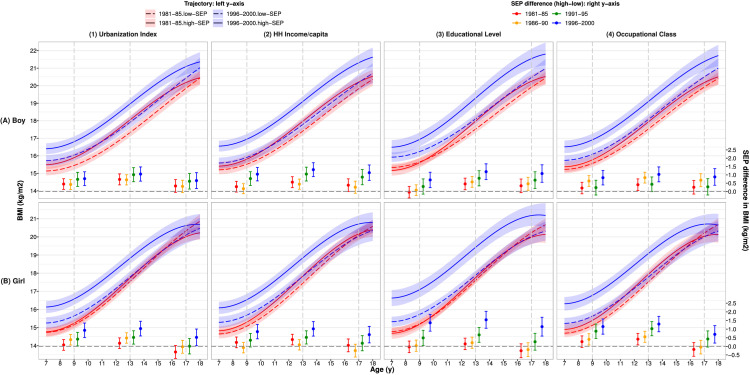
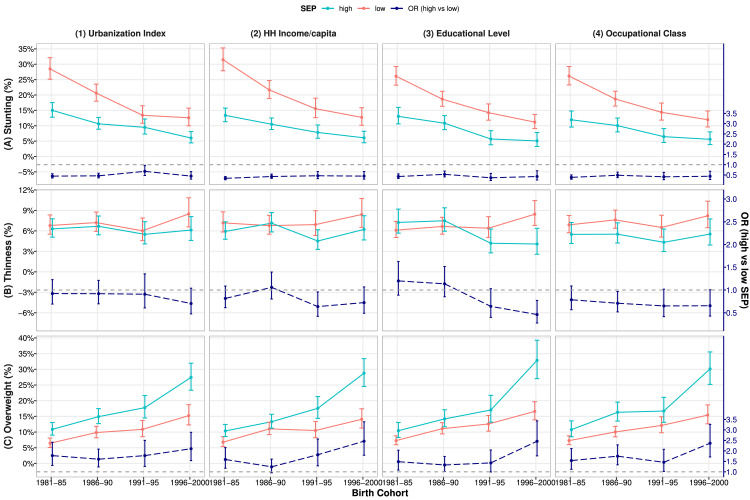
Findings: Mean height and BMI trajectories have shifted upwards across cohorts. In all cohorts, growth trajectories for high SEP groups were above those for low SEP groups across SEP indicators. For height, socio-economic differences persisted across cohorts (e.g. 3.8cm and 2.9cm in earliest and latest cohorts by urbanization index for boys at 10 year, and 3.6cm and 3.1cm respectively by household income). For BMI, trends were greater in high than low SEP groups, thus socio-economic differences increased across cohorts (e.g. 0.5 to 0.8kg/m2 by urbanization index, 0.4 to 1.1kg/m2 by household income for boys at 10 year). Similar trends were found for stunting and overweight/obesity by SEP. There was no association between SEP indicators and thinness.
Interpretation: Socio-economic disparities in physical growth persist among Chinese youth. Short stature was associated with lower SEP, but high BMI with higher SEP. Public health interventions should be tailored by SEP, in order to improve children's growth while reducing overweight/obesity.
Funding: MG is supported by UCL Overseas Research Scholarship and China Scholarship Council for her PhD study. WJ is supported by a UK Medical Research Council (MRC) New Investigator Research Grant (MR/P023347/1) and acknowledges support from the National Institute for Health Research (NIHR) Leicester Biomedical Research Centre, which is a partnership between University Hospitals of Leicester NHS Trust, Loughborough University, and the University of Leicester.
Keywords: BAZ, BMI-for-age z-scores; BMI trajectories; BMI, Body mass index; CHNS, China Health and Nutrition Survey; Changes over time; Chinese children and adolescents; HAZ, height-for-age z-scores; HICs, high-income countries; Height trajectories; LMICs, low-/middle-income countries; SEP, socio-economic position; Socio-economic disparities.
© 2022 The Authors.
Conflict of interest statement
We declare no competing interests.
Figures


References
-
- NCD Risk Factor Collaboration, (NCD-RisC) Height and body-mass index trajectories of school-aged children and adolescents from 1985 to 2019 in 200 countries and territories: a pooled analysis of 2181 population-based studies with 65 million participants. Lancet. 2020;396(10261):1511–1524. - PMC - PubMed
-
- Paajanen T.A., Oksala N.K.J., Kuukasjärvi P., Karhunen P.J. Short stature is associated with coronary heart disease: a systematic review of the literature and a meta-analysis. Eur Heart J. 2010;31(14):1802–1809. - PubMed
-
- Park M.H., Falconer C., Viner R.M., Kinra S. The impact of childhood obesity on morbidity and mortality in adulthood: a systematic review. Obes Rev. 2012;13(11):985–1000. - PubMed
-
- Hume-Nixon M., Kuper H. The association between malnutrition and childhood disability in low- and middle- income countries: systematic review and meta-analysis of observational studies. Trop Med Int Health. 2018;23(11):1158–1175. - PubMed
Grants and funding
LinkOut - more resources
Full Text Sources
