


Effect of Abduction Brace Wearing Compliance on the Results of Arthroscopic Rotator Cuff Repair
- PMID: 35540728
- PMCID: PMC9071251
- DOI: 10.2106/JBJS.OA.21.00148
Effect of Abduction Brace Wearing Compliance on the Results of Arthroscopic Rotator Cuff Repair
Abstract
The benefit of protective bracing after rotator cuff reconstruction has been debated for many years, although immobilization compliance has never been assessed objectively to date. In a previous study, compliance with the wearing of an abduction brace was measured for the first time with use of temperature-sensitive sensors. The purpose of the present follow-up study was to assess the effect of immobilization compliance on tendon-healing after rotator cuff repair.
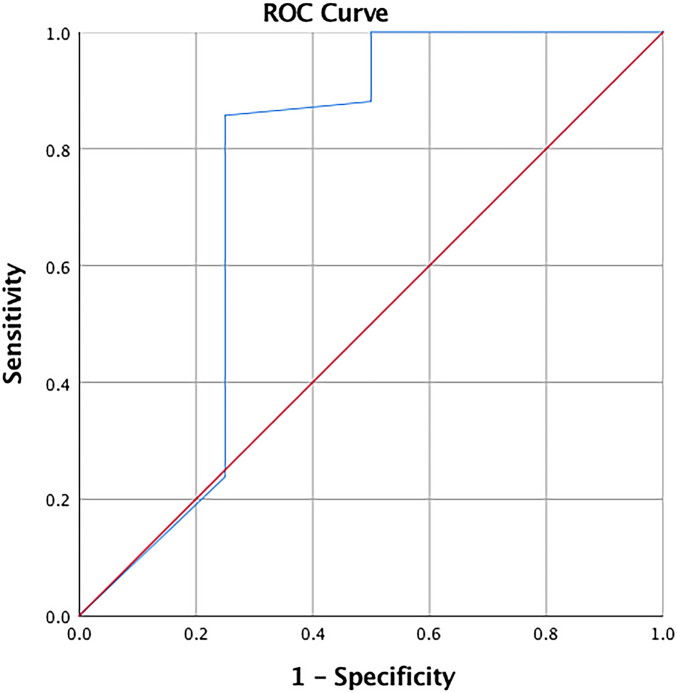
Methods: The clinical and radiographic outcomes for 46 consecutive patients with objectively assessed abduction brace wearing compliance after arthroscopic repair of a superior rotator cuff tear were prospectively analyzed. Rotator cuff integrity was examined with ultrasound. Clinical outcomes were assessed with the relative Constant-Murley score (RCS), the Subjective Shoulder Value (SSV), and pain and patient satisfaction ratings. Receiver operating characteristic (ROC) curves were used to determine the optimal cutoff value of abduction brace compliance for discriminating between shoulders that will and will not have a retear and the association of compliance with the failure of rotator cuff repair.
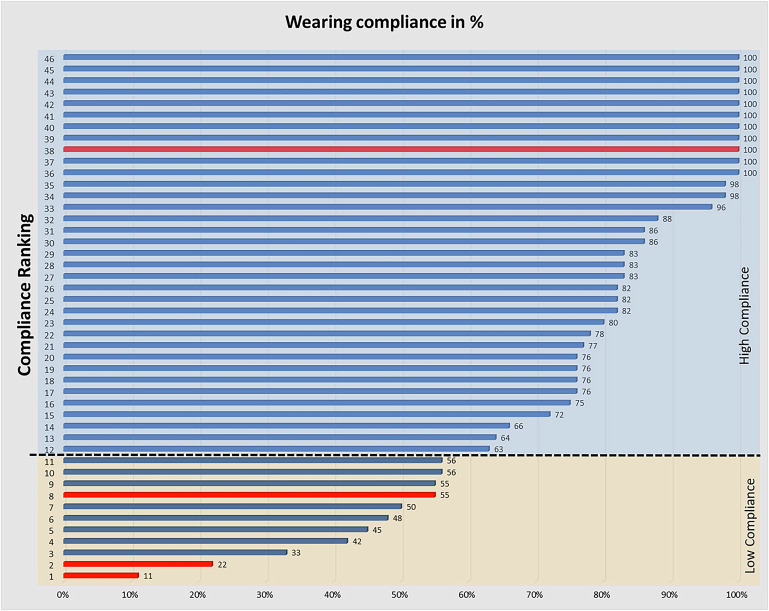
Results: After a mean duration of follow-up of 20 ± 9 months, the odds ratio for having a rotator cuff repair failure was 13-fold higher for patients with a compliance rate of <60% (p = 0.037). The retear rate was 3% (1 of 35 patients) in the high-compliance cohort (≥60% compliance) and 27% (3 of 11) in the low-compliance cohort (<60% compliance) (p = 0.037). No differences in RCS, SSV, pain, or postoperative patient satisfaction were observed between patients with ≥60% compliance and those with <60% compliance.
Conclusions: Patients with a compliance rate of <60% had a 13-fold increase in the risk of rotator cuff retear. The 2 patients with the lowest compliance rates (11% and 22%) both had retears. Due to the small sample size, no final conclusions can be drawn regarding the influence of immobilization compliance on tendon-healing after rotator cuff repair. These findings justify a prospective trial with a larger cohort to confirm or disprove the value of compliance with abduction bracing.
Level of evidence: Therapeutic Level II. See Instructions for Authors for a complete description of levels of evidence.
Copyright © 2022 The Authors. Published by The Journal of Bone and Joint Surgery, Incorporated. All rights reserved.
Conflict of interest statement
Disclosure: The Disclosure of Potential Conflicts of Interest forms are provided with the online version of the article (http://links.lww.com/JBJSOA/A388).
Figures
References
-
- Felsch Q, Mai V, Durchholz H, Flury M, Lenz M, Capellen C, Audigé L. Complications Within 6 Months After Arthroscopic Rotator Cuff Repair: Registry-Based Evaluation According to a Core Event Set and Severity Grading. Arthroscopy. 2021. Jan;37(1):50-8. - PubMed
-
- Nho SJ, Brown BS, Lyman S, Adler RS, Altchek DW, MacGillivray JD. Prospective analysis of arthroscopic rotator cuff repair: prognostic factors affecting clinical and ultrasound outcome. J Shoulder Elbow Surg. 2009. Jan-Feb;18(1):13-20. - PubMed
-
- Boileau P, Brassart N, Watkinson DJ, Carles M, Hatzidakis AM, Krishnan SG. Arthroscopic repair of full-thickness tears of the supraspinatus: does the tendon really heal? J Bone Joint Surg Am. 2005. Jun;87(6):1229-40. - PubMed
-
- Liem D, Bartl C, Lichtenberg S, Magosch P, Habermeyer P. Clinical outcome and tendon integrity of arthroscopic versus mini-open supraspinatus tendon repair: a magnetic resonance imaging-controlled matched-pair analysis. Arthroscopy. 2007. May;23(5):514-21. - PubMed
LinkOut - more resources
Full Text Sources
Research Materials