


Assessment of inhalation toxicity of cigarette smoke and aerosols from flavor mixtures: 5-week study in A/J mice
- PMID: 35543240
- PMCID: PMC9545811
- DOI: 10.1002/jat.4338
Assessment of inhalation toxicity of cigarette smoke and aerosols from flavor mixtures: 5-week study in A/J mice
Abstract
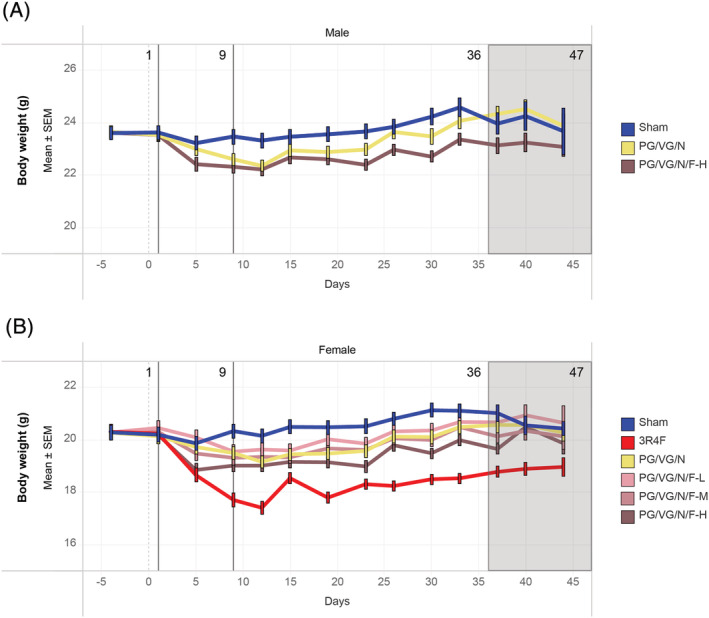
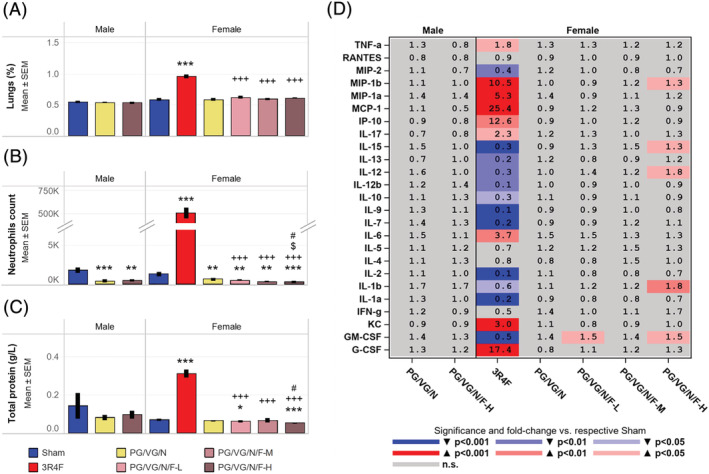
Most flavors used in e-liquids are generally recognized as safe for oral consumption, but their potential effects when inhaled are not well characterized. In vivo inhalation studies of flavor ingredients in e-liquids are scarce. A structure-based grouping approach was used to select 38 flavor group representatives (FGR) on the basis of known and in silico-predicted toxicological data. These FGRs were combined to create prototype e-liquid formulations and tested against cigarette smoke (CS) in a 5-week inhalation study. Female A/J mice were whole-body exposed for 6 h/day, 5 days/week, for 5 weeks to air, mainstream CS, or aerosols from (1) test formulations containing propylene glycol (PG), vegetable glycerol (VG), nicotine (N; 2% w/w), and flavor (F) mixtures at low (4.6% w/w), medium (9.3% w/w), or high (18.6% w/w) concentration or (2) base formulation (PG/VG/N). Male A/J mice were exposed to air, PG/VG/N, or PG/VG/N/F-high under the same exposure regimen. There were no significant mortality or in-life clinical findings in the treatment groups, with only transient weight loss during the early exposure adaptation period. While exposure to flavor aerosols did not cause notable lung inflammation, it caused only minimal adaptive changes in the larynx and nasal epithelia. In contrast, exposure to CS resulted in lung inflammation and moderate-to-severe changes in the epithelia of the nose, larynx, and trachea. In summary, the study evaluates an approach for assessing the inhalation toxicity potential of flavor mixtures, thereby informing the selection of flavor exposure concentrations (up to 18.6%) for a future chronic inhalation study.
Keywords: E-cigarette; emphysema; flavor toolbox; harm reduction; inflammation; inhalation.
© 2022 The Authors. Journal of Applied Toxicology published by John Wiley & Sons Ltd.
Conflict of interest statement
The flavor groups representatives (FGR) used in this study were developed on the basis of individual flavor chemicals used at PMI and ALCS. All authors are (or were) employees of PMI or ALCS or worked with PMI under contractual agreement.
Figures
References
-
- Action on Smoking and Health . (2021). Use of e‐cigarettes (vapes) among adults in Great Britain. Retrieved from https://ash.org.uk/wp-content/uploads/2021/06/Use-of-e-cigarettes-vapes-...
-
- Asgharian, B. , Price, O. T. , Oldham, M. , Chen, L. C. , Saunders, E. L. , Gordon, T. , Mikheev, V. B. , Minard, K. R. , & Teeguarden, J. G. (2014). Computational modeling of nanoscale and microscale particle deposition, retention and dosimetry in the mouse respiratory tract. Inhalation Toxicology, 26(14), 829–842. 10.3109/08958378.2014.935535 - DOI - PMC - PubMed
Publication types
MeSH terms
Substances
Grants and funding
LinkOut - more resources
Full Text Sources
Miscellaneous
