Analysis of Stimulant Prescriptions and Drug-Related Poisoning Risk Among Persons Receiving Buprenorphine Treatment for Opioid Use Disorder
- PMID: 35544135
- PMCID: PMC9096599
- DOI: 10.1001/jamanetworkopen.2022.11634
Analysis of Stimulant Prescriptions and Drug-Related Poisoning Risk Among Persons Receiving Buprenorphine Treatment for Opioid Use Disorder
Abstract
Importance: Stimulant medication use is common among individuals receiving buprenorphine for opioid use disorder (OUD). Associations between prescription stimulant use and treatment outcomes in this population have been understudied.
Objectives: To investigate whether use of prescription stimulants was associated with (1) drug-related poisoning and (2) buprenorphine treatment retention.
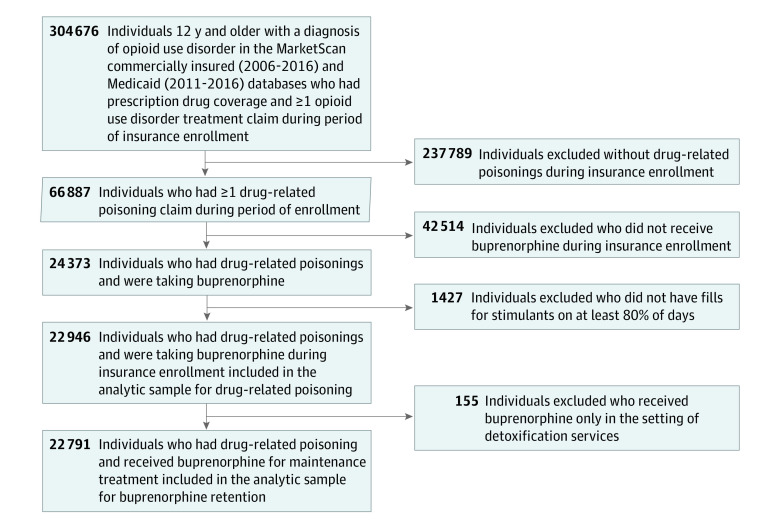
Design, setting, and participants: This retrospective, recurrent-event cohort study with a case-crossover design used a secondary analysis of administrative claims data from IBM MarketScan Commercial and Multi-State Medicaid databases from January 1, 2006, to December 31, 2016. Primary analyses were conducted from March 1 through August 31, 2021. Individuals aged 12 to 64 years with an OUD diagnosis and prescribed buprenorphine who experienced at least 1 drug-related poisoning were included in the analysis. Unit of observation was the person-day.
Exposures: Days of active stimulant prescriptions.
Main outcomes and measures: Primary outcomes were drug-related poisoning and buprenorphine treatment retention. Drug-related poisonings were defined using International Classification of Diseases, Ninth Revision, and International Statistical Classification of Diseases and Related Health Problems, Tenth Revision, codes; treatment retention was defined by continuous treatment claims until a 45-day gap was observed.
Results: There were 13 778 567 person-days of observation time among 22 946 individuals (mean [SD] age, 32.8 [11.8] years; 50.3% men) who experienced a drug-related poisoning. Stimulant treatment days were associated with 19% increased odds of drug-related poisoning (odds ratio [OR], 1.19 [95% CI, 1.06-1.34]) compared with nontreatment days; buprenorphine treatment days were associated with 38% decreased odds of poisoning (OR, 0.62 [95% CI, 0.59-0.65]). There were no significant interaction effects between use of stimulants and buprenorphine. Stimulant treatment days were associated with decreased odds of attrition from buprenorphine treatment (OR, 0.64 [95% CI, 0.59-0.70]), indicating that stimulants were associated with 36% longer mean exposure to buprenorphine and its concomitant protection.
Conclusions and relevance: Among persons with OUD, use of prescription stimulants was associated with a modest increase in per-day risk of drug-related poisoning, but this risk was offset by the association between stimulant use and improved retention to buprenorphine treatment, which is associated with protection against overdose.
Conflict of interest statement
Figures

Comment in
-
Stimulant Prescription Medications Among Persons Receiving Buprenorphine for Opioid Use Disorder With Prior Drug-Related Poisoning-Evidence of Net-Sum Gain.JAMA Netw Open. 2022 May 2;5(5):e2211641. doi: 10.1001/jamanetworkopen.2022.11641. JAMA Netw Open. 2022. PMID: 35544141 No abstract available.
References
-
- Hedegaard H, Miniño AM, Warner M. Drug overdose deaths in the United States, 1999-2019. NCHS Data Brief. 2020;(394):1-8. - PubMed
-
- National Institute on Drug Abuse . Overdose death rates. January 20, 2022. Accessed February 8, 2022. https://nida.nih.gov/drug-topics/trends-statistics/overdose-death-rates
Publication types
MeSH terms
Substances
Grants and funding
LinkOut - more resources
Full Text Sources
Medical
Miscellaneous