


Visceral, subcutaneous, and total fat mass accumulation in a prospective cohort of adolescents
- PMID: 35544287
- PMCID: PMC9437989
- DOI: 10.1093/ajcn/nqac129
Visceral, subcutaneous, and total fat mass accumulation in a prospective cohort of adolescents
Abstract
Background: Race and sex differences in adolescents' body fat are demonstrated in cross-sectional cohorts, yet a longitudinal design would better identify patterns of fat distribution over time.
Objectives: The aim was to examine race and sex differences in adiposity between black and white adolescents over 2 y.
Methods: A cohort of adolescents aged 10-16 y (38% black; 52% girls; 15% overweight, 34% with obesity) underwent body composition measurements at baseline (n = 309) and 2 y later (n = 236), using DXA to quantify whole-body fat mass (FM) and MRI for abdominal subcutaneous (SAT) and visceral adipose tissue (VAT) volumes. General linear models were used to examine race and sex differences in log-transformed FM, SAT, and VAT, adjusting for age, sexual maturation, extended BMI percentile, and race-by-sex interaction. SAT and VAT models in addition controlled for baseline FM and change in FM (for change models).
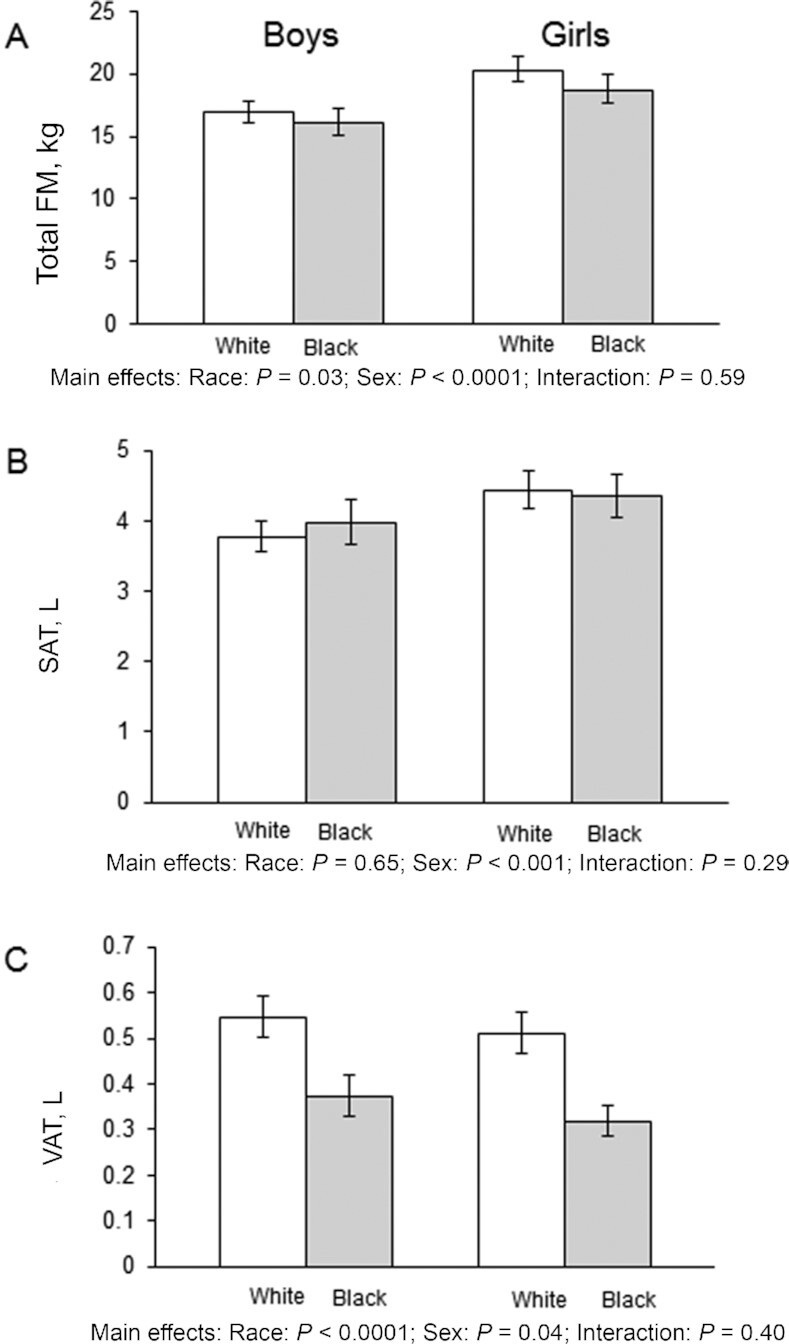
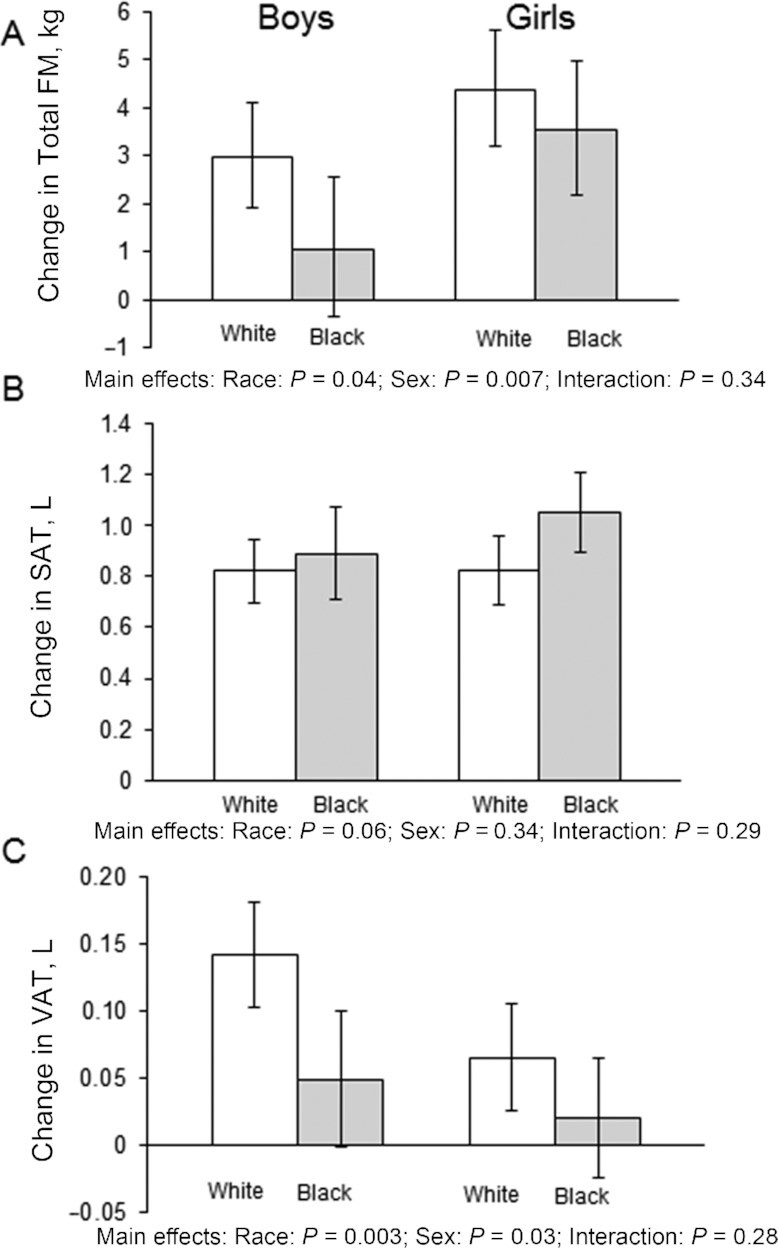
Results: Mean (95% CI) baseline FM (kg) was higher among white [18.5 (17.9, 19.2) than among black adolescents [17.4 (16.6, 18.2), P = 0.03] and girls [19.5 (18.8, 20.3) than boys [16.5 (15.8, 17.2), P < 0.0001]. Mean (95% CI) baseline SAT (L) was higher among girls [4.4 (4.2, 4.6)] than among boys [3.9 (3.7, 4.1), P < 0.0001]. Mean (95% CI) baseline VAT (L) was higher among white [0.5 (0.5, 0.6)] than among black [0.3 (0.3, 0.4)] adolescents (P < 0.0001) and boys [0.5 (0.4, 0.5)] than girls [0.4 (0.4, 0.4), P = 0.04]. Over 2 y mean (95% CI) FM change (kg) was higher among white [3.7 (2.9, 4.5)] than among black adolescents [2.3 (1.3, 3.3), P = 0.04] and girls [4.0 (3.0, 4.9)] than boys [2.0 (1.1, 3.0), P = 0.007], but SAT change (L) did not differ by race or sex. VAT change (L) was higher among white [0.1 (0.1, 0.1)] than among black adolescents [0.0 (0.0, 0.1), P = 0.003] and boys [0.1 (0.1, 0.1)] than girls [0.0 (0.0, 0.1), P = 0.034].
Conclusions: Sex and race differences in the deposition and accumulation of excess fat are important considerations for understanding obesity prevalence and obesity-related disease risk among adolescents.This trial was registered at clinicaltrials.gov as NCT02784509.
Keywords: African Americans; abdominal fat/diagnostic imaging; adipose tissue/anatomy and histology; ectopic fat; intra-abdominal fat/diagnostic imaging; longitudinal studies; obesity/ethnology; racial groups/genetics; sex characteristics.
© The Author(s) 2022. Published by Oxford University Press on behalf of the American Society for Nutrition.
Figures
References
-
- Fryar CD, Carroll MD, Ogden CL. Prevalence of overweight, obesity, and severe obesity among children and adolescents aged 2–19 years: United States, 1963–1965 through 2015–2016 [Internet]. Hyattsville, MD: National Center for Health Statistics; 2018. [Accessed 2022 May 20]. Available from: https://www.cdc.gov/nchs/data/hestat/obesity_child_15_16/obesity_child_1....
-
- Daniels SR, Khoury PR, Morrison JA. The utility of body mass index as a measure of body fatness in children and adolescents: differences by race and gender. Pediatrics. 1997;99(6):804–7. - PubMed
-
- Daniels SR, Morrison JA, Sprecher DL, Khoury P, Kimball TR. Association of body fat distribution and cardiovascular risk factors in children and adolescents. Circulation. 1999;99(4):541–5. - PubMed
Publication types
MeSH terms
Associated data
Grants and funding
LinkOut - more resources
Full Text Sources
Medical
Research Materials
