


mHealth Interventions to Reduce Physical Inactivity and Sedentary Behavior in Children and Adolescents: Systematic Review and Meta-analysis of Randomized Controlled Trials
- PMID: 35544294
- PMCID: PMC9133983
- DOI: 10.2196/35920
mHealth Interventions to Reduce Physical Inactivity and Sedentary Behavior in Children and Adolescents: Systematic Review and Meta-analysis of Randomized Controlled Trials
Abstract
Background: Children and adolescents increasingly do not meet physical activity (PA) recommendations. Hence, insufficient PA (IPA) and sedentary behavior (SB) among children and adolescents are relevant behavior change domains for using individualized mobile health (mHealth) interventions.
Objective: This review and meta-analysis investigated the effectiveness of mHealth interventions on IPA and SB, with a special focus on the age and level of individualization.
Methods: PubMed, Scopus, Web of Science, SPORTDiscus, and Cochrane Library were searched for randomized controlled trials published between January 2000 and March 2021. mHealth interventions for primary prevention in children and adolescents addressing behavior change related to IPA and SB were included. Included studies were compared for content characteristics and methodological quality and summarized narratively. In addition, a meta-analysis with a subsequent exploratory meta-regression examining the moderating effects of age and individualization on overall effectiveness was performed.
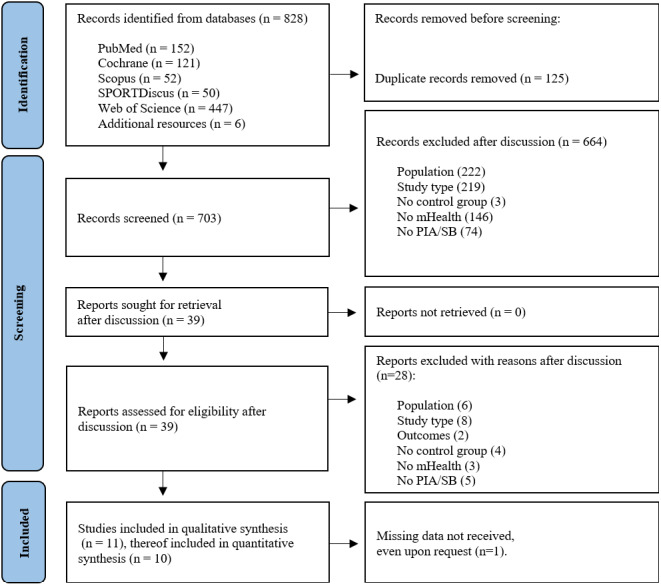
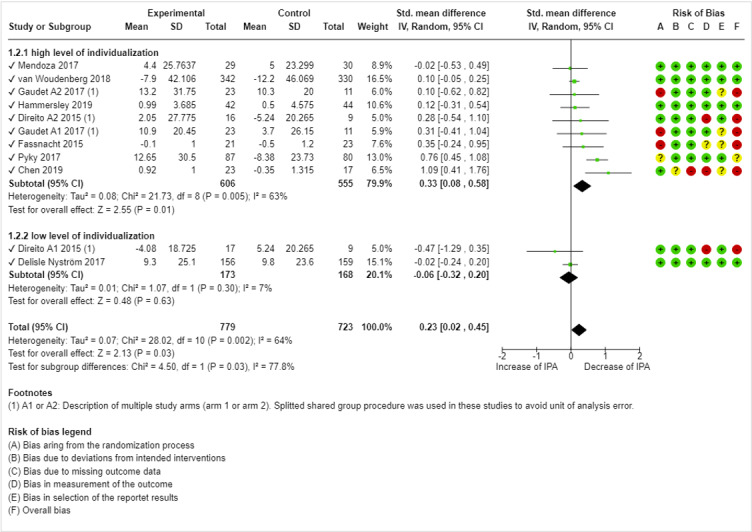
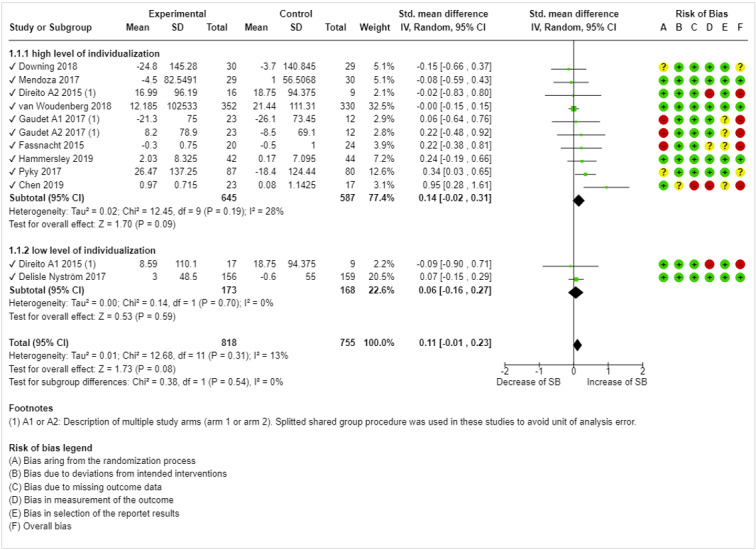
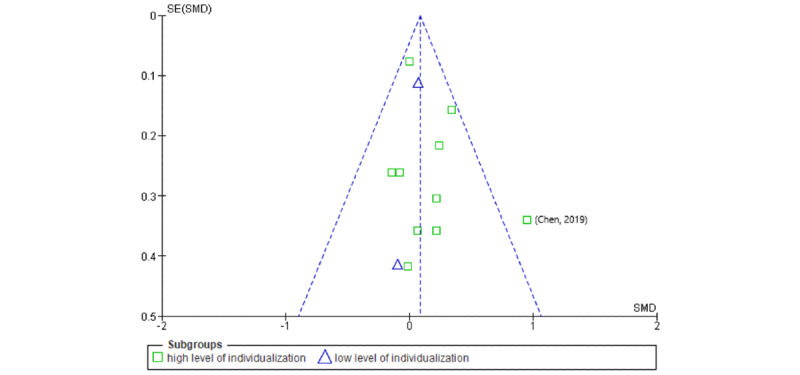
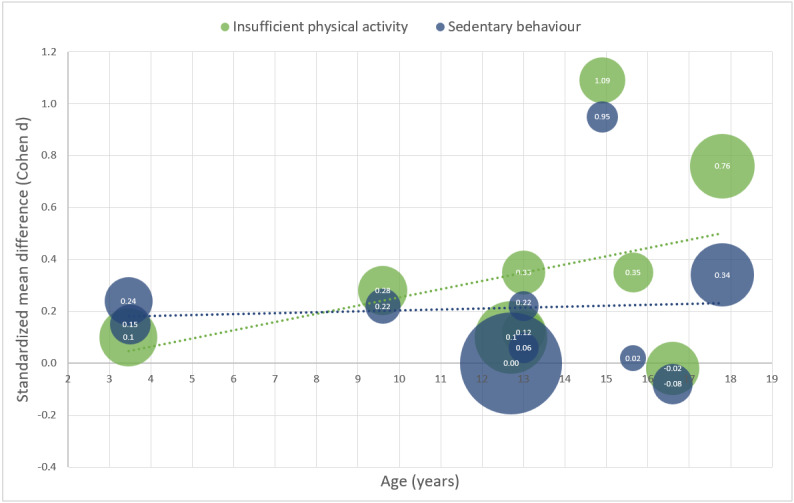
Results: On the basis of the inclusion criteria, 1.3% (11/828) of the preliminary identified studies were included in the qualitative synthesis, and 1.2% (10/828) were included in the meta-analysis. Trials included a total of 1515 participants (mean age (11.69, SD 0.788 years; 65% male and 35% female) self-reported (3/11, 27%) or device-measured (8/11, 73%) health data on the duration of SB and IPA for an average of 9.3 (SD 5.6) weeks. Studies with high levels of individualization significantly decreased insufficient PA levels (Cohen d=0.33; 95% CI 0.08-0.58; Z=2.55; P=.01), whereas those with low levels of individualization (Cohen d=-0.06; 95% CI -0.32 to 0.20; Z=0.48; P=.63) or targeting SB (Cohen d=-0.11; 95% CI -0.01 to 0.23; Z=1.73; P=.08) indicated no overall significant effect. The heterogeneity of the studies was moderate to low, and significant subgroup differences were found between trials with high and low levels of individualization (χ21=4.0; P=.04; I2=75.2%). Age as a moderator variable showed a small effect; however, the results were not significant, which might have been because of being underpowered.
Conclusions: Evidence suggests that mHealth interventions for children and adolescents can foster moderate reductions in IPA but not SB. Moreover, individualized mHealth interventions to reduce IPA seem to be more effective for adolescents than for children. Although, to date, only a few mHealth studies have addressed inactive and sedentary young people, and their quality of evidence is moderate, these findings indicate the relevance of individualization on the one hand and the difficulties in reducing SB using mHealth interventions on the other.
Trial registration: PROSPERO CRD42020209417; https://www.crd.york.ac.uk/prospero/display_record.php?RecordID=209417.
Keywords: health app; health behavior change; individualization; mobile phone; personalized medicine; physical activity; sedentary behavior; tailored interventions.
©Hannes Baumann, Janis Fiedler, Kathrin Wunsch, Alexander Woll, Bettina Wollesen. Originally published in JMIR mHealth and uHealth (https://mhealth.jmir.org), 11.05.2022.
Conflict of interest statement
Conflicts of Interest: None declared.
Figures
References
-
- Hall G, Laddu DR, Phillips SA, Lavie CJ, Arena R. A tale of two pandemics: how will COVID-19 and global trends in physical inactivity and sedentary behavior affect one another? Prog Cardiovasc Dis. 2021;64:108–10. doi: 10.1016/j.pcad.2020.04.005. http://europepmc.org/abstract/MED/32277997 S0033-0620(20)30077-3 - DOI - PMC - PubMed
-
- Tremblay MS, Aubert S, Barnes JD, Saunders TJ, Carson V, Latimer-Cheung AE, Chastin SF, Altenburg TM, Chinapaw MJ, SBRN Terminology Consensus Project Participants Sedentary Behavior Research Network (SBRN) - terminology consensus project process and outcome. Int J Behav Nutr Phys Act. 2017 Jun 10;14(1):75. doi: 10.1186/s12966-017-0525-8. https://ijbnpa.biomedcentral.com/articles/10.1186/s12966-017-0525-8 10.1186/s12966-017-0525-8 - DOI - PMC - PubMed
-
- Tremblay MS, Gray CE, Akinroye K, Harrington DM, Katzmarzyk PT, Lambert EV, Liukkonen J, Maddison R, Ocansey RT, Onywera VO, Prista A, Reilly JJ, Rodríguez Martínez MP, Sarmiento Duenas OL, Standage M, Tomkinson G. Physical activity of children: a global matrix of grades comparing 15 countries. J Phys Act Health. 2014 May;11 Suppl 1:S113–25. doi: 10.1123/jpah.2014-0177. - DOI - PubMed
-
- Guthold R, Stevens GA, Riley LM, Bull FC. Worldwide trends in insufficient physical activity from 2001 to 2016: a pooled analysis of 358 population-based surveys with 1·9 million participants. Lancet Glob Health. 2018 Oct;6(10):e1077–86. doi: 10.1016/S2214-109X(18)30357-7. https://linkinghub.elsevier.com/retrieve/pii/S2214-109X(18)30357-7 S2214-109X(18)30357-7 - DOI - PubMed
-
- WHO Guidelines on physical activity and sedentary behavior. World Health Organisation. 2020. [2021-01-12]. https://apps.who.int/iris/bitstream/handle/10665/336656/9789240015128-en... .
Publication types
MeSH terms
LinkOut - more resources
Full Text Sources
Medical
