


Creatine Chemical Exchange Saturation Transfer (Cr-CEST) Imaging Can Evaluate Cisplatin-induced Testicular Damage
- PMID: 35545506
- PMCID: PMC10449556
- DOI: 10.2463/mrms.mp.2021-0125
Creatine Chemical Exchange Saturation Transfer (Cr-CEST) Imaging Can Evaluate Cisplatin-induced Testicular Damage
Abstract
Purpose: This study aimed to investigate the ability of creatine-chemical exchange saturation transfer (Cr-CEST) technique assessed through 7-T MRI to evaluate cisplatin-induced testicular damage.
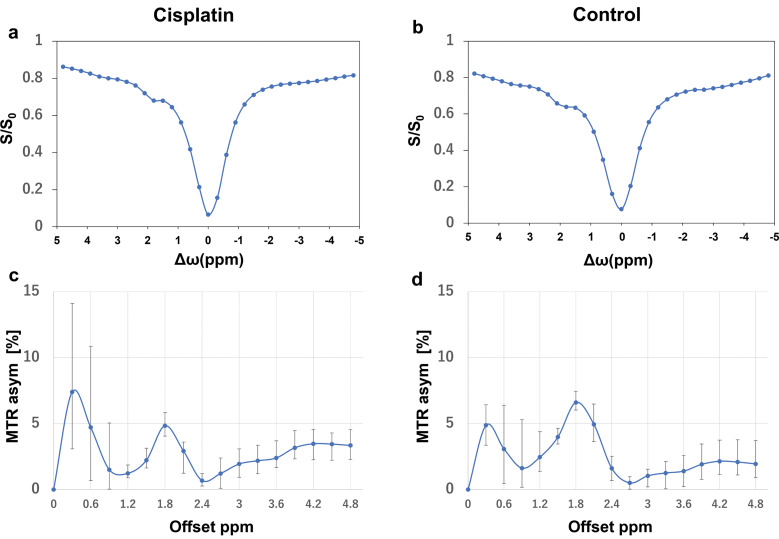
Methods: We used 8-10 weeks C57BL/6 mice (n = 10) that were divided into a control group (n = 5) and a cisplatin-treated group (n = 5). The cisplatin group received cisplatin at a dose of 15 mg/kg, via intraperitoneal injection, while the control group received saline. MR images of mouse testes were acquired under anesthesia 18 days after the injection using a horizontal 7-T scanner. The pulse sequence consisted of rapid acquisition with a relaxation enhancement (RARE) with magnetization transfer. The Z-spectra were collected using a 2000-ms saturation pulse at a B1 amplitude of 1.2 μT, with frequencies varying from -4.8 to +4.8 parts per million (ppm). Maps of magnetization transfer ratio with asymmetric analysis (MTRasym) were reconstructed at a Cr metabolite concentration of 1.8 ppm.
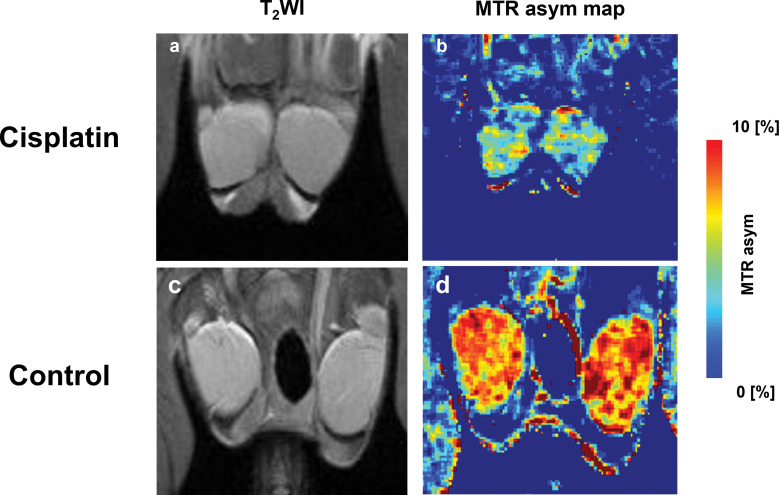
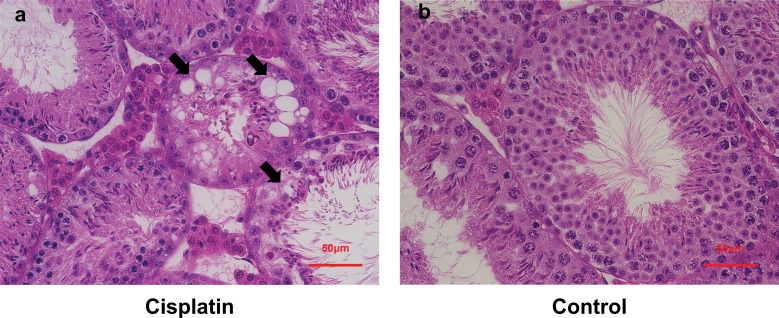
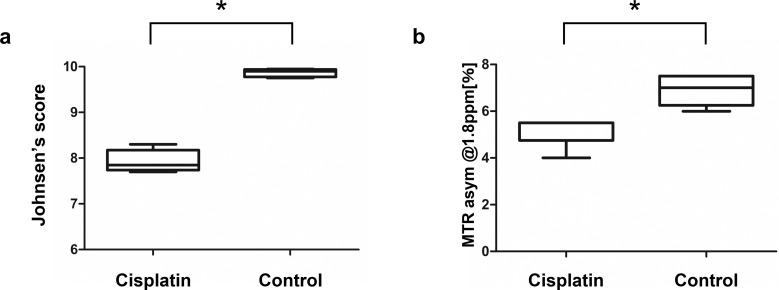
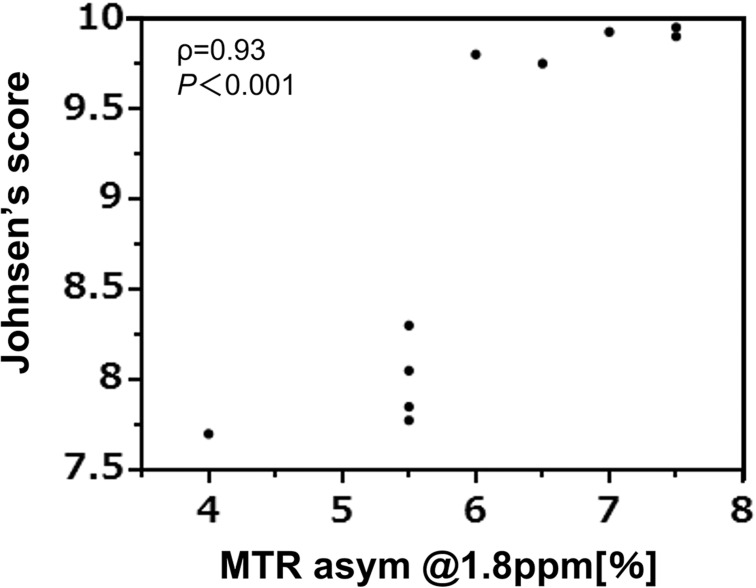
Results: The Cr-CEST effect was significantly reduced in the cisplatin-treated group compared to the control group (MTRasym of control mice vs. cisplatin-treated mice: 6.9 [6-7.5] vs. 5.2 [4-5.5], P = 0.008). Correlation analysis revealed a strong correlation between the Cr-CEST effect and the pathological score (ρ = 0.93, P < 0.001).
Conclusion: Cr-CEST MRI can be useful for the evaluation of cisplatin-induced testicular damage in mice.
Keywords: chemical exchange saturation transfer; cisplatin; creatine; testes.
Conflict of interest statement
The authors declare that they have no conflicts of interest.
Figures
References
-
- DeSantis CE, Lin CC, Mariotto AB, et al. Cancer treatment and survivorship statistics, 2014. CA Cancer J Clin 2014; 64:252–271. - PubMed
-
- Howell SJ, Shalet SM. Spermatogenesis after cancer treatment: damage and recovery. J Natl Cancer Inst Monogr 2005; 2005:12–17. - PubMed
-
- Schlegel PN, Sigman M, Collura B, et al. Diagnosis and treatment of infertility in men: AUA/ASRM guideline part I. Fertil Steril 2021; 115:54–61. - PubMed
