


Established and emerging treatments for diabetes-associated lower urinary tract dysfunction
- PMID: 35545721
- PMCID: PMC9276575
- DOI: 10.1007/s00210-022-02249-9
Established and emerging treatments for diabetes-associated lower urinary tract dysfunction
Abstract
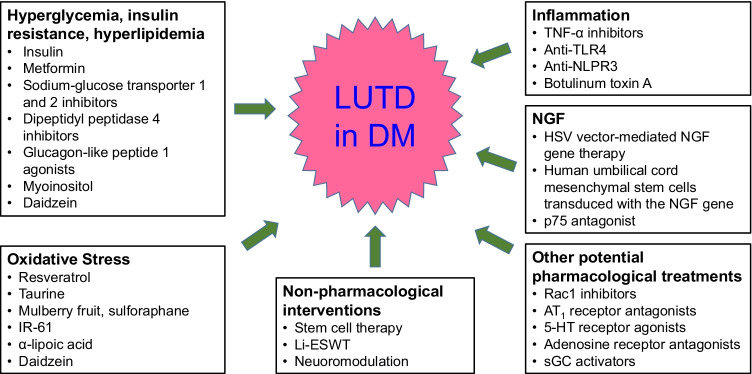
Dysfunction of the lower urinary tract (LUT) including urinary bladder and urethra (and prostate in men) is one of the most frequent complications of diabetes and can manifest as overactive bladder, underactive bladder, urinary incontinence, and as aggravated symptoms of benign prostate hyperplasia. We have performed a selective literature search to review existing evidence on efficacy of classic medications for the treatment of LUT dysfunction in diabetic patients and animals, i.e., α1-adrenoceptor and muscarinic receptor antagonists, β3-adrenoceptor agonists, and phosphodiesterase type 5 inhibitors. Generally, these agents appear to have comparable efficacy in patients and/or animals with and without diabetes. We also review effects of antidiabetic medications on LUT function. Such studies have largely been performed in animal models. In the streptozotocin-induced models of type 1 diabetes, insulin can prevent and reverse alterations of morphology, function, and gene expression patterns in bladder and prostate. Typical medications for the treatment of type 2 diabetes have been studied less often, and the reported findings are not yet sufficient to derive robust conclusions. Thereafter, we review animal studies with emerging medications perhaps targeting diabetes-associated LUT dysfunction. Data with myoinositol, daidzein, and with compounds that target oxidative stress, inflammation, Rac1, nerve growth factor, angiotensin II receptor, serotonin receptor, adenosine receptor, and soluble guanylyl cyclase are not conclusive yet, but some hold promise as potential treatments. Finally, we review nonpharmacological interventions in diabetic bladder dysfunction. These approaches are relatively new and give promising results in preclinical studies. In conclusion, the insulin data in rodent models of type 1 diabetes suggest that diabetes-associated LUT function can be mostly or partially reversed. However, we propose that considerable additional experimental and clinical studies are needed to target diabetes itself or pathophysiological changes induced by chronic hyperglycemia for the treatment of diabetic uropathy.
Keywords: Bladder; Diabetes; Insulin; Prostate; Sodium-glucose transporter 2 inhibitors.
© 2022. The Author(s).
Conflict of interest statement
BRE, EAI, and GL do not report a conflict of interest. In the field of LUT dysfunction, MCM has been a consultant and/or speaker for Apogepha, Astellas, Dr. Willmar Schwabe, GSK and Sanofi-Aventis.
Figures
References
-
- Antony PJ, Gandhi GR, Stalin A, Balakrishna K, Toppo E, Sivasankaran K, Ignacimuthu S, Al-Dhabi NA. Myoinositol ameliorates high-fat diet and streptozotocin-induced diabetes in rats through promoting insulin receptor signaling. Biomed Pharmacother. 2017;88:1098–1113. doi: 10.1016/j.biopha.2017.01.170. - DOI - PubMed
-
- Antunes-Lopes T, Vasconcelos A, Costa D, Charrua A, Neves J, Silva J, Cruz F, Silva C. The impact of chronic pelvic ischemia on LUTS and urinary levels of neuroinflammatory, inflammatory, and oxidative stress markers in elderly men: a case-control study. Urology. 2019;123:230–234. doi: 10.1016/j.urology.2018.09.004. - DOI - PubMed
-
- Arioglu Inan E, Bese OD, Karaca GE, San HS, Kayki Mutlu G, Erdogan BR, Michel MC (2022) The angiotensin II receptor antagonist valsartan does not attenuate diabetes-induced bladder enlargement in rats. Neurourol Urodyn Press
Publication types
MeSH terms
Substances
Grants and funding
LinkOut - more resources
Full Text Sources
Medical
Research Materials
