Low-quality employment trajectories and the risk of common mental health disorders among individuals with Swedish and foreign background - a register-based cohort study
- PMID: 35546057
- PMCID: PMC9527776
- DOI: 10.5271/sjweh.4029
Low-quality employment trajectories and the risk of common mental health disorders among individuals with Swedish and foreign background - a register-based cohort study
Abstract
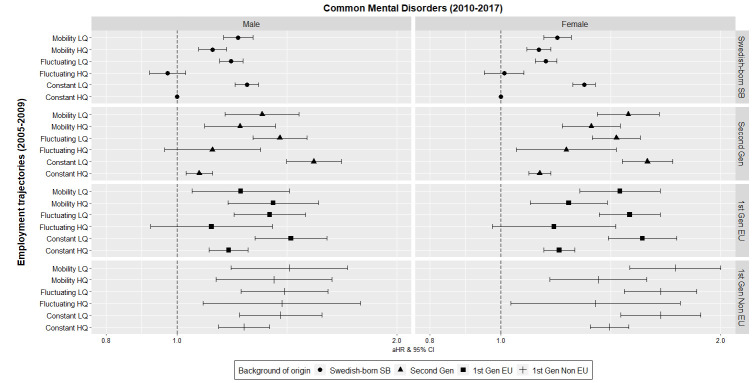
Objective: This study aimed to examine the effects of low-quality employment trajectories on severe common mental disorders (CMD) according to Swedish and foreign background.
Methods: In this longitudinal study based on Swedish population registries (N=2 703 687), low- and high-quality employment trajectories were the main exposures observed across five years (2005-2009), with severe CMD as outcome variable (2010-2017). Adjusted hazard ratios (HR) were calculated by means of Cox regression models and stratified according to Swedish and foreign background [first-generation (i) EU migrants, (ii) non-EU migrants, (iii) second-generation migrants, (iv) Swedish-born of Swedish background] and sex. The reference group was Swedish-born of Swedish background in a constant high-quality employment trajectory.
Results: Second-generation migrants had an increased risk of CMD compared to Swedish-born of Swedish background when following low-quality employment trajectories [eg, male in constant low-quality HR 1.54, 95% confidence interval (CI) 1.41-1.68]. Female migrant workers, especially first-generation from non-EU countries in low-quality employment trajectories (eg, constant low-quality HR 1.66, 95% CI 1.46-1.88), had a higher risk of CMD compared to female Swedish-born of Swedish background. The risk for CMD according to employment trajectories showed little differences between first- and second-generation migrants.
Conclusion: Low-quality employment trajectories appear to be determinants of risk for CMD in association with Swedish or foreign background of origin and sex. Our study shows a higher risk for severe CMD in second-generation and non-EU migrant compared to Swedish-born of Swedish background in constant low-quality employment. Further qualitative research is recommended to understand the mechanism behind the differential mental health impact of low-quality employment trajectories according to foreign background.
Conflict of interest statement
The authors declare no conflicts of interest
Figures
References
-
- Benach J, Muntaner C. Precarious employment and health:developing a research agenda. J Epidemiol Community Health. 2007 Apr;61(4):276–7. https://doi.org/10.1136/jech.2005.045237. - PMC - PubMed
-
- Andersson LM, Hjern A, Ascher H. Undocumented adult migrants in Sweden:mental health and associated factors. BMC Public Health. 2018 Dec;18(1):1369. https://doi.org/10.1186/s12889-018-6294-8. - PMC - PubMed
-
- Jonsson J, Matilla-Santander N, Kreshpaj B, Johansson G, Kjellberg K, Burström B, et al. Precarious employment and general, mental and physical health in Stockholm, Sweden:a cross-sectional study. Scand J Public Health. 2021 Mar;49(2):228–36. https://doi.org/10.1177/1403494820956451. - PMC - PubMed
-
- Kreshpaj B, Orellana C, Burström B, Davis L, Hemmingsson T, Johansson G, et al. What is precarious employment?A systematic review of definitions and operationalizations from quantitative and qualitative studies. Scand J Work Environ Health. 2020 May;46(3):235–47. https://doi.org/10.5271/sjweh.3875. - PubMed
-
- Rönnblad T, Grönholm E, Jonsson J, Koranyi I, Orellana C, Kreshpaj B, et al. Precarious employment and mental health:a systematic review and meta-analysis of longitudinal studies. Scand J Work Environ Health. 2019 Sep;45(5):429–43. https://doi.org/10.5271/sjweh.3797. - PubMed
Publication types
MeSH terms
LinkOut - more resources
Full Text Sources
Medical