


Is Hearing Impairment Causally Associated With Falls? Evidence From a Two-Sample Mendelian Randomization Study
- PMID: 35547384
- PMCID: PMC9082948
- DOI: 10.3389/fneur.2022.876165
Is Hearing Impairment Causally Associated With Falls? Evidence From a Two-Sample Mendelian Randomization Study
Abstract
Background: Observational studies have suggested that hearing impairment (HI) was associated with the risk of falls, but it remains unclear if this association is of causal nature.
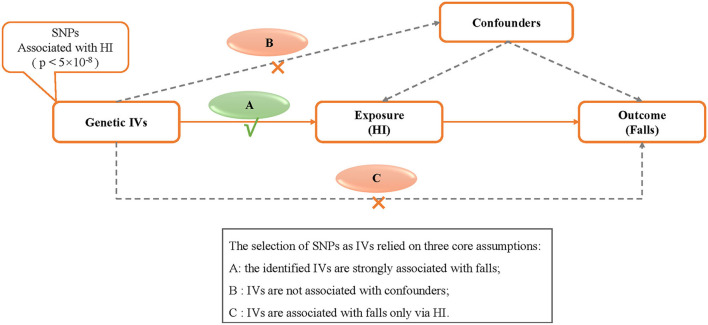
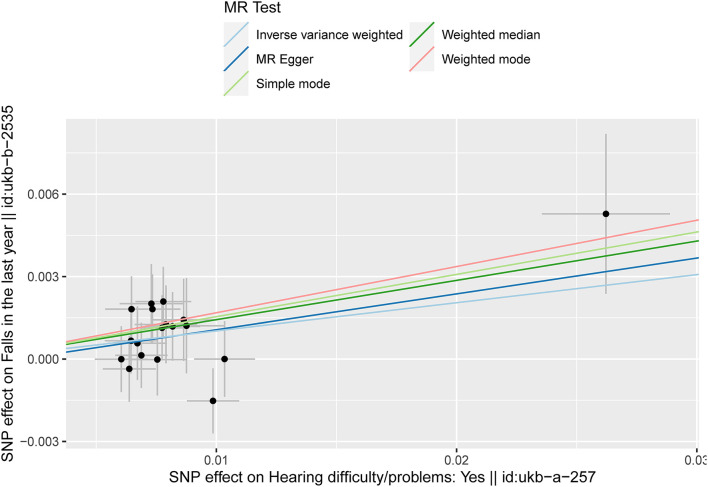
Methods: A two-sample Mendelian randomization (MR) study was conducted to investigate the causal association between HI and falls in individuals of European descent. Summary data on the association of single nucleotide polymorphisms (SNPs) with HI were obtained from the hitherto largest genome-wide association study (GWAS) (n = 323,978), and statistics on the association of SNPs with falls were extracted from another recently published GWAS (n = 461,725). MR Steiger filtering method was applied to determine the causal direction between HI and falls. Inverse-variance weighted (IVW) method was employed as the main approach to analyze the causal association between HI and falls, whereas weighted median, simple mode, weighted mode, and MR-Egger methods were used as complementary analyses. The MR-Egger intercept test, the MR-PRESSO test, and Cochran's Q statistic were performed to detect the potential directional pleiotropy and heterogeneity, respectively. The odds ratio (OR) with 95% confidence intervals (CIs) was used to evaluate this association.
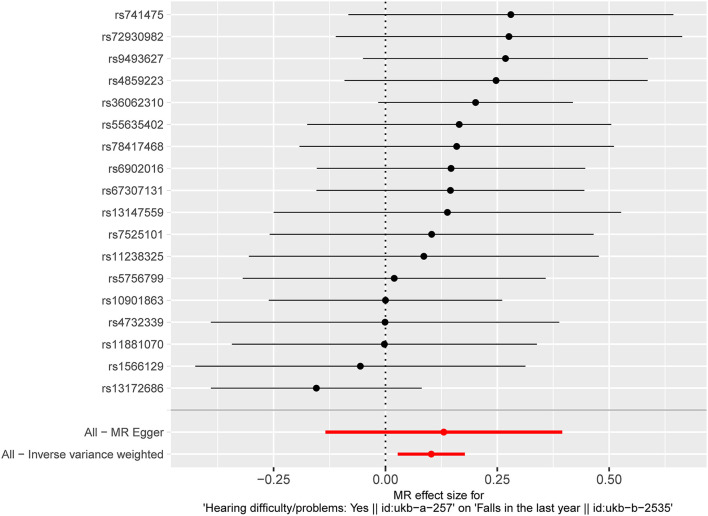
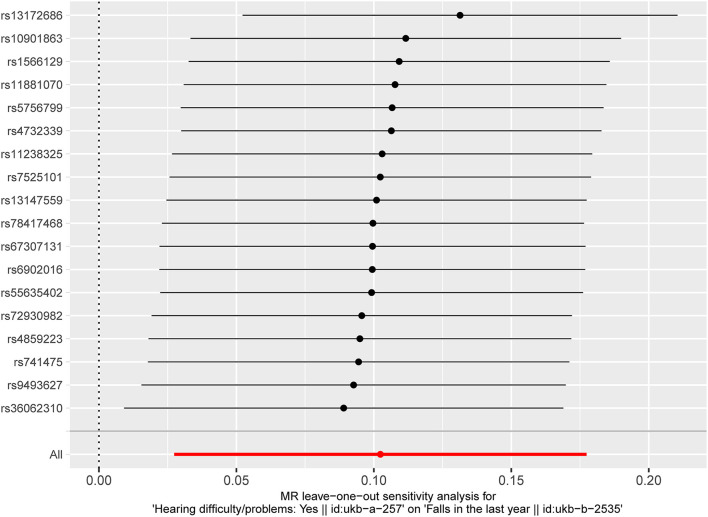
Results: A total of 18 SNPs were identified as valid instrumental variables in our two-sample MR analysis. The positive causality between HI and risk of falls was indicated by IVW [OR 1.108 (95% CI 1.028, 1.194), p = 0.007]. The sensitivity analyses yielded comparable results. The "leave-one-out" analysis proved that lack of a single SNP did not affect the robustness of our results. The MR-Egger intercept test exhibited that genetic pleiotropy did not bias the results [intercept = -2.4E-04, SE = 0.001, p = 0.832]. Cochran's Q test revealed no heterogeneity.
Conclusion: Our MR study revealed a causal association between genetically predicted HI and falls. These results provide further evidence supporting the need to effectively manage HI to minimize fall risks and improve quality of life.
Keywords: Mendelian randomization; causal association; falls; genome-wide association study; hearing impairment.
Copyright © 2022 Wang, Liu, Tian, Guo, Chen, Kong and Zhang.
Conflict of interest statement
The authors declare that the research was conducted in the absence of any commercial or financial relationships that could be construed as a potential conflict of interest.
Figures
References
-
- Montero-Odasso MM, Kamkar N, Pieruccini-Faria F, Osman A, Sarquis-Adamson Y, Close J, et al. . Evaluation of clinical practice guidelines on fall prevention and management for older adults: a systematic review. JAMA Netw Open. (2021) 4:e2138911. 10.1001/jamanetworkopen.2021.38911 - DOI - PMC - PubMed
-
- Kruisbrink M, Delbaere K, Kempen GIJM, Crutzen R, Ambergen T, Cheung K-L, et al. . Intervention characteristics associated with a reduction in fear of falling among community-dwelling older people: a systematic review and meta-analysis of randomized controlled trials. Gerontologist. (2021) 61:e269–82. 10.1093/geront/gnaa021 - DOI - PMC - PubMed
LinkOut - more resources
Full Text Sources
