


Efficacy of contralaterally controlled functional electrical stimulation compared to cyclic neuromuscular electrical stimulation and task-oriented training for recovery of hand function after stroke: study protocol for a multi-site randomized controlled trial
- PMID: 35549747
- PMCID: PMC9097385
- DOI: 10.1186/s13063-022-06303-y
Efficacy of contralaterally controlled functional electrical stimulation compared to cyclic neuromuscular electrical stimulation and task-oriented training for recovery of hand function after stroke: study protocol for a multi-site randomized controlled trial
Abstract
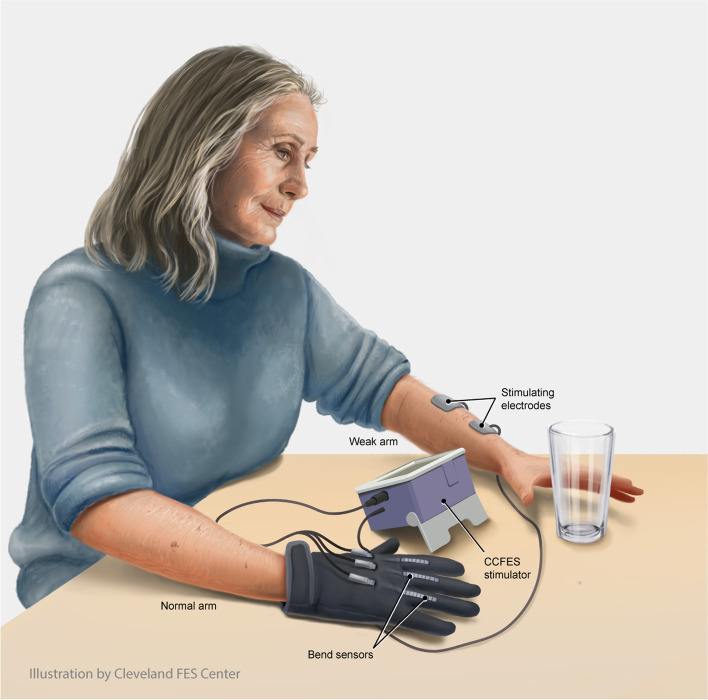
Background: Multi-site studies in stroke rehabilitation are important for determining whether a technology and/or treatment can be successfully administered by sites other than the originating site and with similar positive outcomes. This study is the first multi-site clinical trial of a novel intervention for post-stroke upper limb rehabilitation called contralaterally controlled functional electrical stimulation (CCFES). Previous pilot and single-site studies showed positive effects of CCFES on upper limb impairment and hand dexterity in stroke survivors. The main purpose of this study is to confirm and demonstrate the efficacy of CCFES in a larger group of most likely responders across multiple clinical sites.
Methods: Up to 129 stroke survivors with moderate to severe upper extremity hemiparesis at 4 clinical trial sites will be randomized to CCFES, cyclic neuromuscular electrical stimulation (cNMES), or task-oriented-training (TOT). Participants will receive 12 weeks of group-specific therapy. Blinded assessments of upper limb impairment and activity limitation, quality of life, and neurophysiology will be used to compare outcomes at baseline, after treatment, and up to 6 months post-treatment. The primary endpoint is change in dexterity from baseline to 6 months post-treatment.
Discussion: Loss of hand function following stroke is a major rehabilitation problem affecting millions of people per year globally. More effective rehabilitation therapies are needed to restore hand function in these individuals. This study will determine whether CCFES therapy produces greater improvements in upper extremity function than cNMES or TOT, and will begin to elucidate the different mechanisms underlying each of the three treatments. This multi-site study is a critical step in advancing a novel method of rehabilitation toward clinical translation and widespread dissemination.
Trial registration: ClinicalTrials.gov NCT03574623 . Registered prior to first enrollment; July 2, 2018.
Keywords: Electrical stimulation; Hemiparesis; Stroke rehabilitation; Therapy; Upper extremity.
© 2022. The Author(s).
Conflict of interest statement
JSK and JC are co-inventors on the CCFES patent assigned to Case Western Reserve University, Patent 8,165,685: System and Method for Therapeutic Neuromuscular Electrical Stimulation. This patent was licensed to Synapse Biomedical Inc., Oberlin, Ohio, on February 1, 2019.
Figures
References
-
- Virani SS, Alonso A, Aparicio HJ, Benjamin EJ, Bittencourt MS, Callaway CW, et al. Heart Disease and Stroke Statistics-2021 Update: a report from the American Heart Association. Circulation. 2021;143(8):e254–e743. - PubMed
-
- Lai SM, Studenski S, Duncan PW, Perera S. Persisting consequences of stroke measured by the Stroke Impact Scale. Stroke. 2002;33(7):1840–1844. - PubMed
-
- Kamper DG, Fischer HC, Cruz EG, Rymer WZ. Weakness is the primary contributor to finger impairment in chronic stroke. Arch Phys Med Rehabil. 2006;87(9):1262–1269. - PubMed
-
- Franceschini M, La Porta F, Agosti M, Massucci M. group ICR. Is health-related-quality of life of stroke patients influenced by neurological impairments at one year after stroke? Eur J Phys Rehabil Med. 2010;46(3):389–399. - PubMed
Publication types
MeSH terms
Associated data
Grants and funding
LinkOut - more resources
Full Text Sources
Medical
