


The immunogenetics of viral antigen response is associated with subtype-specific glioma risk and survival
- PMID: 35550063
- PMCID: PMC9247888
- DOI: 10.1016/j.ajhg.2022.04.011
The immunogenetics of viral antigen response is associated with subtype-specific glioma risk and survival
Abstract
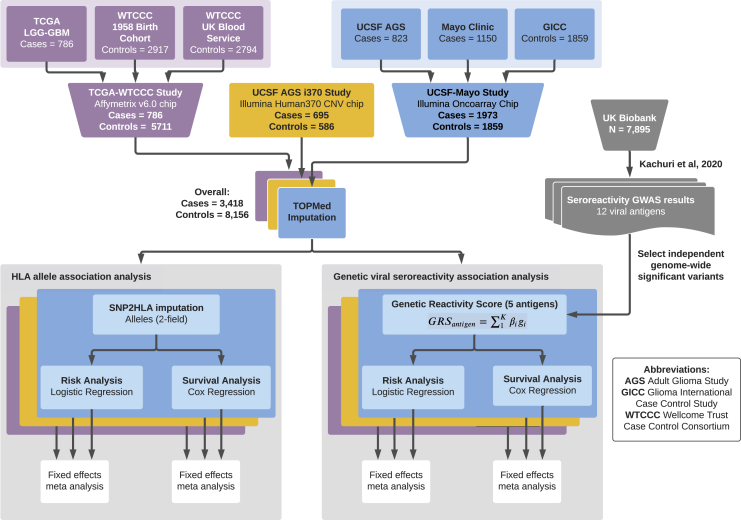
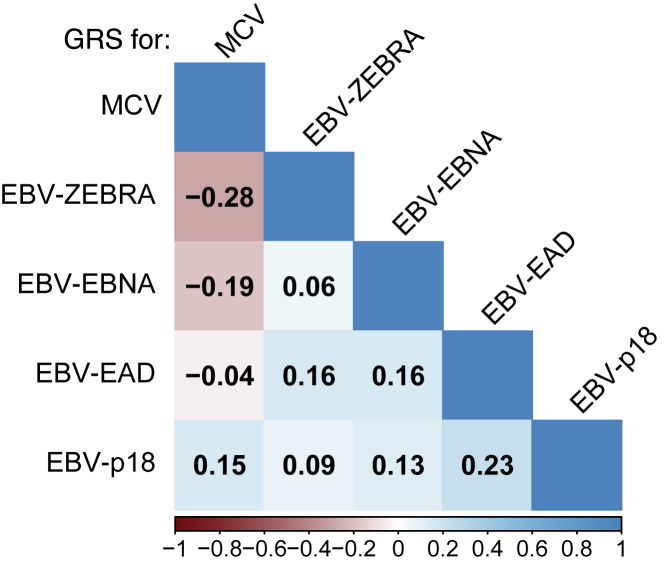
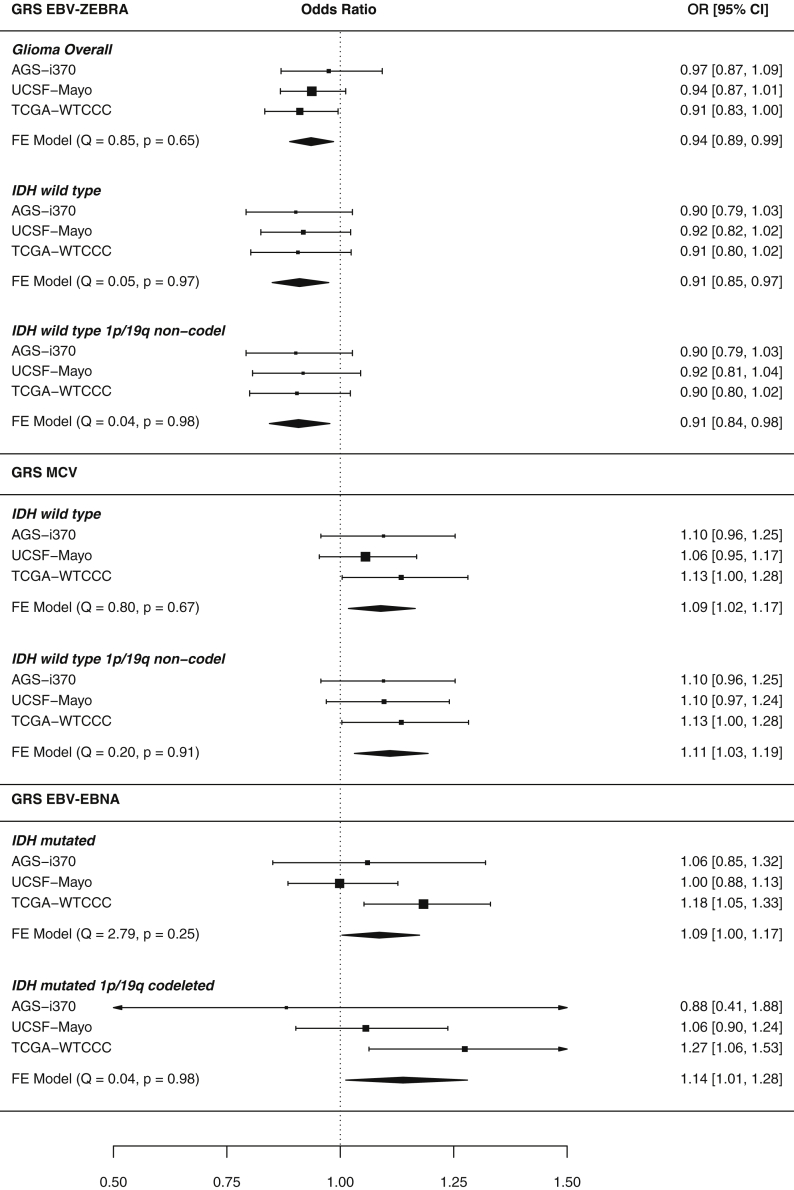
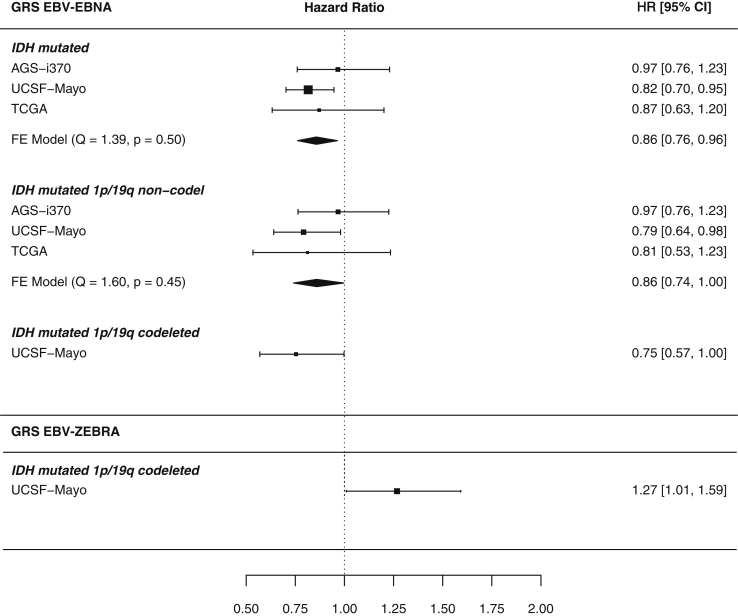
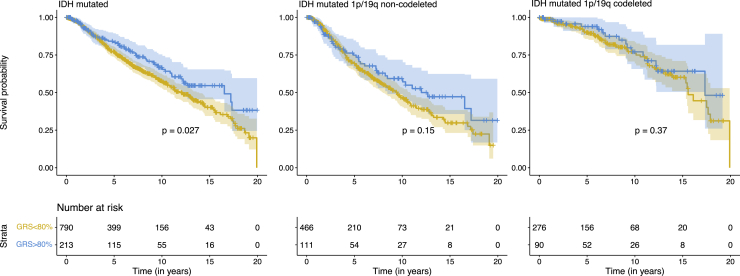
Glioma is a highly fatal cancer with prognostically significant molecular subtypes and few known risk factors. Multiple studies have implicated infections in glioma susceptibility, but evidence remains inconsistent. Genetic variants in the human leukocyte antigen (HLA) region modulate host response to infection and have been linked to glioma risk. In this study, we leveraged genetic predictors of antibody response to 12 viral antigens to investigate the relationship with glioma risk and survival. Genetic reactivity scores (GRSs) for each antigen were derived from genome-wide-significant (p < 5 × 10⁻⁸) variants associated with immunoglobulin G antibody response in the UK Biobank cohort. We conducted parallel analyses of glioma risk and survival for each GRS and HLA alleles imputed at two-field resolution by using data from 3,418 glioma-affected individuals subtyped by somatic mutations and 8,156 controls. Genetic reactivity scores to Epstein-Barr virus (EBV) ZEBRA and EBNA antigens and Merkel cell polyomavirus (MCV) VP1 antigen were associated with glioma risk and survival (Bonferroni-corrected p < 0.01). GRSZEBRA and GRSMCV were associated in opposite directions with risk of IDH wild-type gliomas (ORZEBRA = 0.91, p = 0.0099/ORMCV = 1.11, p = 0.0054). GRSEBNA was associated with both increased risk for IDH mutated gliomas (OR = 1.09, p = 0.040) and improved survival (HR = 0.86, p = 0.010). HLA-DQA1∗03:01 was significantly associated with decreased risk of glioma overall (OR = 0.85, p = 3.96 × 10⁻⁴) after multiple testing adjustment. This systematic investigation of the role of genetic determinants of viral antigen reactivity in glioma risk and survival provides insight into complex immunogenomic mechanisms of glioma pathogenesis. These results may inform applications of antiviral-based therapies in glioma treatment.
Keywords: Epstein-Barr virus; Merkel cell polyomavirus; glioma; human leukocyte antigen; polygenic risk score.
Copyright © 2022. Published by Elsevier Inc.
Conflict of interest statement
Declaration of interests The authors declare no competing interests.
Figures
References
-
- Sudlow C., Gallacher J., Allen N., Beral V., Burton P., Danesh J., Downey P., Elliott P., Green J., Landray M., et al. UK Biobank: an open access resource for identifying the causes of a wide range of complex diseases of middle and old age. PLoS Med. 2015;12:e1001779. doi: 10.1371/journal.pmed.1001779. - DOI - PMC - PubMed
Publication types
MeSH terms
Substances
Grants and funding
- R01 CA139020/CA/NCI NIH HHS/United States
- HHSN261201800032C/CA/NCI NIH HHS/United States
- HHSN261201800009C/CA/NCI NIH HHS/United States
- NU58DP006344/DP/NCCDPHP CDC HHS/United States
- T32 CA151022/CA/NCI NIH HHS/United States
- R25 CA112355/CA/NCI NIH HHS/United States
- HHSN261201800015I/CA/NCI NIH HHS/United States
- R01 CA126831/CA/NCI NIH HHS/United States
- UL1 RR024131/RR/NCRR NIH HHS/United States
- P50 CA097257/CA/NCI NIH HHS/United States
- HHSN261201800032I/CA/NCI NIH HHS/United States
- MC_PC_17228/MRC_/Medical Research Council/United Kingdom
- HHSN261201800015C/CA/NCI NIH HHS/United States
- R01 CA230712/CA/NCI NIH HHS/United States
- MC_QA137853/MRC_/Medical Research Council/United Kingdom
- P30 CA015083/CA/NCI NIH HHS/United States
- K99 CA246076/CA/NCI NIH HHS/United States
- R01 CA052689/CA/NCI NIH HHS/United States
- HHSN261201800009I/CA/NCI NIH HHS/United States
- R01 AI128775/AI/NIAID NIH HHS/United States
LinkOut - more resources
Full Text Sources
Medical
Research Materials
