


Digital Health Interventions for Delivery of Mental Health Care: Systematic and Comprehensive Meta-Review
- PMID: 35551058
- PMCID: PMC9109782
- DOI: 10.2196/35159
Digital Health Interventions for Delivery of Mental Health Care: Systematic and Comprehensive Meta-Review
Abstract
Background: The COVID-19 pandemic has shifted mental health care delivery to digital platforms, videoconferencing, and other mobile communications. However, existing reviews of digital health interventions are narrow in scope and focus on a limited number of mental health conditions.
Objective: To address this gap, we conducted a comprehensive systematic meta-review of the literature to assess the state of digital health interventions for the treatment of mental health conditions.
Methods: We searched MEDLINE for secondary literature published between 2010 and 2021 on the use, efficacy, and appropriateness of digital health interventions for the delivery of mental health care.
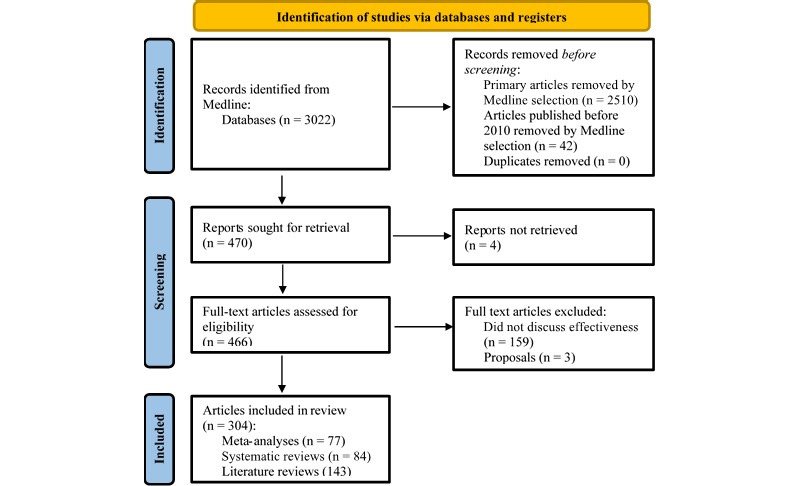
Results: Of the 3022 records identified, 466 proceeded to full-text review and 304 met the criteria for inclusion in this study. A majority (52%) of research involved the treatment of substance use disorders, 29% focused on mood, anxiety, and traumatic stress disorders, and >5% for each remaining mental health conditions. Synchronous and asynchronous communication, computerized therapy, and cognitive training appear to be effective but require further examination in understudied mental health conditions. Similarly, virtual reality, mobile apps, social media platforms, and web-based forums are novel technologies that have the potential to improve mental health but require higher quality evidence.
Conclusions: Digital health interventions offer promise in the treatment of mental health conditions. In the context of the COVID-19 pandemic, digital health interventions provide a safer alternative to face-to-face treatment. However, further research on the applications of digital interventions in understudied mental health conditions is needed. Additionally, evidence is needed on the effectiveness and appropriateness of digital health tools for patients who are marginalized and may lack access to digital health interventions.
Keywords: COVID-19; computer-assisted therapy; digital health; mental health; mobile applications; mobile apps; online therapy; telemedicine; telepsychiatry; telepsychology; virtual reality exposure therapy.
©Tristan J Philippe, Naureen Sikder, Anna Jackson, Maya E Koblanski, Eric Liow, Andreas Pilarinos, Krisztina Vasarhelyi. Originally published in JMIR Mental Health (https://mental.jmir.org), 12.05.2022.
Conflict of interest statement
Conflicts of Interest: None declared
Figures
References
-
- Gordon AL, Goodman C, Achterberg W, Barker RO, Burns E, Hanratty B, Martin FC, Meyer J, O'Neill D, Schols J, Spilsbury K. Commentary: COVID in care homes-challenges and dilemmas in healthcare delivery. Age Ageing. 2020 Aug 24;49(5):701–705. doi: 10.1093/ageing/afaa113. http://europepmc.org/abstract/MED/32402088 5836695 - DOI - PMC - PubMed
-
- Malek J. Senior's care was in crisis before COVID-19. The Council of Canadians. [2020-04-10]. https://canadians.org/analysis/seniors-care-was-crisis-covid-19 .
-
- Qadir J, Al-Fuqaha A. A Student Primer on How to Thrive in Engineering Education during and beyond COVID-19. Educ Sci. 2020 Sep 05;10(9):236. doi: 10.3390/educsci10090236. - DOI
Publication types
LinkOut - more resources
Full Text Sources
Medical
Miscellaneous
