. 2022 May 12;5(1):452.
doi: 10.1038/s42003-022-03411-y.

Validated determination of NRG1 Ig-like domain structure by mass spectrometry coupled with computational modeling

Affiliations

Validated determination of NRG1 Ig-like domain structure by mass spectrometry coupled with computational modeling

Niloofar Abolhasani Khaje et al. Commun Biol. .

Abstract

High resolution hydroxyl radical protein footprinting (HR-HRPF) is a mass spectrometry-based method that measures the solvent exposure of multiple amino acids in a single experiment, offering constraints for experimentally informed computational modeling. HR-HRPF-based modeling has previously been used to accurately model the structure of proteins of known structure, but the technique has never been used to determine the structure of a protein of unknown structure. Here, we present the use of HR-HRPF-based modeling to determine the structure of the Ig-like domain of NRG1, a protein with no close homolog of known structure. Independent determination of the protein structure by both HR-HRPF-based modeling and heteronuclear NMR was carried out, with results compared only after both processes were complete. The HR-HRPF-based model was highly similar to the lowest energy NMR model, with a backbone RMSD of 1.6 Å. To our knowledge, this is the first use of HR-HRPF-based modeling to determine a previously uncharacterized protein structure.


Conflict of interest statement

The authors declare the following competing interests: J.S.S. has a financial interest in GenNext Technologies, Inc., a company commercializing technologies for protein higher structure analysis.

Figures
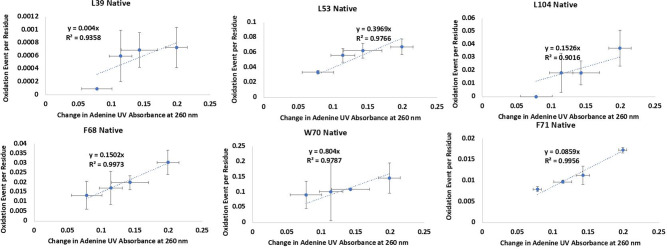
Fig. 1
Fig. 1. Measured radical dose response rate of six amino acids used for structural modeling in NRG1-Ig via HR-HRPF.
Each figure shows the calculated oxidation of each residue at four different hydrogen peroxide concentrations plotted against the changes in adenine absorbance at 260 nm. The error bars represent one standard deviation from triplicate measurements for each data point. Each point represents the oxidation of one residue at a specific radical dose. The slopes of best-fit lines are radical dose responses.
Fig. 2
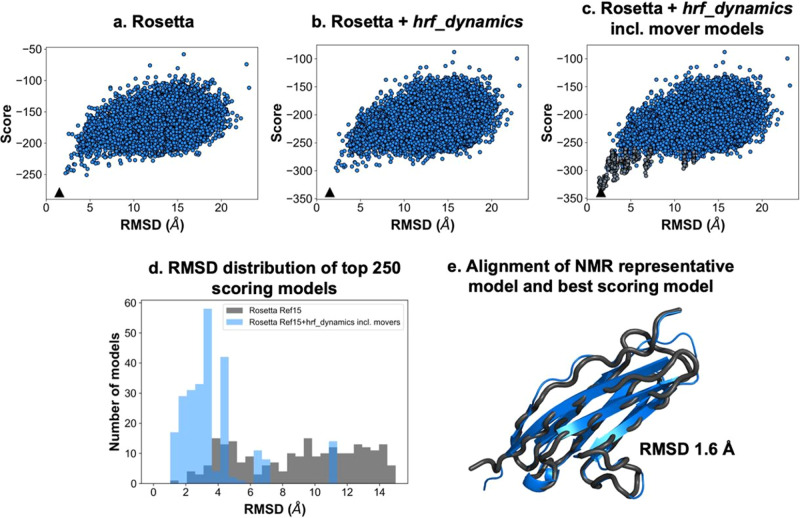
Fig. 2. Ab initio modeling of NRG1-Ig with relaxation ensemble and FPOP-guided scoring significantly enriched high-quality models.
Score versus RMSD to NMR model 1 when (a) scoring with Rosetta’s score function; (b) scoring with Rosetta and hrf_dynamics; and (c) scoring with Rosetta and hrf_dynamics including mover models (dark grey). Best scoring models are denoted by a black triangle. d RMSD histograms for top 250 scoring models when scoring with Rosetta (grey) versus Rosetta and hrf_dynamics including mover models (blue). Bin widths were maintained at 0.5 Å. e Alignment of NMR model 1 (black) with the top-scoring model identified from our HRPF-guided and mover model protocol (blue). The RMSD to the NMR model was determined to be 1.6 Å.
Fig. 3
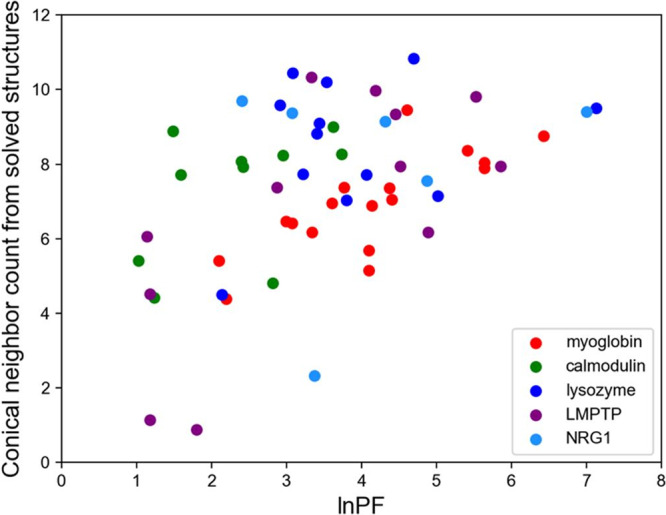
Fig. 3. Correlation between HR-HRPF lnPF and conical neighbor count.
The correlation measured for NRG1 performed blinded to the NMR structure (cyan) was consistent with those reported for proteins of known structure (red: myoglobin; green: calmodulin; blue: lysozyme; violet: LMPTP).

References

    1. Engen JR, Botzanowski T, Peterle D, Georgescauld F, Wales TE. Developments in hydrogen/deuterium exchange mass spectrometry. Anal. Chem. 2021;93:567–582. doi: 10.1021/acs.analchem.0c04281. - DOI - PubMed
    1. Feng Y, et al. Global analysis of protein structural changes in complex proteomes. Nat. Biotechnol. 2014;32:1036–1044. doi: 10.1038/nbt.2999. - DOI - PubMed
    1. Yugandhar K., Zhao Q., Gupta S., Xiong D., Yu H. Progress in methodologies and quality-control strategies in protein cross-linking mass spectrometry. Proteomics21, e2100145 (2021). - PubMed
    1. Liu XR, Zhang MM, Gross ML. Mass spectrometry-based protein footprinting for higher-order structure analysis: fundamentals and applications. Chem. Rev. 2020;120:4355–4454. doi: 10.1021/acs.chemrev.9b00815. - DOI - PMC - PubMed
    1. Suckau D, Mak M, Przybylski M. Protein surface topology-probing by selective chemical modification and mass spectrometric peptide mapping. Proc. Natl Acad. Sci. USA. 1992;89:5630–5634. doi: 10.1073/pnas.89.12.5630. - DOI - PMC - PubMed

Publication types