


The evolution of human fatigue resistance
- PMID: 35552490
- PMCID: PMC9197885
- DOI: 10.1007/s00360-022-01439-4
The evolution of human fatigue resistance
Abstract
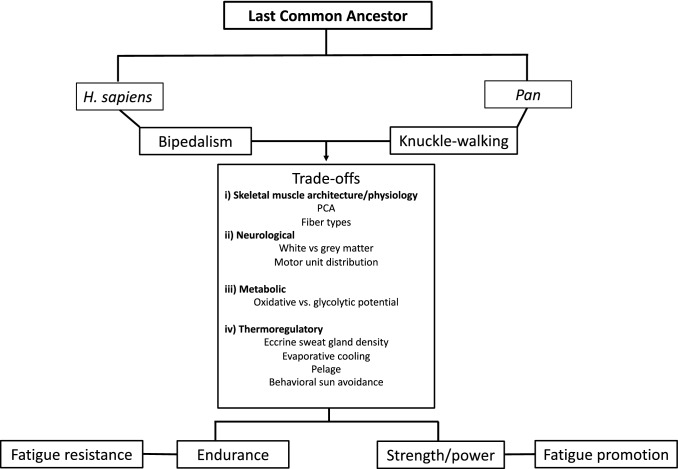
Humans differ from African great apes in numerous respects, but the chief initial difference setting hominins on their unique evolutionary trajectory was habitual bipedalism. The two most widely supported selective forces for this adaptation are increased efficiency of locomotion and improved ability to feed in upright contexts. By 4 million years ago, hominins had evolved the ability to walk long distances but extreme selection for endurance capabilities likely occurred later in the genus Homo to help them forage, power scavenge and persistence hunt in hot, arid conditions. In this review we explore the hypothesis that to be effective long-distance walkers and especially runners, there would also have been a strong selective benefit among Homo to resist fatigue. Our hypothesis is that since fatigue is an important factor that limits the ability to perform endurance-based activities, fatigue resistance was likely an important target for selection during human evolution for improved endurance capabilities. We review the trade-offs between strength, power, and stamina in apes and Homo and discuss three biological systems that we hypothesize humans evolved adaptations for fatigue resistance: neurological, metabolic and thermoregulatory. We conclude that the evolution of endurance at the cost of strength and power likely also involved the evolution of mechanisms to resist fatigue.
Keywords: Adaptations; Endurance; Homo; Pan; Speed; Trade-offs.
© 2022. The Author(s).
Conflict of interest statement
The authors have no conflicts to declare.
Figures
References
-
- Adolph EF. Physiology of man in the desert. New York: Interscience Publishers Inc; 1947.
Publication types
MeSH terms
LinkOut - more resources
Full Text Sources
