Randomized Controlled Trial
. 2022 May 12;12(1):7857.
doi: 10.1038/s41598-022-11979-y.

Child saliva microbiota and caries: a randomized controlled maternal education trial in rural Uganda

Affiliations
Randomized Controlled Trial

Child saliva microbiota and caries: a randomized controlled maternal education trial in rural Uganda

Grace K M Muhoozi et al. Sci Rep. .

Abstract

Undernutrition is a public health challenge in sub-Saharan countries, including Uganda. In a previous randomized controlled trial (RCT) with a nutrition, hygiene and stimulation education intervention among mothers of 6 months' old children, we found less caries in the intervention group when the children were 36 months of age. We now examined the effects of (i) the intervention on the microbiota, (ii) microbiota on caries, and (iii) the intervention and microbiota on caries. The original RCT comprised 511 mother/child pairs whereas in the current study we had access to data from 344/511 (67%) children aged 36 months. The saliva microbiota was determined using 16S rRNA gene sequencing. Carious lesions (a proxy for dental health) were identified using close-up intra-oral photographs of the upper front teeth. Statistical models were used to determine host-microbiota associations. The intervention had a significant effect on the microbiota, e.g. an increase in Streptococcus abundance and decreases in Alloprevotella and Tannerella. Significant associations between the microbiota and dental caries were identified: Positive associations of Capnocytophaga and Tannerella suggest that these taxa may be deleterious to dental health while negative associations of Granulicatella, Fusobacterium, and Abiotrophia suggest taxa potentially beneficial or benign contributors to dental health. Based on taxonomic profiles, the effects of the intervention and microbiota on dental health may be independent of one another. Educational interventions with emphasis on nutrition and oral hygiene may provide a feasible strategy to decrease progression of childhood caries in low-resource settings.


Conflict of interest statement

The authors declare no competing interests.

Figures
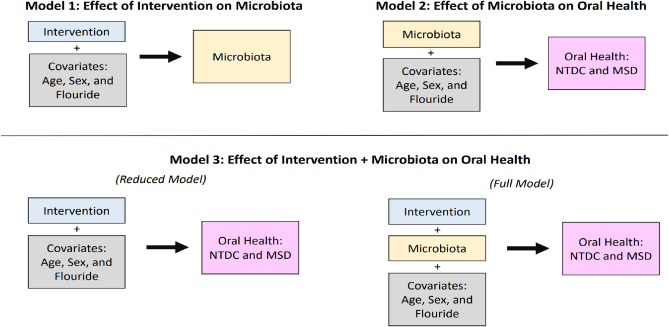
Figure 1
Figure 1
Statistical models used to analyze the interactions between intervention, the microbiota and oral (i.e. dental) health. The rectangles on the left- or right-hand side of the arrows represent groups of variables designated as either predictors (x) or response variables (y), respectively, in a linear regression model. Model 3 is evaluated by fitting the reduced and full model separately, then comparing them to determine whether inclusion of the microbiota improved the prediction of oral health. NTDC, number of dentin caries. MSD, most severe diagnosis.
Figure 2
Figure 2
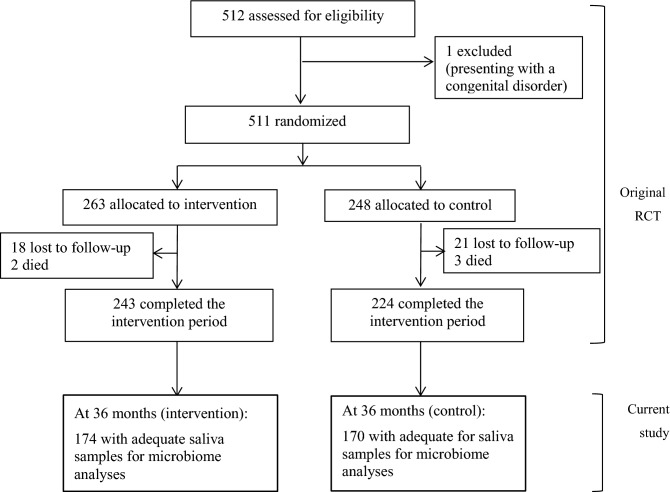
Flowchart showing the inclusion of study participants into the original trial and the current follow-up study. RCT, randomized controlled trial.
Figure 3
Figure 3
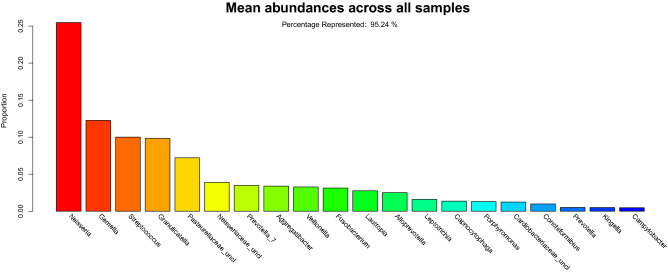
Overall rank abundance bar plot. The rank abundance plot illustrates the average abundance across all samples from the most abundant (Neisseria) to the least abundant (Campylobacter) across the top 20 taxa. The y-axis indicates the proportion of the taxa. The top 20 taxa represent 95.2% of the taxonomic classifications.
Figure 4
Figure 4
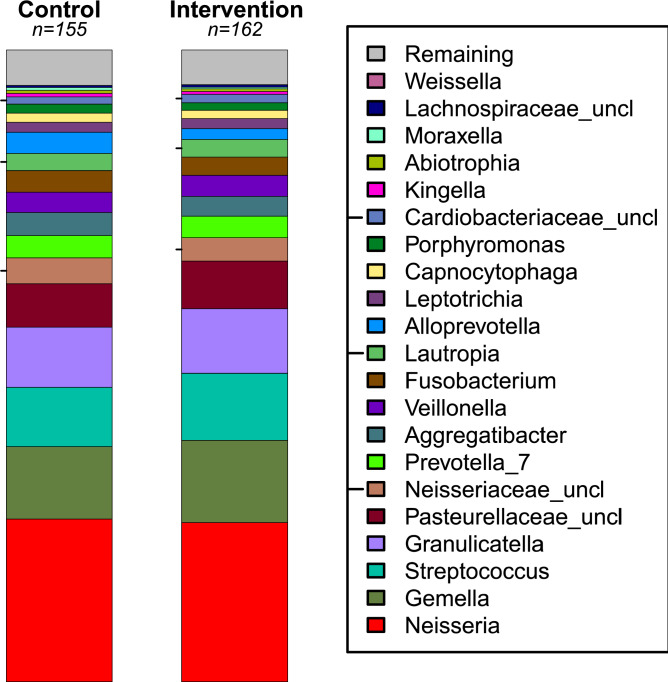
Stacked bar plot comparing control and intervention. The left and right stacked bar plots illustrate the average taxonomic composition of the control (155 subjects) and intervention (162 subjects) groups, respectively. The most and least abundant taxa are depicted at the bottom (Neisseria) and at the top (Weissella), respectively. The “Remaining” category is a placeholder for all the remaining taxa with abundances too low to represent. Tick marks placed on the left margin of the legend are also located by their corresponding position in the stacked bar plot. “Uncl” labeled taxa are reads not classifiable with confidence to the genus level.
Figure 5
Figure 5
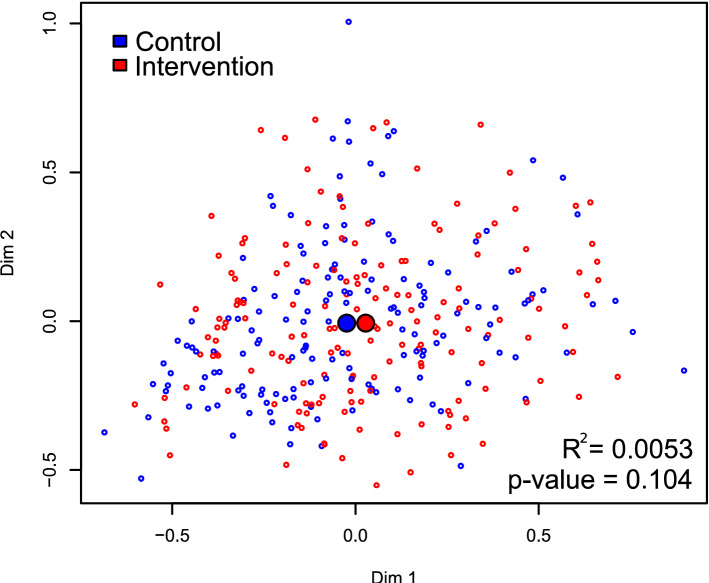
Multidimensional scaling (MDS) plot comparing control and intervention. The spatial separation between points represents the degree of the compositional Manhattan distance of the microbiota between samples. The x and y axes are unitless dimensions, although (0,0) represents the center of mass of all samples. Control and intervention samples are colored blue and red, respectively. The large blue and red circles represent the centroid of each group. PERMANOVA estimated a small difference (R2 = 0.0053) that was marginally statistically insignificant (p-value = 0.104).

References

    1. Atukunda P, Eide WB, Kardel KR, Iversen PO, Westerberg AC. Unlocking the potential for achievement of the UN Sustainable Development Goal 2—“Zero Hunger”—in Africa: Targets, strategies, synergies and challenges. Food Nutr. Res. 2021;65:7686. doi: 10.29219/fnr.v65.7686. - DOI - PMC - PubMed
    1. Peres MA, et al. Oral diseases: A global public health challenge. Lancet. 2019;394:249–260. doi: 10.1016/S0140-6736(19)31146-8. - DOI - PubMed
    1. Hugo FN, Kassebaum NJ, Marcenes W, Bernabé E. Role of dentistry in global health: Challenges and research priorities. J. Dent. Res. 2021;100:681–685. doi: 10.1177/0022034521992011. - DOI - PMC - PubMed
    1. Carpenter GH. Salivary factors that maintain the normal oral commensal microflora. J. Dent. Res. 2020;99:644–649. doi: 10.1177/0022034520915486. - DOI - PMC - PubMed
    1. Birungi N, et al. Effect of breastfeeding promotion on early childhood caries and breastfeeding duration among 5 year old children in Eastern Uganda: A cluster randomized trial. PLoS One. 2015;10:e0125352. doi: 10.1371/journal.pone.0125352. - DOI - PMC - PubMed

Publication types

Substances