


Cognitive control, interference inhibition, and ordering of information during working memory in younger and older healthy adults
- PMID: 35553346
- PMCID: PMC9616976
- DOI: 10.1007/s11357-022-00577-5
Cognitive control, interference inhibition, and ordering of information during working memory in younger and older healthy adults
Abstract
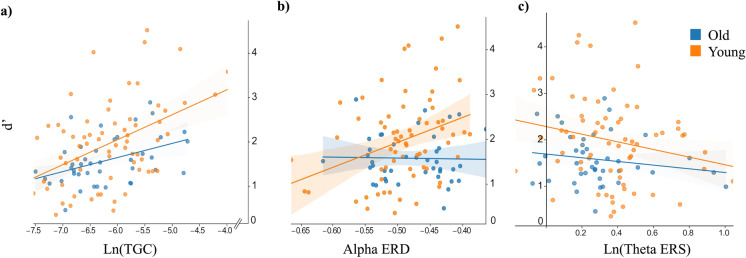
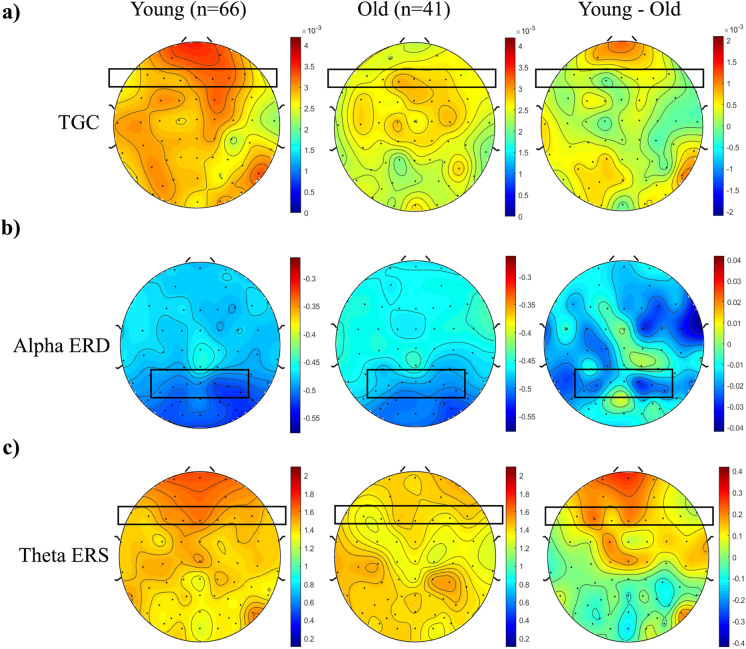
Investigating effects of aging on neurophysiological mechanisms underlying working memory provides a better understanding of potential targets for brain intervention to prevent cognitive decline. Theta-gamma coupling (TGC) indexes the ability to order information processed during working memory tasks. Frontal theta event-related synchronization (ERS) and parietal alpha event-related desynchronization (ERD) index cognitive control and interference inhibition, respectively. Relative contributions of TGC, theta ERS, and alpha ERD in relation to stimulus presentation are not characterized. Further, differential effect of normal aging on pre- or post-stimulus processes is unknown. Electroencephalography was recorded in 66 younger and 41 older healthy participants while performing 3-back working memory task. We assessed relationships between 3-back task performance and each of post-stimulus TGC, pre-stimulus parietal alpha ERD, and pre-stimulus frontal theta ERS in each age group. While older adults performed worse on 3-back task than younger adults, TGC, alpha ERD, or theta ERS did not differ between the two groups. TGC was positively associated with 3-back performance in both age groups; pre-stimulus alpha ERD was associated with performance among younger adults; and pre-stimulus theta ERS was not associated with performance in either group. Our findings suggest that both pre-stimulus interference inhibition and post-stimulus ordering of information are important for working memory in younger adults. In contrast, performance in older adults appears to depend only on post-stimulus ordering of information. These specific contributions of neurophysiological resources may explain the poorer performance of older adults and suggest different targets to enhance working memory in age groups.
Keywords: Aging; EEG; Event-related desynchronization; Event-related synchronization; Theta gamma coupling; Working memory.
© 2022. The Author(s), under exclusive licence to American Aging Association.
Conflict of interest statement
DMB receives research support from the CIHR, NIH, Brain Canada and the Temerty Family Foundation through the CAMH Foundation and the Campbell Research Institute. He received research support and in-kind equipment support for an investigator-initiated study from Brainsway Ltd, and he was the principal site investigator for three sponsor-initiated studies for Brainsway Ltd. He receives in-kind equipment support from Magventure for investigator-initiated research. He received medication supplies for an investigator-initiated trial from Indivior. He has participated in a scientific advisory board meeting for Janssen and Welcony Inc. ZJD has received research and equipment in-kind support for an investigator-initiated study through Brainsway Inc and Magventure Inc. His work was supported by the Canadian Institutes of Health Research (CIHR), the National Institutes of Mental Health (NIMH), and the Temerty Family and Grant Family and through the Centre for Addiction and Mental Health (CAMH) Foundation and the Campbell Institute. CEF receives grant funding from Brain Canada, Patient Centred Outcomes Research Institute (PCORI), St. Michaels Hospital Foundation, Hoffman LaRoche and Vielight Inc. AJF has received grant support from the U.S. National Institutes of Health, the Patient-Centered Outcomes Research Institute, the Canadian Institutes of Health Research, Brain Canada, the Ontario Brain Institute, the Alzheimer’s Association, AGE-WELL, and the Canadian Foundation for Healthcare Improvement. KLL has grant support from the U.S. National Institutes of Health, the Canadian Institutes of Health Research, the Weston Brain Institute, the Alzheimer’s Drug Discovery Foundation, and the Alzheimer’s Association, has received consultation fees from Acadia, BioXcel Therapeutics, Cerevel Therapeutics, ICG Pharma, Kondor Pharma, Otsuka, and holds stock options in Highmark Interactive. SK has received grant support from Brain Canada, NIH, Brain and Behavior Foundation (NARSAD), BrightFocus Foundation, Weston Brain Institute, Canadian Centre for Aging and Brain Health Innovation, CAMH foundation and University of Toronto, and in Kind equipment support from Soterix Medical Inc. BHM holds and receives support from the Labatt Family Chair in Biology of Depression in Late-Life Adults at the University of Toronto. He currently receives research support from Brain Canada, the Canadian Institutes of Health Research, the CAMH Foundation, the Patient-Centered Outcomes Research Institute (PCORI), the US National Institute of Health (NIH), Capital Solution Design LLC (software used in a study founded by CAMH Foundation), and HAPPYneuron (software used in a study founded by Brain Canada). Within the past 5 years, he has also received research support from Eli Lilly (medications for a NIH-funded clinical trial) and Pfizer (medications for a NIH-funded clinical trial). TKR has received research support from Brain Canada, Brain and Behavior Research Foundation, BrightFocus Foundation, Canada Foundation for Innovation, Canada Research Chair, Canadian Institutes of Health Research, Centre for Aging and Brain Health Innovation, National Institutes of Health, Ontario Ministry of Health and Long-Term Care, Ontario Ministry of Research and Innovation, and the Weston Brain Institute. TKR also received in-kind equipment support for an investigator-initiated study from Magstim, and in-kind research accounts from Scientific Brain Training Pro. TKR participated in 2021 in an advisory board for Biogen Canada Inc. TKR is also an inventor on the United States Provisional Patent No. 17/396,030 that describes cell-based assays and kits for assessing serum cholinergic receptor activity.
Figures
References
Publication types
MeSH terms
LinkOut - more resources
Full Text Sources
Medical
