


Human Gut Microbiome Across Different Lifestyles: From Hunter-Gatherers to Urban Populations
- PMID: 35558108
- PMCID: PMC9087276
- DOI: 10.3389/fmicb.2022.843170
Human Gut Microbiome Across Different Lifestyles: From Hunter-Gatherers to Urban Populations
Erratum in
-
Corrigendum: Human gut microbiome across different lifestyles: from hunter-gatherers to urban populations.Front Microbiol. 2024 Jul 3;15:1435763. doi: 10.3389/fmicb.2024.1435763. eCollection 2024. Front Microbiol. 2024. PMID: 39021628 Free PMC article.
Abstract
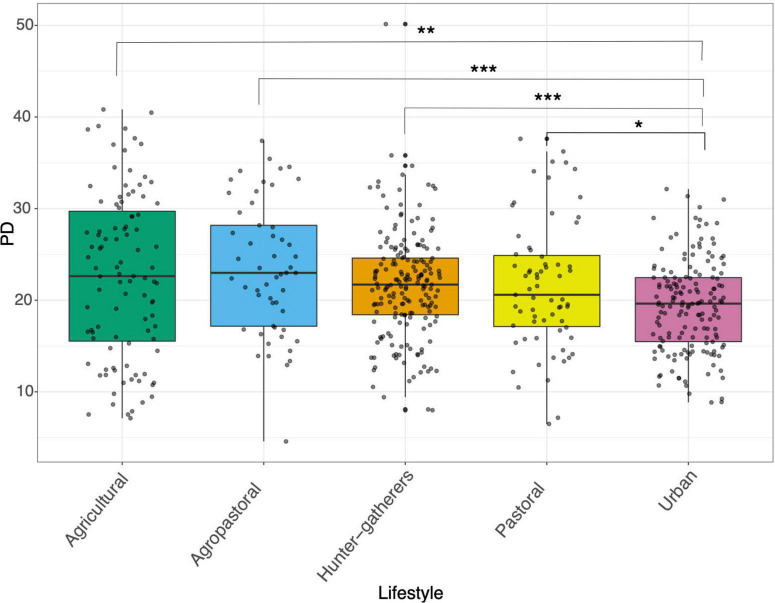
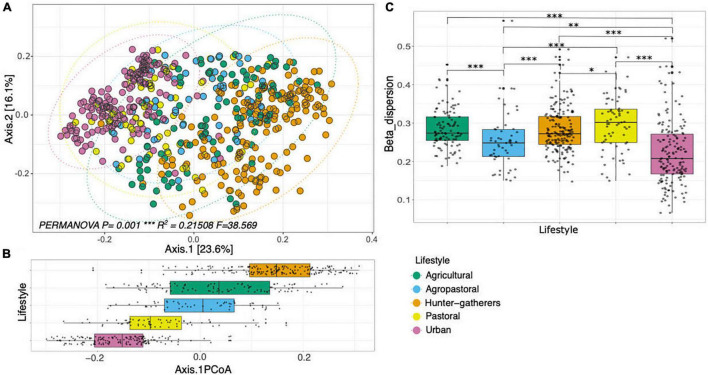
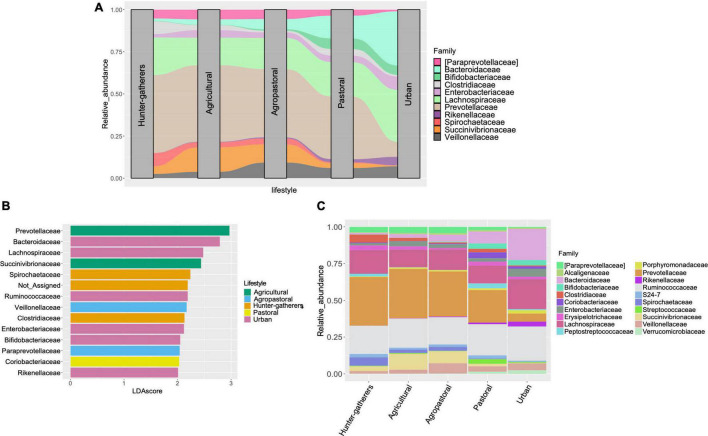
Human lifestyle and its relationship with the human microbiome has been a line of research widely studied. This is because, throughout human history, civilizations have experienced different environments and lifestyles that could have promoted changes in the human microbiome. The comparison between industrialized and non-industrialized human populations in several studies has allowed to observe variation in the microbiome structure due to the population lifestyle. Nevertheless, the lifestyle of human populations is a gradient where several subcategories can be described. Yet, it is not known how these different lifestyles of human populations affect the microbiome structure on a large scale. Therefore, the main goal of this work was the collection and comparison of 16S data from the gut microbiome of populations that have different lifestyles around the world. With the data obtained from 14 studies, it was possible to compare the gut microbiome of 568 individuals that represent populations of hunter-gatherers, agricultural, agropastoral, pastoral, and urban populations. Results showed that industrialized populations present less diversity than those from non-industrialized populations, as has been described before. However, by separating traditional populations into different categories, we were able to observe patterns that cannot be appreciated by encompassing the different traditional lifestyles in a single category. In this sense, we could confirm that different lifestyles exhibit distinct alpha and beta diversity. In particular, the gut microbiome of pastoral and agropastoral populations seems to be more similar to those of urban populations according to beta diversity analysis. Beyond that, beta diversity analyses revealed that bacterial composition reflects the different lifestyles, representing a transition from hunters-gatherers to industrialized populations. Also, we found that certain groups such as Bacteoidaceae, Lanchospiraceae, and Rickenellaceae have been favored in the transition to modern societies, being differentially abundant in urban populations. Thus, we could hypothesize that due to adaptive/ecological processes; multifunctional bacterial groups (e.g., Bacteroidaceae) could be replacing some functions lost in the transition to modern lifestyle.
Keywords: 16S r RNA; bacterial diversity; gut microbiome; lifestyles; meta-analysis.
Copyright © 2022 Rosas-Plaza, Hernández-Terán, Navarro-Díaz, Escalante, Morales-Espinosa and Cerritos.
Conflict of interest statement
The authors declare that the research was conducted in the absence of any commercial or financial relationships that could be construed as a potential conflict of interest.
Figures
References
LinkOut - more resources
Full Text Sources
