The Effect of Walnut (Juglans regia) Leaf Extract on Glycemic Control and Lipid Profile in Patients With Type 2 Diabetes Mellitus: A Systematic Review and Meta-Analysis of Randomized Clinical Trials
- PMID: 35558998
- PMCID: PMC9065396
- DOI: 10.7762/cnr.2022.11.2.120
The Effect of Walnut (Juglans regia) Leaf Extract on Glycemic Control and Lipid Profile in Patients With Type 2 Diabetes Mellitus: A Systematic Review and Meta-Analysis of Randomized Clinical Trials
Abstract
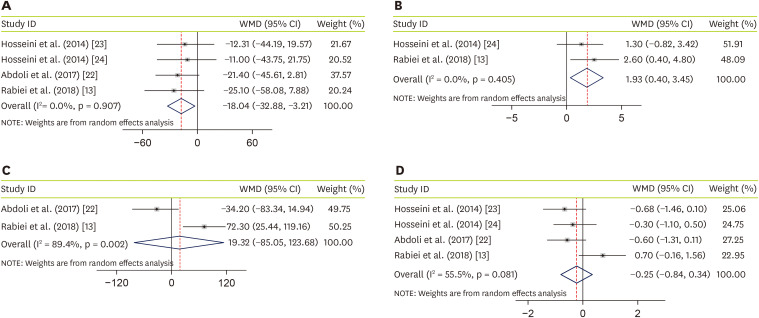
Numerous clinical trials have examined the beneficial effects of Juglans regia leaf extract (JRLE) in patients with type 2 diabetes mellitus (T2DM); however, the results of these studies are inconsistent. Therefore, we conducted the current systematic review and meta-analysis to evaluate the effect of JRLE on glycemic control and lipid profile in T2DM patients. We searched online databases including PubMed, Scopus, EMBASE, and Web of Science for randomized controlled clinical trials that examined the effect of JRLE on glycemic and lipid indices in T2DM patients. Data were pooled using both fixed and random-effect models and weighted mean difference (WMD) was considered as the overall effect size. Of the total records, 4 eligible studies, with a total sample size of 195 subjects, were included. The meta-analysis revealed that JRLE supplementation significantly reduces fasting blood glucose (WMD, -18.04; 95% confidence interval [CI], -32.88 mg/dL, -3.21 mg/dL; p = 0.017) and significantly increases fasting insulin level (WMD, 1.93; 95% CI, 0.40 U/L, 3.45 U/L; p = 0.014). Although the overall effect of JRLE supplementation on hemoglobin A1c was not significant, a significant reduction was seen in studies with an intervention duration of > 8 weeks (WMD, -0.64; 95% CI, -1.16%, -0.11%; p = 0.018). Moreover, we also found no significant change in lipid parameters. Our findings revealed a beneficial effect of JRLE supplementation on glycemic indices in T2DM patients, but no significant improvement was found for lipid profile parameters.
Keywords: Diabetes mellitus; Glycemic control; HDL-cholesterol; Juglans; LDL-cholesterol; cholesterol.
Copyright © 2022. The Korean Society of Clinical Nutrition.
Conflict of interest statement
Conflict of Interest: The authors declare that they have no competing interests.
Figures



References
-
- Whiting DR, Guariguata L, Weil C, Shaw J. IDF diabetes atlas: global estimates of the prevalence of diabetes for 2011 and 2030. Diabetes Res Clin Pract. 2011;94:311–321. - PubMed
-
- Wild S, Roglic G, Green A, Sicree R, King H. Global prevalence of diabetes: estimates for the year 2000 and projections for 2030. Diabetes Care. 2004;27:1047–1053. - PubMed
-
- Chatterjee S, Khunti K, Davies MJ. Type 2 diabetes. Lancet. 2017;389:2239–2251. - PubMed
-
- Mooradian AD. Dyslipidemia in type 2 diabetes mellitus. Nat Clin Pract Endocrinol Metab. 2009;5:150–159. - PubMed
-
- Haffner SM American Diabetes Association. Management of dyslipidemia in adults with diabetes. Diabetes Care. 2003;26(Suppl 1):S83–S86. - PubMed
LinkOut - more resources
Full Text Sources