


Reliability of heart rate variability during stable and disrupted polysomnographic sleep
- PMID: 35559723
- PMCID: PMC9169847
- DOI: 10.1152/ajpheart.00143.2022
Reliability of heart rate variability during stable and disrupted polysomnographic sleep
Abstract
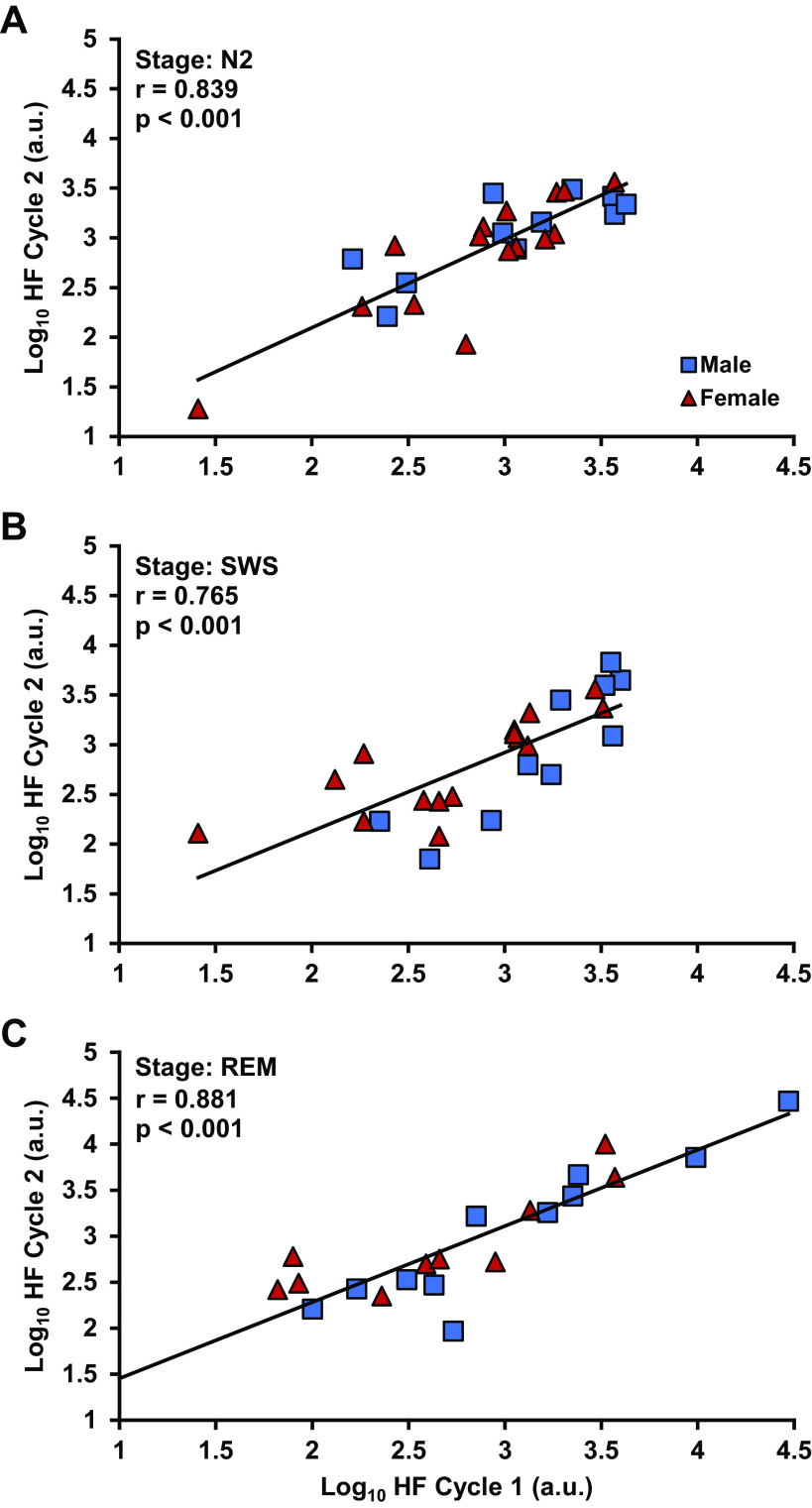
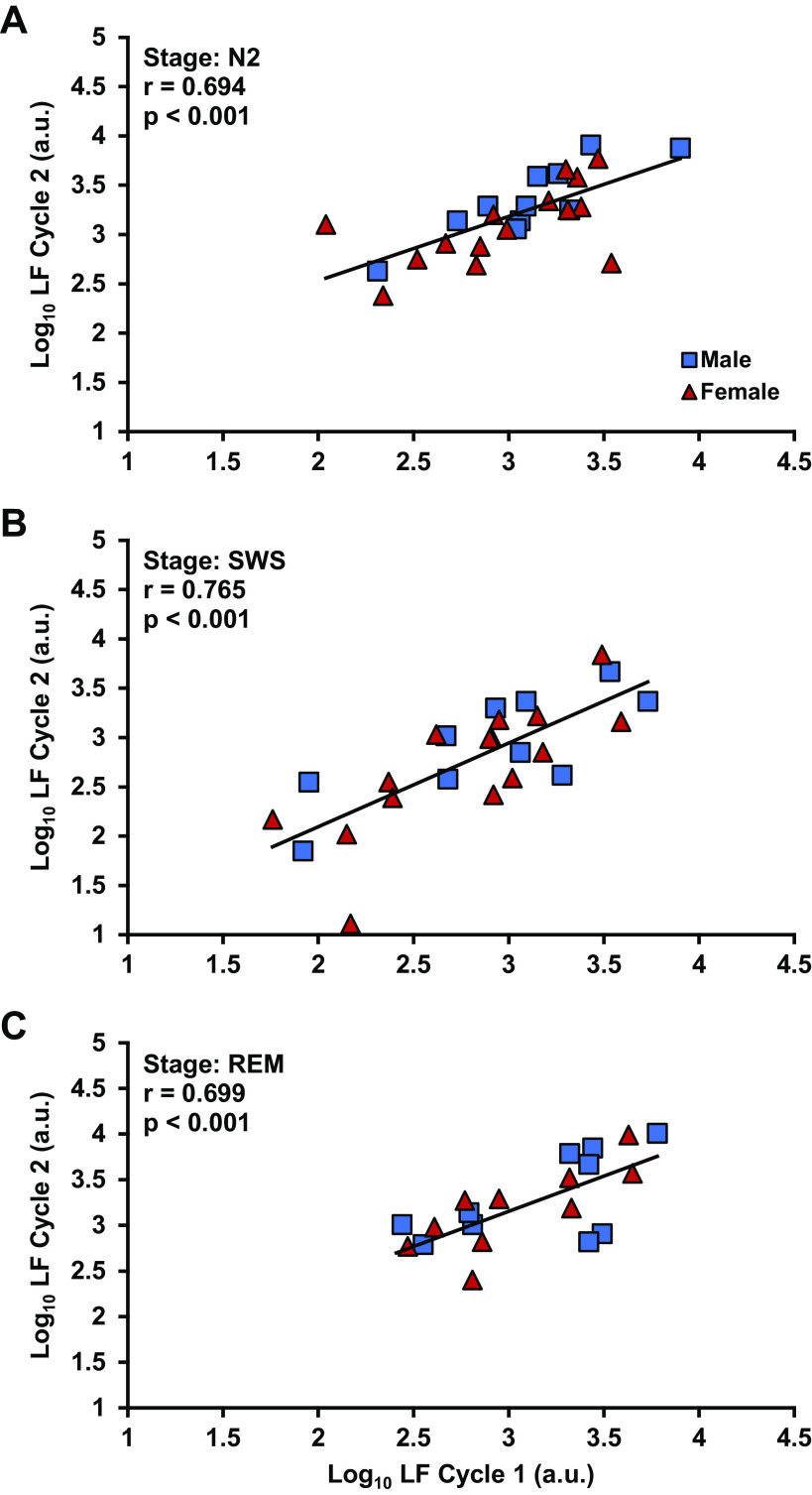
Heart rate variability (HRV) is commonly used within sleep and cardiovascular research, yet HRV reliability across various sleep stages remains equivocal. The present study examined the reliability of frequency- and time-domain HRV within stage-2 (N2), slow-wave (SWS), and rapid-eye-movement (REM) sleep during both stable and disrupted sleep. We hypothesized that high-frequency (HF) HRV would be reliable in all three sleep stages, low-frequency (LF) HRV would be reliable during N2 and SWS, and that disrupted sleep via spontaneous cortical arousals would decrease HRV reliability. Twenty-seven participants (11 men, 16 women, 26 ± 1 yr) were equipped with laboratory polysomnography for 1 night. Both frequency- and time-domain HRV were analyzed in two 5- to 10-min blocks during multiple stable and disrupted sleep cycles across N2, SWS, and REM sleep. HF HRV was highly correlated across stable N2 (r = 0.839, P < 0.001), SWS (r = 0.765, P < 0.001), and REM (r = 0.881, P < 0.001). LF HRV was moderate-to-highly correlated during stable cycles of N2 sleep (r = 0.694, P < 0.001), SWS, (r = 0.765, P < 0.001), and REM (r = 0.699, P < 0.001) sleep. When stable sleep was compared with disrupted sleep, both time- and frequency-domain HRV were reliable (α > 0.90, P < 0.05) in N2, SWS, and REM, except for LF HRV during SWS (α = 0.62, P = 0.089). In conclusion, time- and frequency-domain HRV demonstrated reliability across stable N2, SWS, and REM sleep, and remained reliable during disrupted sleep. These findings support the use of HRV during sleep as a tool for assessing cardiovascular health and risk stratification.NEW & NOTEWORTHY Heart rate variability (HRV) is a commonly employed indirect estimate of cardiac autonomic activity during sleep with limited reliability studies. Nocturnal frequency-domain HRV was reliable across differing stable sleep cycles of stage-2 (N2), slow-wave (SWS), and rapid-eye-movement (REM) sleep. Moreover, frequency- and time-domain HRV were reliable during stable and disturbed sleep, except SWS low-frequency HRV. Our finding supports nocturnal HRV as a potential tool for cardiovascular risk stratification.
Keywords: autonomic control; cardiovascular health; cortical arousals; sleep disorders.
Conflict of interest statement
No conflicts of interest, financial or otherwise, are declared by the authors.
Jason Carter is an associate editor of
Figures
References
-
- Makivić B, Nikić Djordjević M, Willis MS. . Heart rate variability (HRV) as a tool for diagnostic and monitoring performance in sport and physical activities. J Exer Physiol Online 16: 103–131, 2013.
Publication types
MeSH terms
Grants and funding
LinkOut - more resources
Full Text Sources
Research Materials
Miscellaneous
