. 2022 May 13;17(5):e0267967.
doi: 10.1371/journal.pone.0267967. eCollection 2022.

Quantitative glycoproteomics of human milk and association with atopic disease

Affiliations

Quantitative glycoproteomics of human milk and association with atopic disease

Matilda Holm et al. PLoS One. .

Abstract

The prevalence of allergic diseases and asthma is increasing rapidly worldwide, with environmental and lifestyle behaviors implicated as a reason. Epidemiological studies have shown that children who grow up on farms are at lower risk of developing childhood atopic disease, indicating the presence of a protective "farm effect". The Old Order Mennonite (OOM) community in Upstate New York have traditional, agrarian lifestyles, a low rate of atopic disease, and long periods of exclusive breastfeeding. Human milk proteins are heavily glycosylated, although there is a paucity of studies investigating the milk glycoproteome. In this study, we have used quantitative glycoproteomics to compare the N-glycoprotein profiles of 54 milk samples from Rochester urban/suburban and OOM mothers, two populations with different lifestyles, exposures, and risk of atopic disease. We also compared N-glycoprotein profiles according to the presence or absence of atopic disease in the mothers and, separately, the children. We identified 79 N-glycopeptides from 15 different proteins and found that proteins including immunoglobulin A1, polymeric immunoglobulin receptor, and lactotransferrin displayed significant glycan heterogeneity. We found that the abundances of 38 glycopeptides differed significantly between Rochester and OOM mothers and also identified four glycopeptides with significantly different abundances between all comparisons. These four glycopeptides may be associated with the development of atopic disease. The findings of this study suggest that the differential glycosylation of milk proteins could be linked to atopic disease.


Conflict of interest statement

The authors have declared that no competing interests exist.

Figures
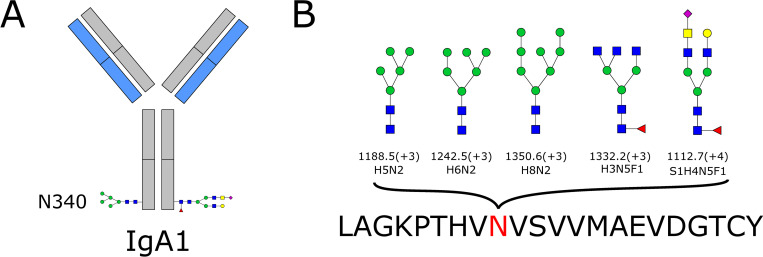
Fig 1
Fig 1
A) IgA1 with N-glycosylation site 340 shown. B) The five different glycan compositions identified at site 340 of IgA1. Five different N-glycopeptides were identified that belonged to IgA1 and contained glycans attached at site 340. Fig 1A shows IgA1 with two of these glycans as an example (it is not possible to determine if these two glycans were both detected on the same IgA1 antibody). The heavy chains are shown in gray and the light chains in blue. The three high-mannose N-glycans and two complex-type N-glycans identified at site 340 are shown in Fig 1B. Monosaccharide symbols follow the SNFG (Symbol Nomenclature for Glycans) system [18]. The m/z value and charge are given below the glycan structures. For the glycan structures, the following abbreviations were used: H = hexose, N = N-acetylhexosamine, F = fucose, S = sialic acid. The peptide sequence is given at the bottom of the figure, with asparagine (N) being the amino acid to which the glycan is linked. L = leucine, A = alanine, G = glycine, K = lysine, P = proline, T = threonine, H = histidine, V = valine, S = serine, M = methionine, E = glutamic acid, D = aspartic acid, C = cysteine, Y = tyrosine.
Fig 2
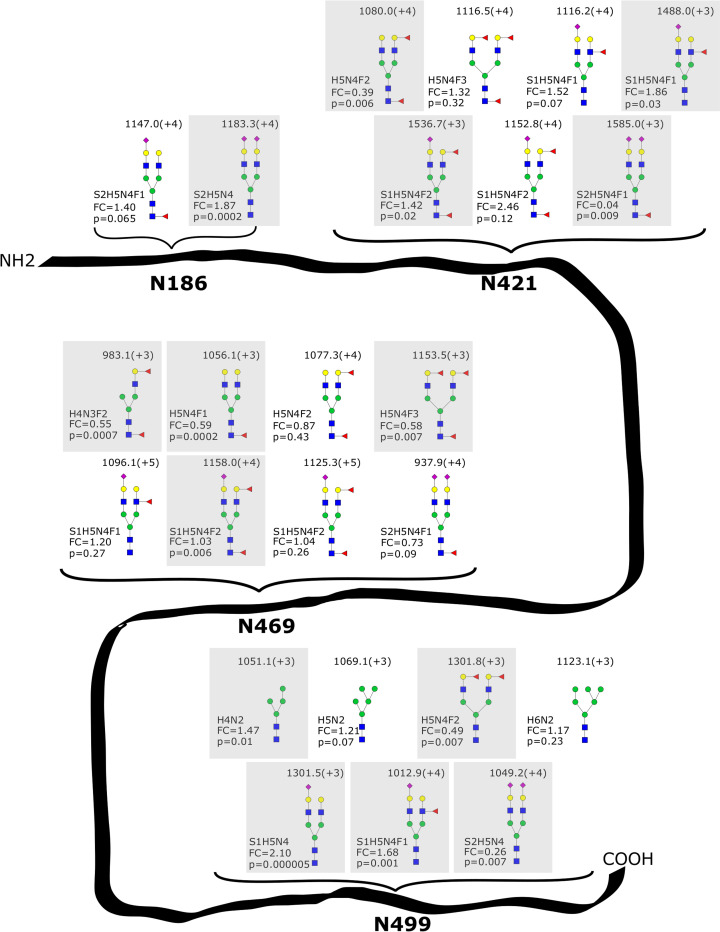
Fig 2. The 24 glycan compositions identified belonging to N-glycopeptides that were part of pIgR.
Two glycan compositions were identified at site 186, seven at site 421, eight at site 469, and seven at site 499. The m/z value and charge are given above the glycan structures. Monosaccharide symbols follow the SNFG (Symbol Nomenclature for Glycans) system [18]. For the glycan structures, the following abbreviations were used: H = hexose, N = N-acetylhexosamine, F = fucose, S = sialic acid. Gray boxes indicate a significant (p<0.05) p-value. The fold change (FC) when abundances were compared between Rochester and OOM mothers is also given, with values greater than 1 indicating a higher abundance of the glycopeptide containing that specific glycan composition in Rochester mothers and values less than 1 indicating a higher abundance in OOM mothers. NH2 indicates the N-terminus and COOH the C-terminus of the protein.
Fig 3
Fig 3
(A) The Venn diagram showing the significant N-glycopeptides identified in each comparison in relation to each other. (B) The three glycan compositions with significantly different abundances in all three comparisons in this study. Monosaccharide symbols follow the SNFG (Symbol Nomenclature for Glycans) system [18]. For the glycan structures, the following abbreviations were used: H = hexose, N = N-acetylhexosamine, F = fucose, S = sialic acid. The m/z value and charge are given to the left of the glycan structures. OOM = Old Order Mennonites. IgA1 = immunoglobulin A1. pIgR = polymeric immunoglobulin receptor.

References

    1. Pawankar R. Allergic diseases and asthma: a global public health concern and a call to action. World Allergy Organ J. 2014;7(1):12. doi: 10.1186/1939-4551-7-12 - DOI - PMC - PubMed
    1. Martina C, Looney RJ, Marcus C, Allen M, Stahlhut R. Prevalence of allergic disease in Old Order Mennonites in New York. Ann Allergy Asthma Immunol. 2016;117(5):562–3 e1. doi: 10.1016/j.anai.2016.08.023 - DOI - PMC - PubMed
    1. Friedman NJ, Zeiger RS. The role of breast-feeding in the development of allergies and asthma. J Allergy Clin Immunol. 2005;115(6):1238–48. doi: 10.1016/j.jaci.2005.01.069 - DOI - PubMed
    1. Järvinen KM, Bergmann KE, Bergmann R. 15—Breast—Always Best? In: Wahn U, Sampson HA, editors. Allergy, Immunity and Tolerance in Early Childhood. Amsterdam: Academic Press; 2016. p. 235–60.

    1. Elbert NJ, van Meel ER, den Dekker HT, de Jong NW, Nijsten TEC, Jaddoe VWV, et al. Duration and exclusiveness of breastfeeding and risk of childhood atopic diseases. Allergy. 2017;72(12):1936–43. doi: 10.1111/all.13195 - DOI - PubMed

Publication types