


Causal assessment in evidence synthesis: A methodological review of reviews
- PMID: 35560730
- PMCID: PMC9543433
- DOI: 10.1002/jrsm.1569
Causal assessment in evidence synthesis: A methodological review of reviews
Abstract
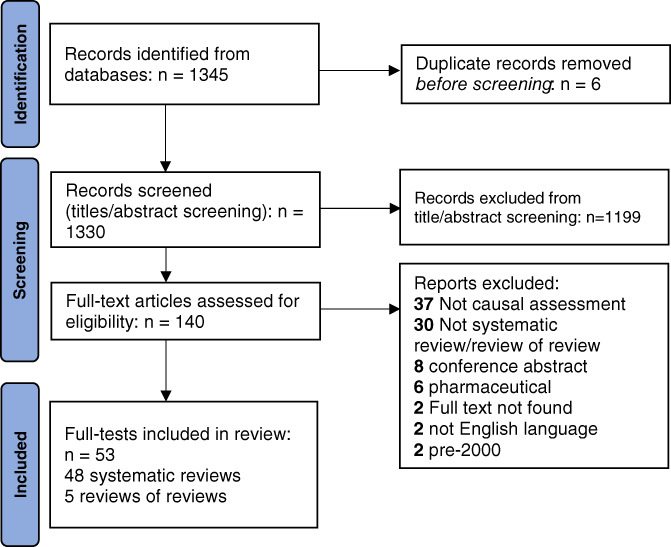
In fields (such as population health) where randomised trials are often lacking, systematic reviews (SRs) can harness diversity in study design, settings and populations to assess the evidence for a putative causal relationship. SRs may incorporate causal assessment approaches (CAAs), sometimes called 'causal reviews', but there is currently no consensus on how these should be conducted. We conducted a methodological review of self-identifying 'causal reviews' within the field of population health to establish: (1) which CAAs are used; (2) differences in how CAAs are implemented; (3) how methods were modified to incorporate causal assessment in SRs. Three databases were searched and two independent reviewers selected reviews for inclusion. Data were extracted using a standardised form and summarised using tabulation and narratively. Fifty-three reviews incorporated CAAs: 46/53 applied Bradford Hill (BH) viewpoints/criteria, with the remainder taking alternative approaches: Medical Research Council guidance on natural experiments (2/53, 3.8%); realist reviews (2/53, 3.8%); horizontal SRs (1/53, 1.9%); 'sign test' of causal mechanisms (1/53, 1.9%); and a causal cascade model (1/53, 1.9%). Though most SRs incorporated BH, there was variation in application and transparency. There was considerable overlap across the CAAs, with a trade-off between breadth (BH viewpoints considered a greater range of causal characteristics) and depth (many alternative CAAs focused on one viewpoint). Improved transparency in the implementation of CAA in SRs in needed to ensure their validity and allow robust assessments of causality within evidence synthesis.
Keywords: causal assessment; causality; population health; systematic review.
© 2022 The Authors. Research Synthesis Methods published by John Wiley & Sons Ltd.
Conflict of interest statement
The authors declare there is no conflict of interest.
Figures
References
-
- Haneuse S, Rothman KJ. Stratification and standardization. In: Rothman KJ, ed. Modern Epidemiology. 4th ed. Wolters Kluwer; 2021.
Publication types
MeSH terms
Grants and funding
LinkOut - more resources
Full Text Sources
