Review
. 2022 May 13;27(1):37.
doi: 10.1186/s11658-022-00338-4.

Lectins and lectibodies: potential promising antiviral agents

Affiliations
Review

Lectins and lectibodies: potential promising antiviral agents

Mohsen Nabi-Afjadi et al. Cell Mol Biol Lett. .

Abstract

In nature, lectins are widely dispersed proteins that selectively recognize and bind to carbohydrates and glycoconjugates via reversible bonds at specific binding sites. Many viral diseases have been treated with lectins due to their wide range of structures, specificity for carbohydrates, and ability to bind carbohydrates. Through hemagglutination assays, these proteins can be detected interacting with various carbohydrates on the surface of cells and viral envelopes. This review discusses the most robust lectins and their rationally engineered versions, such as lectibodies, as antiviral proteins. Fusion of lectin and antibody's crystallizable fragment (Fc) of immunoglobulin G (IgG) produces a molecule called a "lectibody" that can act as a carbohydrate-targeting antibody. Lectibodies can not only bind to the surface glycoproteins via their lectins and neutralize and clear viruses or infected cells by viruses but also perform Fc-mediated antibody effector functions. These functions include complement-dependent cytotoxicity (CDC), antibody-dependent cell-mediated cytotoxicity (ADCC), and antibody-dependent cell-mediated phagocytosis (ADCP). In addition to entering host cells, the severe acute respiratory syndrome coronavirus 2 (SARS-CoV-2) spike protein S1 binds to angiotensin-converting enzyme 2 (ACE2) and downregulates it and type I interferons in a way that may lead to lung disease. The SARS-CoV-2 spike protein S1 and human immunodeficiency virus (HIV) envelope are heavily glycosylated, which could make them a major target for developing vaccines, diagnostic tests, and therapeutic drugs. Lectibodies can lead to neutralization and clearance of viruses and cells infected by viruses by binding to glycans located on the envelope surface (e.g., the heavily glycosylated SARS-CoV-2 spike protein).

Keywords: Carbohydrates; EBV; HCV; HIV; Lectibody; Lectins; SARS-CoV-2; Virus envelope.


Conflict of interest statement

The authors declare that they have no competing interests.

Figures
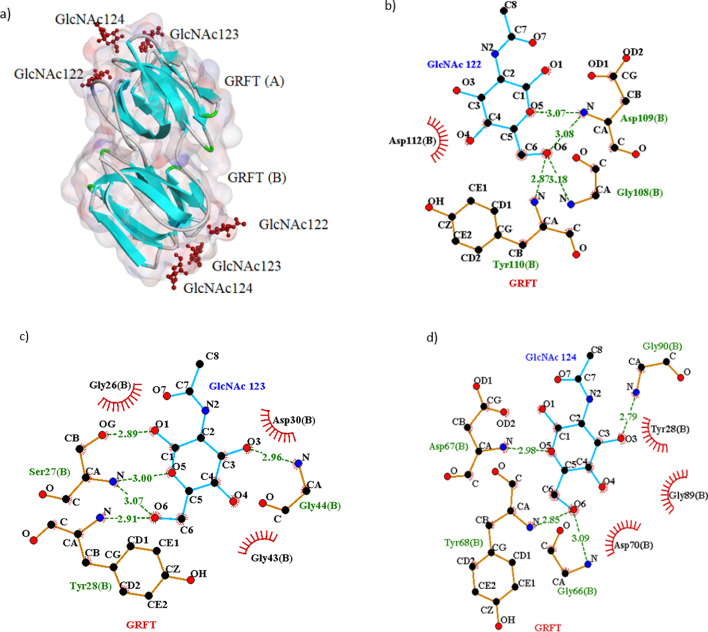
Fig. 1
Fig. 1
Interaction between lectin griffithsin (GRFT) (PDB ID: 2NU5) that was homodimer (A and B chain) with N-acetylglucosamine (GlcNAc) as ligand. a The interacting domains of the lectin with GlcNAc, depicted by BIOVIA Discovery Studio Visualizer, are shown. In the figure, the lectin is shown schematically in blue, while ligands are shown in scaled ball-and-stick style in red. bd Residues and atoms participating in the interaction between B chain of the lectin and three residues of ligand (GlcNAc 122, 123 and 124), depicted by using the LigPlot+ v.2.2 program [15]. The bonds shown by dashed lines in olive-green color represent hydrogenic bonds, while the bonds shown by radius lines in brick-red color represent hydrophobic bonds. The numbers on the hydrogen bond show bond distances. Note: Two carbohydrates of N-acetylglucosamine and mannose are contained in SARS-CoV-2 surface glycan, and the residues are exposed to the innate immune system [16]. So, the crystal structure of complexes of antiviral lectin GRFT with glucose and N-acetylglucosamine were solved and refined at high resolution. In both complexes, all six monosaccharide-binding sites of GRFT were occupied, and the mode of binding was similar to that of mannose [17]. Therefore, as an example of multiple lectins, the interaction pattern of GRFT with GlcNAc is selected to be shown in the figure
Fig. 2
Fig. 2
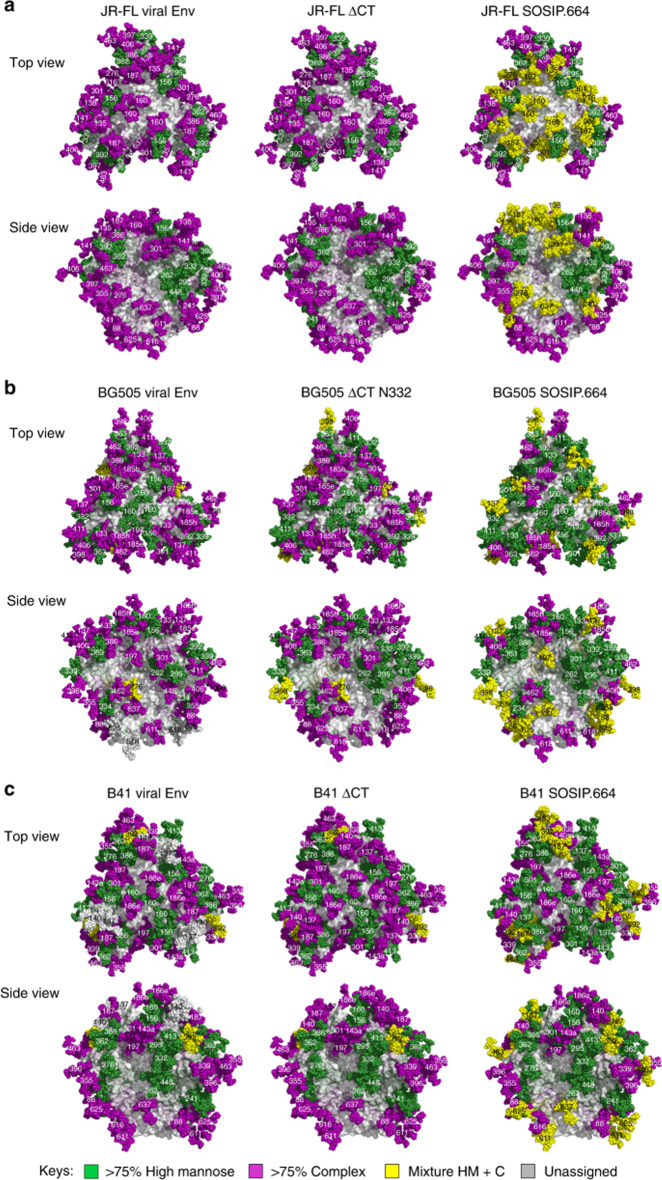
Map of site-specific N-glycan processing onto the structure of HIV-1 envelope: a JR-FL strain, b BG505 strain, and c B41 strain. The fully glycosylated models were created with JR-FL ΔCT (PDB: 5FUU), BG505 SOSIP (PDB: 5FYK), and B41 SOSIP. The surfaces of the trimers are represented in grey, and the glycans are represented as spheres colored by the proportion of oligomannose content at that site. The glycans are shown in ball-and-stick representation: > 75% high mannose (green), > 75% complex type glycosylation (purple), mixture of high mannose and complex type glycosylation (25% < high-mannose glycosylation < 75%) (yellow), and the glycosites that were not detected (gray) [25]
Fig. 3
Fig. 3
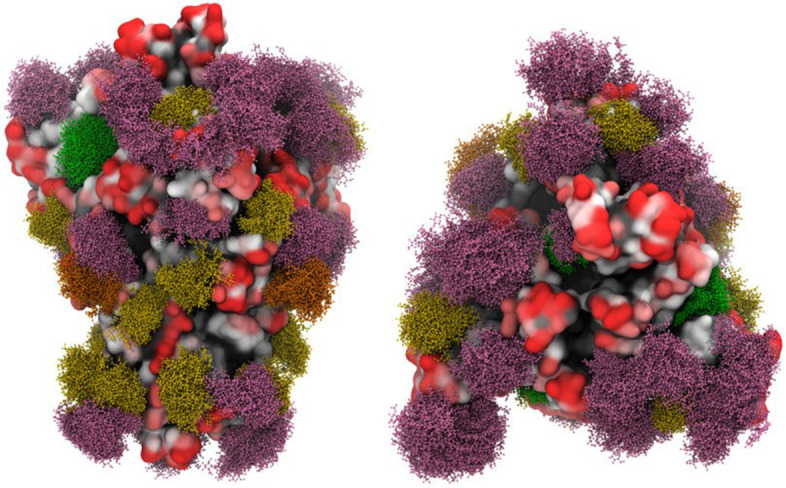
Overlay of snapshots from molecular dynamics (MD) simulation of SARS-CoV-2 S glycoprotein with site-specific glycosylation. The glycans are shown in ball-and-stick representation: high mannose (green), paucimannose (dark yellow), hybrid (orange), and biantennary complex (purple) [82]
Fig. 4
Fig. 4
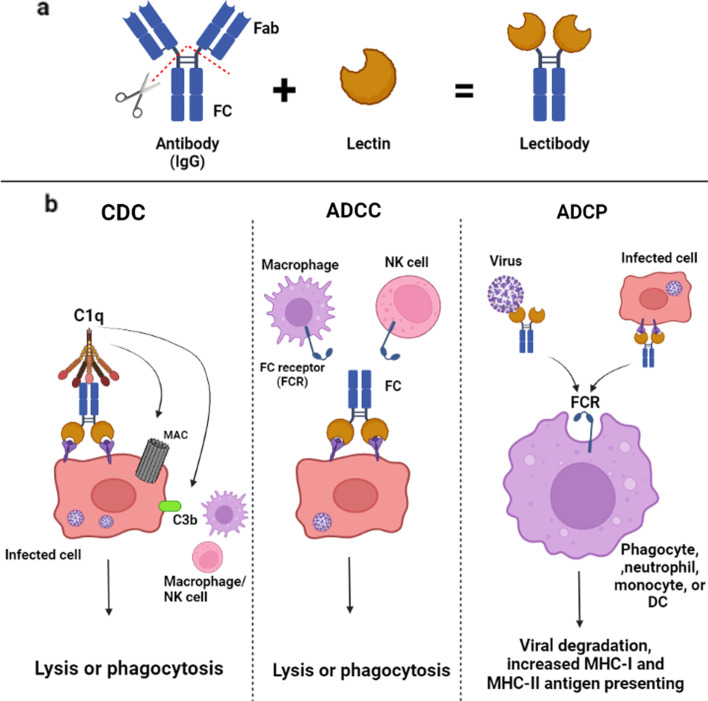
a Fusion of lectin and antibody’s crystallizable fragment (Fc) of immunoglobulin G (IgG) produces a molecule called a “lectibody.” b Lectibodies can bind to surface glycoproteins via their lectins, neutralize viruses or cells infected by viruses, and help the innate and adaptive immune systems function against pathogens through functions including complement-dependent cytotoxicity (CDC), antibody-dependent cell-mediated cytotoxicity (ADCC), and antibody-dependent cell-mediated phagocytosis (ADCP)

References

    1. Santos AF, Da Silva M, Napoleão T, Paiva P, Correia MdS, Coelho L. Lectins: function, structure, biological properties and potential applications. 2014.
    1. Elgavish S, Shaanan B. Lectin-carbohydrate interactions: different folds, common recognition principles. Trends Biochem Sci. 1997;22:462–467. doi: 10.1016/S0968-0004(97)01146-8. - DOI - PubMed
    1. Bah CSF, Fang EF, Ng TB. Medicinal applications of plant lectins. Antitumor Potential and other Emerging Medicinal Properties of Natural Compounds. 2013:55–74.
    1. Tsaneva M, Van Damme EJ. 130 years of plant lectin research. Glycoconj J. 2020:1–19.
    1. Singh RS, Walia AK. Lectins from red algae and their biomedical potential. J Appl Phycol. 2018;30:1833–1858. doi: 10.1007/s10811-017-1338-5. - DOI - PMC - PubMed