. 2022 Apr 19;23(9):4507.
doi: 10.3390/ijms23094507.

Identification of TALE Transcription Factor Family and Expression Patterns Related to Fruit Chloroplast Development in Tomato (Solanum lycopersicum L.)

Affiliations

Identification of TALE Transcription Factor Family and Expression Patterns Related to Fruit Chloroplast Development in Tomato (Solanum lycopersicum L.)

Jin Wang et al. Int J Mol Sci. .

Abstract

The TALE gene family is an important transcription factor family that regulates meristem formation, organ morphogenesis, signal transduction, and fruit development. A total of 24 genes of the TALE family were identified and analyzed in tomato. The 24 SlTALE family members could be classified into five BELL subfamilies and four KNOX subfamilies. SlTALE genes were unevenly distributed on every tomato chromosome, lacked syntenic gene pairs, and had conserved structures but diverse regulatory functions. Promoter activity analysis showed that cis-elements responsive to light, phytohormone, developmental regulation, and environmental stress were enriched in the promoter of SlTALE genes, and the light response elements were the most abundant. An abundance of TF binding sites was also enriched in the promoter of SlTALE genes. Phenotype identification revealed that the green shoulder (GS) mutant fruits showed significantly enhanced chloroplast development and chlorophyll accumulation, and a significant increase of chlorophyll fluorescence parameters in the fruit shoulder region. Analysis of gene expression patterns indicated that six SlTALE genes were highly expressed in the GS fruit shoulder region, and four SlTALE genes were highly expressed in the parts with less-developed chloroplasts. The protein-protein interaction networks predicted interaction combinations among these SlTALE genes, especially between the BELL subfamilies and the KNOX subfamilies, indicating a complex regulatory network of these SlTALE genes in chloroplast development and green fruit shoulder formation. In conclusion, our result provides detailed knowledge of the SlTALE gene for functional research and the utilization of the TALE gene family in fruit quality improvement.

Keywords: TALE; chloroplast development; fruit development; regulatory function; tomato.


Conflict of interest statement

The authors declare no conflict of interest. The funders had no role in the design of the study; in the collection, analyses, or interpretation of data; in the writing of the manuscript, or in the decision to publish the results.

Figures
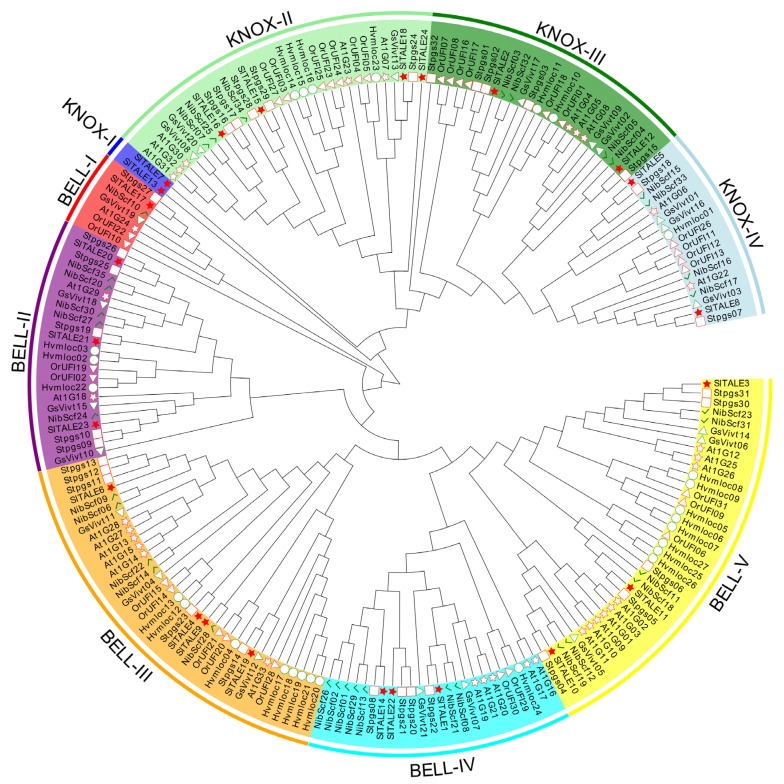
Figure 1
Figure 1
Phylogenetic tree of the TALE family. Phylogenetic relationships among 203 TALE proteins in Solanum lycopersicum, Solanum tuberosum, Arabidopsis thaliana, Hordeum vulgare, Nicotiana benthamiana, Oryza rufipogon, and Vitis vinifera. The phylogenetic tree was constructed using MEGA6 with a neighbor-joining method and 1000 bootstrap replicates. Solanum lycopersicum, Solanum tuberosum, Arabidopsis thaliana, Hordeum vulgare, Nicotiana benthamiana, Oryza rufipogon, and Vitis vinifera were marked with a red star, red rectangle, white red star, white green circle, green check, white red triangle, and white green triangle, respectively.
Figure 2
Figure 2
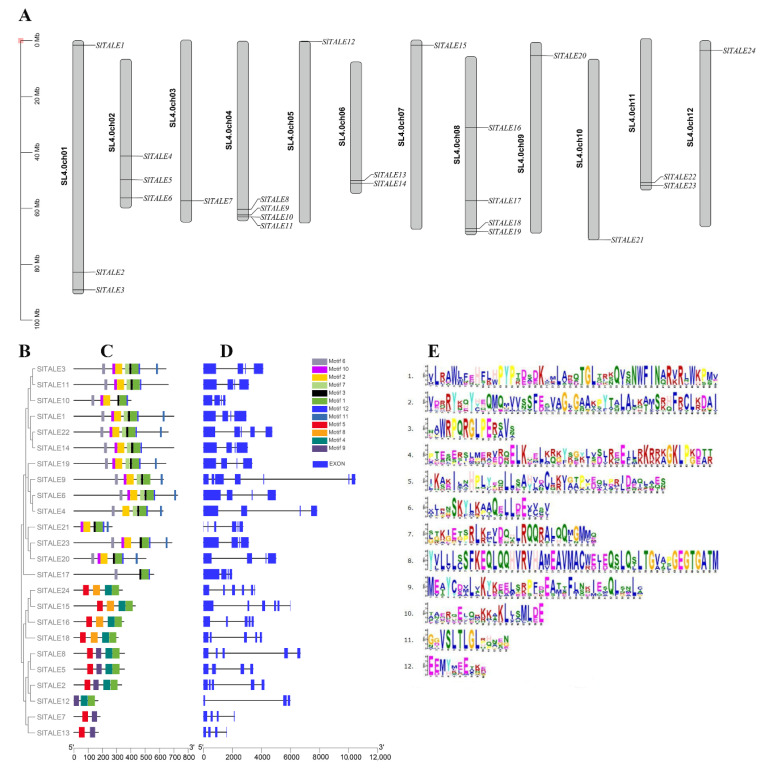
Chromosomal locations, phylogenetic tree, conserved motifs, and gene structures of SlTALE family members. (A) Chromosomal locations of SlTALE genes. (B) The phylogenetic tree of the SlTALE family. (C) Conserved motifs in SlTALE proteins. The motifs were identified by the MEME Suite. Twelve different conserved motifs were displayed in different colored boxes. (D) Gene structures of the SlTALE genes. The intron/exon structure was mapped by TBtools, and introns are indicated by black lines. (E) Sequence logos of 12 conserved motifs were identified.
Figure 3
Figure 3
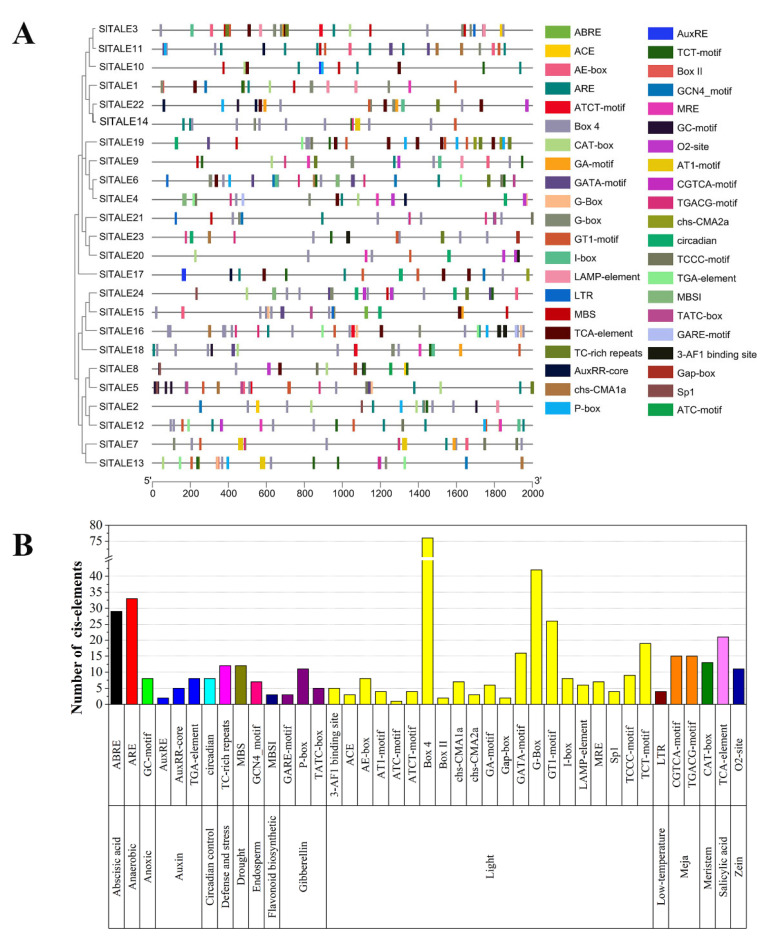
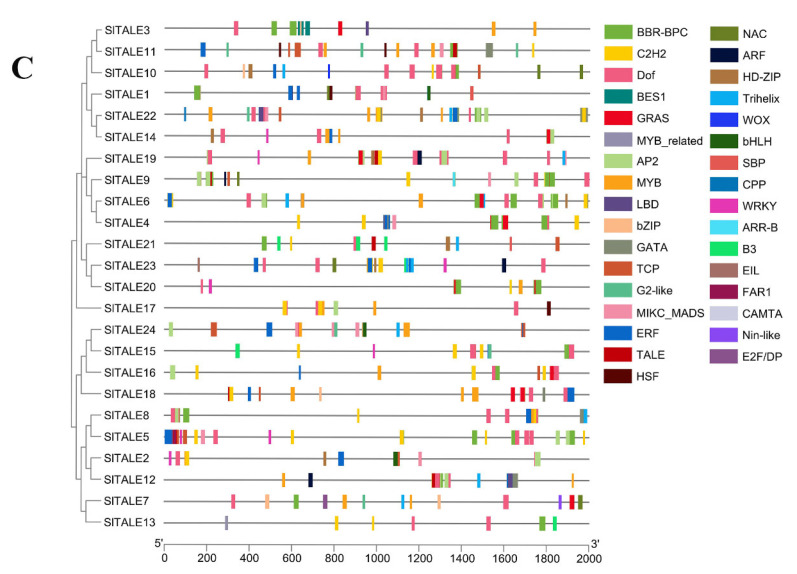
Analysis of the cis-elements and TF binding sites of SlTALE genes. (A) Cis-element analysis of SlTALE genes. (B) The number of the cis-elements of SlTALE genes. (C) TF binding sites analysis of SlTALE genes.
Figure 3
Figure 3
Analysis of the cis-elements and TF binding sites of SlTALE genes. (A) Cis-element analysis of SlTALE genes. (B) The number of the cis-elements of SlTALE genes. (C) TF binding sites analysis of SlTALE genes.
Figure 4
Figure 4
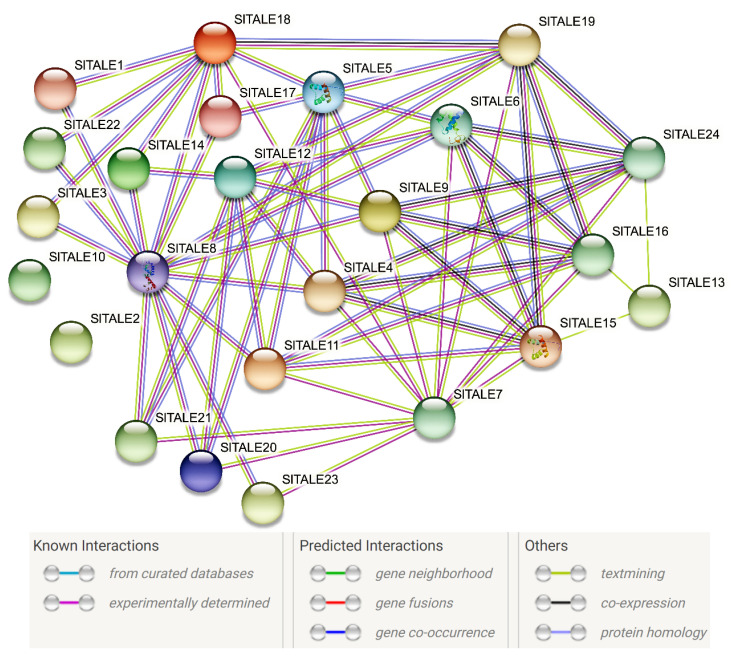
Predicted functional interaction networks of SlTALE proteins in Solanum lycopersicum.
Figure 5
Figure 5
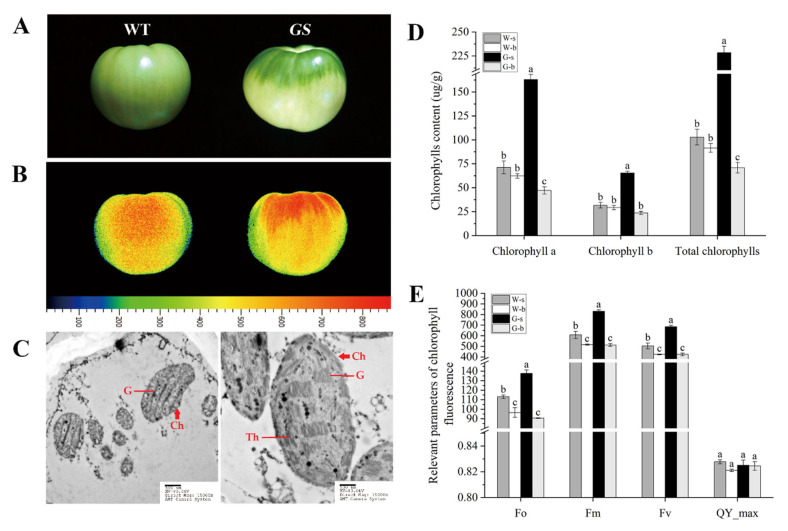
Fruit phenotype and chloroplast development in the GS mutant and WT (Inbred line TTD302A). (A) Fruit phenotype at 28 dpa. (B) The chlorophyll fluorescence dynamic imaging of fruit. (C) Chloroplast ultrastructure (bars, 0.5 µm) of the fruit shoulder pericarp at 28 dpa was observed by transmission electron microscope. (D) Chlorophyll content of the pericarp at 28 dpa. (E) Chlorophyll fluorescence parameters of the fruit shoulder pericarp at 28 dpa. W-s and W-b indicate the shoulder and base of WT fruit, respectively. G-s and G-b indicate the shoulder and base of the GS mutant fruit, respectively. Ch, chloroplast. G, grana. Th, thylakoid. Fo, minimal fluorescence. Fm, maximal fluorescence. Fv, variable fluorescence. QY_max, maximal quantum yield of PSⅡ. The values shown are the means ± standard deviation of three replicates. The different letters in a column denote significant differences among the treatments at p < 0.05.
Figure 6
Figure 6
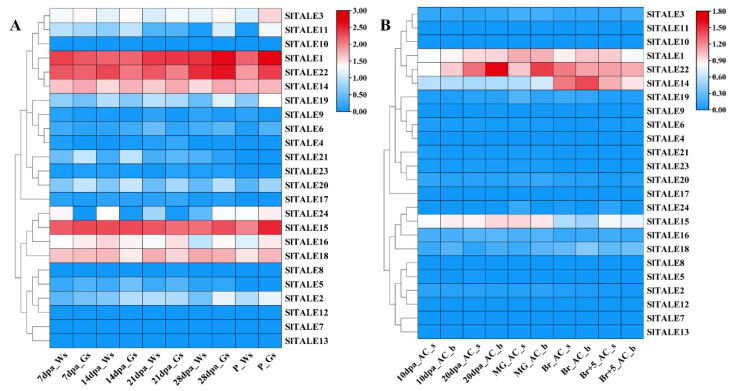
Expression patterns of SlTALE genes during chloroplast development and green shoulder formation in tomato fruit. (A) Expression patterns of SlTALE genes in the shoulder pericarp of WT and GS fruits. (B) Expression patterns of SlTALE genes in the shoulder and base pericarp of AC (Ailsa Craig) fruit. The RNA-seq data were normalized by FPKM (fragments per kilobase of exon per million fragments mapped) to construct the heatmap by TBtools software. The dpa indicates days post-anthesis, and Br+5 means 5 days after the breaker stage. W-s and W-b indicate the shoulder and base of WT fruit, respectively. G-s and G-b indicate the shoulder and base of the GS mutant fruit, respectively. The colored scale varies from blue to yellow, indicating relatively low or high expression, respectively.
Figure 7
Figure 7
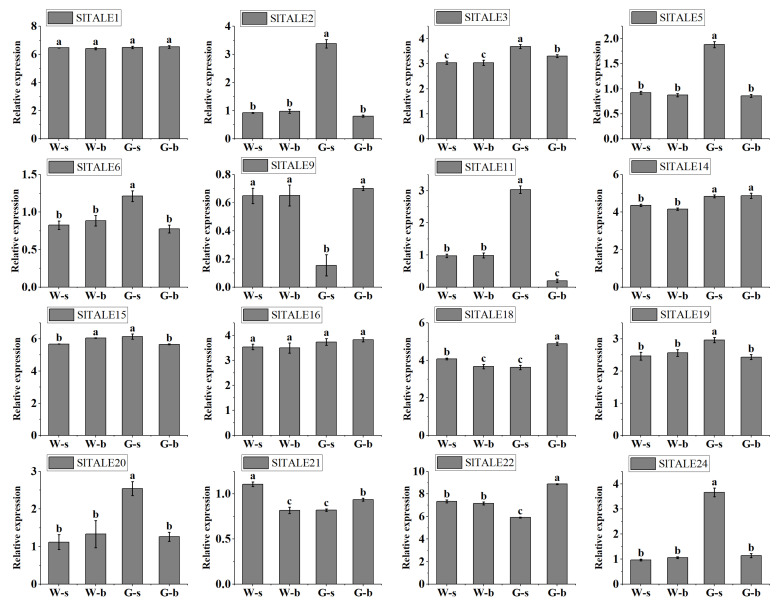
Confirmation of the expression patterns of SlTALE genes in fruit by qRT–PCR. Sixteen differentially expressed or highly expressed genes were used, as well as the pericarp of the tomato fruit at 28 dpa. The values shown are the means ± standard deviation of three replicates. Different letters among columns denote significant differences among the treatments at p < 0.05.

References

    1. Mcginnis W., Crow J.F. A century of homeosis, a decade of homeoboxes. Genetics. 1994;137:607–611. doi: 10.1093/genetics/137.3.607. - DOI - PMC - PubMed
    1. Vollbrecht E., Veit B., Sinha N., Hake S. The developmental gene Knotted-1 is a member of a maize homeobox gene family. Nature. 1991;350:241–243. doi: 10.1038/350241a0. - DOI - PubMed
    1. McGinnis W., Levine M.S., Hafen E., Kuroiwa A., Gehring W.J. A conserved DNA sequence in homoeotic genes of the Drosophila Antennapedia and bithorax complexes. Nature. 1984;308:428–433. doi: 10.1038/308428a0. - DOI - PubMed
    1. Billeter M., Qian Y.Q., Otting G., Müller M., Gehring W., Wüthrich K. Determination of the Nuclear Magnetic Resonance Solution Structure of an Antennapedia Homeodomain-DNA Complex. J. Mol. Biol. 1993;234:1084–1093. doi: 10.1006/jmbi.1993.1661. - DOI - PubMed
    1. Derelle R., Lopez P., Guyader H.L., Manuel M. Homeodomain proteins belong to the ancestral molecular toolkit of eukar-yotes. Evol. Dev. 2007;9:212–219. doi: 10.1111/j.1525-142X.2007.00153.x. - DOI - PubMed

MeSH terms

LinkOut - more resources