


Candida albicans Potassium Transporters
- PMID: 35563275
- PMCID: PMC9105532
- DOI: 10.3390/ijms23094884
Candida albicans Potassium Transporters
Abstract
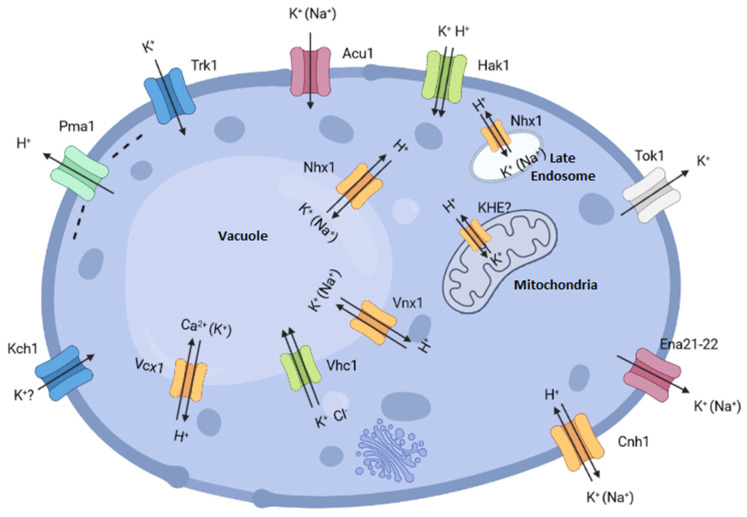
Potassium is basic for life. All living organisms require high amounts of intracellular potassium, which fulfils multiple functions. To reach efficient potassium homeostasis, eukaryotic cells have developed a complex and tightly regulated system of transporters present both in the plasma membrane and in the membranes of internal organelles that allow correct intracellular potassium content and distribution. We review the information available on the pathogenic yeast Candida albicans. While some of the plasma membrane potassium transporters are relatively well known and experimental data about their nature, function or regulation have been published, in the case of most of the transporters present in intracellular membranes, their existence and even function have just been deduced because of their homology with those present in other yeasts, such as Saccharomyces cerevisiae. Finally, we analyse the possible links between pathogenicity and potassium homeostasis. We comment on the possibility of using some of these transporters as tentative targets in the search for new antifungal drugs.
Keywords: Candida albicans; organelles; pathogenicity; plasma membrane; potassium; potassium homeostasis; potassium transporters.
Conflict of interest statement
The authors declare no conflict of interest.
Figures
Similar articles
-
Three Candida albicans potassium uptake systems differ in their ability to provide Saccharomyces cerevisiae trk1trk2 mutants with necessary potassium.FEMS Yeast Res. 2016 Jun;16(4):fow039. doi: 10.1093/femsyr/fow039. Epub 2016 Apr 21. FEMS Yeast Res. 2016. PMID: 27189364
-
Regulation and activity of CaTrk1, CaAcu1 and CaHak1, the three plasma membrane potassium transporters in Candida albicans.Biochim Biophys Acta Biomembr. 2021 Jan 1;1863(1):183486. doi: 10.1016/j.bbamem.2020.183486. Epub 2020 Oct 15. Biochim Biophys Acta Biomembr. 2021. PMID: 33069635
-
Functional expression of Candida albicans drug efflux pump Cdr1p in a Saccharomyces cerevisiae strain deficient in membrane transporters.Antimicrob Agents Chemother. 2001 Dec;45(12):3366-74. doi: 10.1128/AAC.45.12.3366-3374.2001. Antimicrob Agents Chemother. 2001. PMID: 11709310 Free PMC article.
-
Yeast ATP-binding cassette transporters conferring multidrug resistance.Annu Rev Microbiol. 2012;66:39-63. doi: 10.1146/annurev-micro-092611-150111. Epub 2012 Jun 11. Annu Rev Microbiol. 2012. PMID: 22703054 Review.
-
Monovalent cation transporters at the plasma membrane in yeasts.Yeast. 2019 Apr;36(4):177-193. doi: 10.1002/yea.3355. Epub 2018 Oct 3. Yeast. 2019. PMID: 30193006 Review.
Cited by
-
The superior growth of Kluyveromyces marxianus at very low potassium concentrations is enabled by the high-affinity potassium transporter Hak1.FEMS Yeast Res. 2024 Jan 9;24:foae031. doi: 10.1093/femsyr/foae031. FEMS Yeast Res. 2024. PMID: 39363175 Free PMC article.
References
-
- Yenush L. Potassium and Sodium Transport in Yeast. In: Ramos J., Sychrová H., Kschischo M., editors. Yeast Membrane Transport. Volume 892. Springer; Cham, Switzerlands: 2016. pp. 187–228.
Publication types
MeSH terms
Substances
Grants and funding
LinkOut - more resources
Full Text Sources
Medical
